119 P2P Companies Shrinking Industry
Delays in Official Launches Due to Various Incidents
Predictions of Small Business Exits and Market Sorting
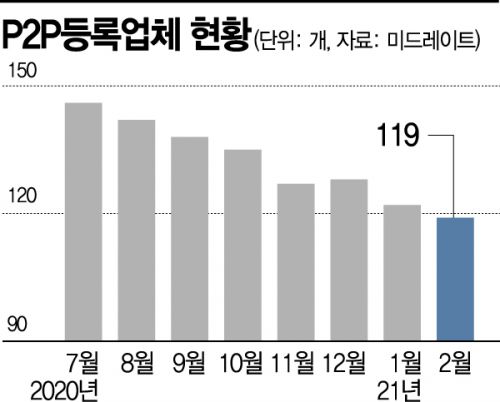
[Asia Economy Reporter Song Seung-seop] The peer-to-peer (P2P) market is rapidly shrinking. The accumulation of negative images due to various embezzlement and fraud incidents has intensified operational difficulties, and the stringent registration requirements stipulated by the Online Investment-Linked Finance Act (OnTu Act) are seen as the reasons behind the wave of business closures and suspensions.
Number of Companies and Credit Balances Decline, Cumulative Loan Amounts Fluctuate
As of the 5th, the number of P2P companies disclosed by P2P analysis firm Midrate stood at 119, showing a decrease of more than 25 companies since the OnTu Act came into effect in August. This is the first time the number of companies disclosed on the site has fallen below 120.
Credit balances are also on the decline. Currently, the total loan balance in the P2P industry is 1.9868 trillion KRW, down by more than 60 billion KRW from the previous month’s 2.0483 trillion KRW. Except for October and December, the loan balance has recorded negative growth rates every month since the implementation of the OnTu Act. In October alone, 271.8 billion KRW was withdrawn.
Cumulative loan amounts are also fluctuating. As of this date, the total cumulative loan amount is 11.9633 trillion KRW, an increase of about 200 billion KRW. Although this is a significant improvement compared to the 30 billion KRW increase last month, it is a sharp decrease compared to the over 750 billion KRW surge the month before. The anticipated acceleration of business closures due to the OnTu Act is becoming a reality. The OnTu Act requires companies to have a minimum capital of 500 million KRW, appoint a compliance officer, establish business plans and conflict-of-interest prevention measures, and secure IT personnel. At the time, financial authorities requested 237 companies to submit audit reports for registration, but 146 did not comply. There were widespread concerns that, except for large companies, many would either close down or convert to loan companies.
It is also pointed out that the accumulation of negative images due to repeated illegal activities is a contributing factor. An industry insider said, "P2P is still strongly perceived as a loan company, and there have been many incidents where CEOs were arrested for embezzlement or fraud," adding, "Even large companies have suffered significant damage to their credibility, and many people now think investing in P2P companies results in losses."
Exit of Small and Medium Companies and Selection Among Large Firms
Some speculate that the market is being reorganized through the exit of small and medium-sized companies and a selection process focused on large firms. The industry repayment rate, which was 70.41% in August, has steadily increased each month and currently stands at 73.83%. For companies maintaining membership in the P2P Finance Association, the rate has risen to 80.43%.
Professor Sung Tae-yoon of Yonsei University’s Department of Economics explained, "Cumulative loan amounts are showing an upward trend, and the repayment rate of P2P companies is also increasing," adding, "While it is necessary to compare and analyze various data, this generally signals a gradual reduction in risky loans."
There are also calls within the industry for the financial authorities to expedite the registration process. Currently, five companies have applied for registration with the Financial Supervisory Service (FSS), which is reviewing qualifications on behalf of the Financial Services Commission. Although the registration decision should be announced within two months, the process is likely to take longer than expected due to requests for document supplementation and major shareholder eligibility reviews.
Another industry insider said, "There are about 100 P2P companies, but from the consumers’ perspective, it is difficult to know which companies are safe," adding, "For the sake of preventing financial consumer damage, companies that enter the regulatory framework should emerge quickly."
© The Asia Business Daily(www.asiae.co.kr). All rights reserved.
![Clutching a Stolen Dior Bag, Saying "I Hate Being Poor but Real"... The Grotesque Con of a "Human Knockoff" [Slate]](https://cwcontent.asiae.co.kr/asiaresize/183/2026021902243444107_1771435474.jpg)















