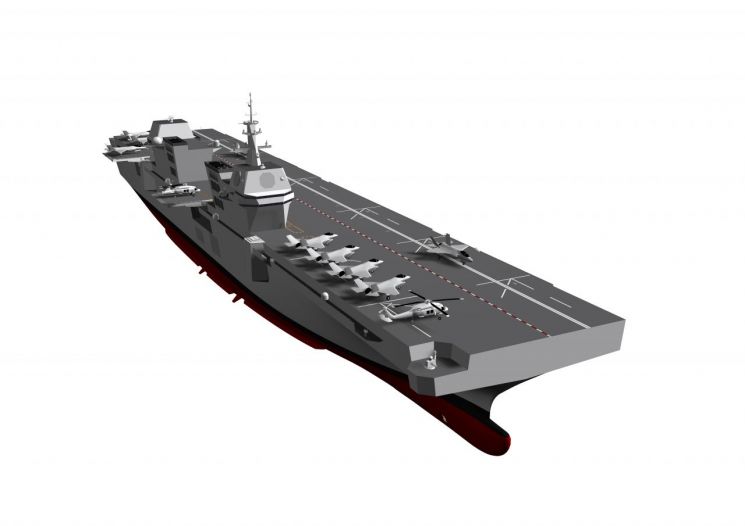
[Asia Economy Yang Nak-gyu, Military Specialist Reporter] As our military is pushing forward with the introduction of light aircraft carriers (hereinafter referred to as light carriers), it has been confirmed that North Korea recently acquired new surface-to-air missiles. Military authorities analyze that this is intended to counter the carrier-based aircraft deployed on the light carriers.
On the 4th, Jung Seung-gyun, Chief of Planning and Management Staff at the Navy Headquarters, stated at the "Light Aircraft Carrier Seminar" hosted by the Navy and Chungnam National University, "The mere presence of carrier-based aircraft and escort forces in the carrier strike group has a deterrent effect on North Korean provocations," adding, "Even if operating air force aircraft becomes difficult in wartime situations, carrier-based aircraft deployed on the light carriers can precisely strike the enemy." Professor Gil Byung-ok of Chungnam National University said, "If a light carrier is constructed, it is expected to have an economic ripple effect of 20 trillion won in shipbuilding, 2.7 trillion won in aerospace industry, and over 3 trillion won in defense exports," adding, "There will also be positive effects in the fields of energy, defense robotics, and defense information and communication technology."
As the Navy's light carrier acquisition project gains momentum, it has been confirmed that North Korea has also acquired three types of new surface-to-air missiles in response. Intelligence authorities have identified the missiles acquired by North Korea as similar to China's HQ-17 and HQ-9 surface-to-air missiles and Russia's S-300. It is also reported that the missile launchers have already been produced.
China's HQ-9 surface-to-air missile has a range of 200 km and can threaten fighter jets launched from aircraft carriers. In 2016, China installed eight surface-to-air missile launchers and radar systems on Woody Island in the Paracel Islands to counter carrier-based aircraft deployed on U.S. aircraft carriers. Russia's S-300 has a range of up to 200 km and has been exported to some overseas countries such as Syria.
Shin Jong-woo, Secretary General of the Korea Defense and Security Forum, said, "North Korea is also producing subsonic anti-ship cruise missiles similar to Russia's Kh-35, so it is necessary to have early warning capabilities to ensure the survivability of the light carriers."
© The Asia Business Daily(www.asiae.co.kr). All rights reserved.

















