July Legal Maximum Interest Rate Reduction, Government Prepares Measures to Minimize Side Effects
Proposal to Expand Financing through First-Tier Banks to Lower Interest Rates
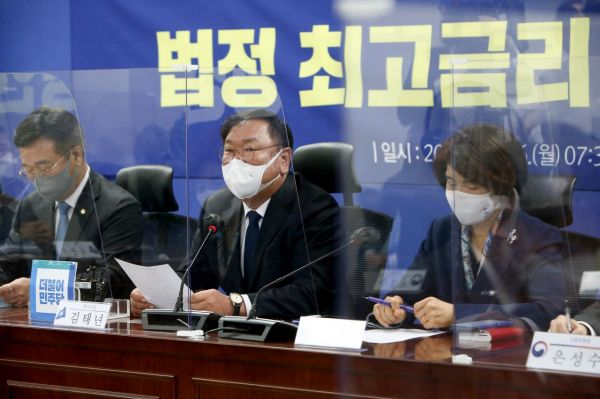 Last year, a party-government consultation on lowering the statutory maximum interest rate was held at the National Assembly. Kim Tae-nyeon, floor leader of the Democratic Party of Korea, is speaking.
 [Image source=Yonhap News]
[Asia Economy Reporter Kwangho Lee] The government is considering easing funding regulations for loan companies to minimize market side effects related to the statutory maximum interest rate reduction set to take effect in July this year. Currently, loan companies raise funds through secondary financial institutions such as savings banks and capital companies at rates of 5-6%, but there is a proposal to expand this to primary financial institutions like banks to lower funding costs. Additionally, plans to allow large loan companies to issue public bonds and asset-backed securities are also being considered.
According to the financial sector on the 29th, financial authorities are preparing supplementary measures under three main frameworks: expanding policy-based microfinance, supporting loan companies' funding costs, and strengthening penalties for illegal private loans. These measures are expected to be announced around May, during the second quarter.
A financial authority official said, "As stated in this year's work plan, we will announce supplementary measures in the first half of the year to enhance financial inclusion," adding, "We are continuously holding meetings with companies to listen to their opinions to support their loan costs."
It has been confirmed that companies have requested relaxation of supervisory regulations and funding restrictions. A loan industry official said, "The average loan loss provision ratio for loan companies is 10% of the loan amount, and they borrow funds from secondary financial institutions at an average rate of 5-6%. Additionally, brokerage fees, labor costs, and advertising expenses each account for 2-3%, so even if loans are provided at an interest rate of 24%, the structure results in only 1-2% profit or losses." He continued, "Loan loss costs, brokerage fees, and labor costs cannot be reduced any further," adding, "Easing funding regulations and loosening strict laws are necessary to prevent customers from turning to illegal private loans."
Supplementary Measures for Statutory Maximum Interest Rate Reduction to be Prepared Around May
Concerns Over Forcing Many Livelihood Borrowers into Illegal Private Loans
Financial authorities are concerned about moral hazard among loan companies. They are also worried that the government might appear to be protecting high-interest loans by loan companies. However, since the statutory maximum interest rate reduction could lead to mass business suspensions by loan companies and push low-income people toward illegal private loans, they plan to devise multifaceted measures.
Industry experts predict, "If the government relaxes funding regulations for loan companies, it may face criticism for encouraging high-interest loans and conflict with banks that value their image," adding, "Incentives such as conditional approvals will be given to loan companies that expand supply to low-income and low-credit households."
The government will lower the statutory maximum interest rate from the current 24% to 20%, a 4 percentage point reduction. The Financial Services Commission will announce the revised enforcement decree in March after legislative notice, review by the Regulatory Reform Committee, and the Ministry of Government Legislation. After a three-month grace period, the new rate will be implemented in July.
© The Asia Business Daily(www.asiae.co.kr). All rights reserved.
![Clutching a Stolen Dior Bag, Saying "I Hate Being Poor but Real"... The Grotesque Con of a "Human Knockoff" [Slate]](https://cwcontent.asiae.co.kr/asiaresize/183/2026021902243444107_1771435474.jpg)















