"Higher Tax Burden Than Competitor Hong Kong... Lack of Communication in Regulatory Introduction Also a Problem"
Boutte, Renault Samsung CFO at KIAF 'Industry Development Forum': "High Korean Taxes and Regulatory Barriers Cause Foreign Investors to Hesitate"
James Kim, AmCham Chairman, Also Points Out "Korean Tax Rates Significantly Exceed Competitors, Causing Issues"
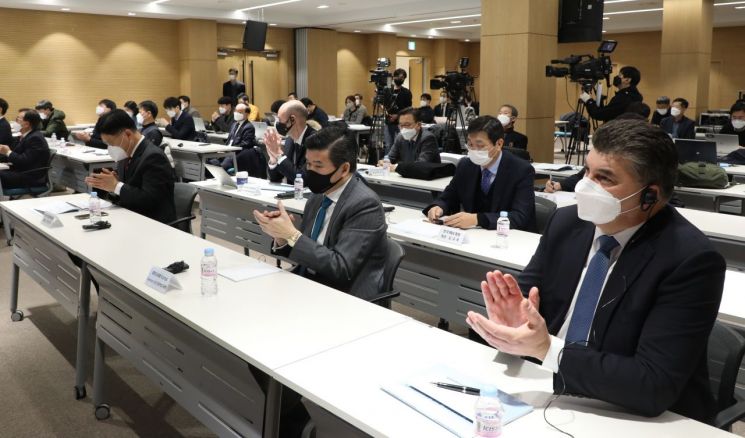 On the 28th, attendees are listening to congratulatory speeches at the 8th Industrial Development Forum and the 12th Automotive Industry Development Forum held at the Korea Automobile Hall in Seocho-gu.
 From the right: Kaher Kazem, President of Korea GM; James Kim, Chairman of the American Chamber of Commerce in Korea; Jeong Manki, Chairman of the Korea Industrial Alliance Forum (KIAF).
[Photo by Yonhap News]
[Asia Economy Reporters Changhwan Lee and Jehun Yoo] Foreign-invested companies unanimously called on the government to reduce the excessive tax burden and ease regulations compared to other countries in order to increase their investments in Korea. Although investments by foreign-invested companies in Korea have been increasing annually, they pointed out that excessive tax and regulatory burdens beyond global standards make them hesitate to invest further.
Christophe Butte, Chief Financial Officer (CFO) of Renault Samsung Motors, argued that Korea’s tax rates need improvement because they are generally higher than those of other countries during his presentation titled “Korean Management and Investment Environment Evaluation and Recommendations from the Perspective of Foreign-Invested Companies” at the 8th Industrial Development Forum hosted by the Korea Industrial Alliance Forum (KIAF) on the 28th.
CFO Butte stated, “Korea’s corporate tax rate is 27.5%, which is higher than the OECD average of 23.5%, and real estate property tax revenue as a percentage of GDP is about 3%, higher than Spain’s 2% and Turkey’s 1%. Korea’s tax system and rates need to be improved to expand and maintain investments by foreign-invested companies.”
He emphasized, “The global automotive industry is facing intensified competition and unprecedented challenges due to the impact of COVID-19, the expansion of electric vehicle adoption, strengthened environmental regulations, and competition among global automakers. In this situation, the role and support of governments for the automotive industry are becoming increasingly important for sustainable growth.”
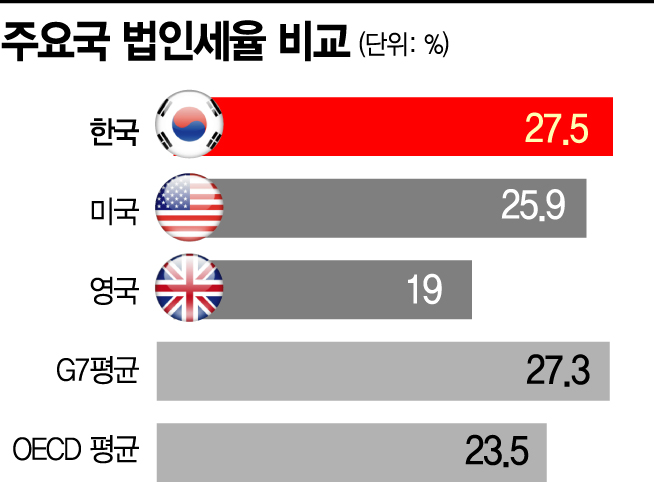
Korea’s Tax Rates Significantly Exceed Major Countries, Hindering Foreign Investment
Although investments by foreign-invested companies in Korea are on the rise, regulations remain a concern. According to the government, exports by foreign-invested companies increased by 6.3% from 2015 to 2018, and sales rose by 17.1% during the same period. Employment also grew by 7.7% from 2016 to 2018, significantly contributing to the Korean economy.
However, complaints arise that government taxes and regulations are holding back progress. James Kim, Chairman of the American Chamber of Commerce in Korea (AMCHAM), also pointed out that Korea’s high tax rates are a factor hindering the expansion of foreign investment.
He stated, “Personal income tax rates and corporate tax rates significantly exceed those of regional competitors, especially Hong Kong. Foreigners in Korea are subject to a fixed personal income tax rate of 19% for five years, but after five years, this becomes a heavy burden for foreign-invested companies and poses difficulties in attracting and retaining foreign talent.”
Intellectual property (IP) protection is also at a lower level compared to competing countries, which hinders foreign-invested companies from utilizing innovative technologies to conduct business in Korea.
Rigid labor-management relations remain a chronic issue. Kaher Kazem, President of Korea GM, said, “Stable labor-management relations, a stable economy, flexibility, and parts supply chains are key considerations for foreign-invested companies when making investment decisions. Compared to competitors, Korea faces problems such as short negotiation cycles (one year), short union executive terms, frequent strikes, frequent regulatory changes and uncertainties related to dispatched and contract workers, which increase costs and rigidity.”
He added, “We have proposed to the government long-term labor agreements and securing union executive terms for stability and certainty, free utilization of contract workers, enhancing flexibility in employment types, and strengthening harmonization with international standards in automotive regulations.”
Regarding non-tariff barriers under the Korea-US Free Trade Agreement (FTA), he emphasized, “Due to non-tariff barriers, the effectiveness of the Korea-US FTA is reduced, increasing vehicle import costs. Korea’s regulations need to be harmonized with international standards such as those of the United States.”
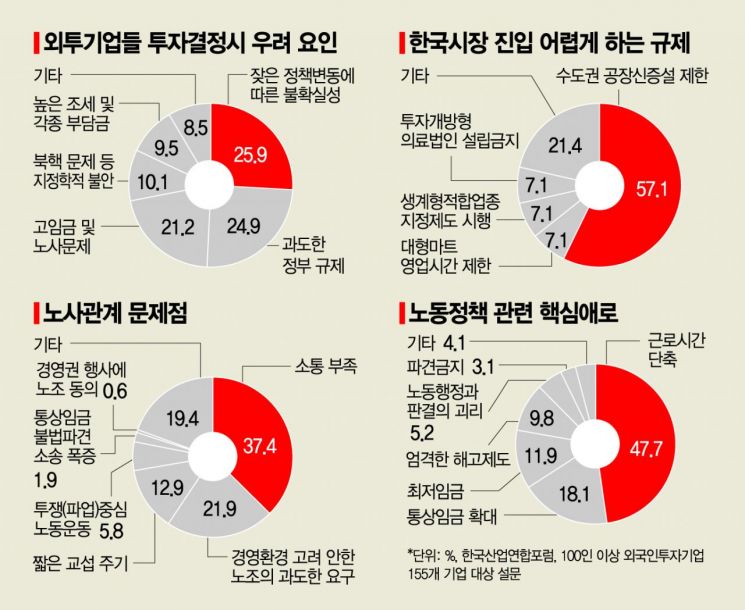
World-Class Stringent Regulations Considered “Excessive”
Dirk Lukat, Chairman of the European Chamber of Commerce in Korea (ECCK), requested that the government engage sufficiently with foreign-invested companies when introducing new regulations. Lukat said, “Foreign-invested companies need ample time for communication with headquarters and legal translation. It is necessary to specify regulations and rules through continuous dialogue among companies, government, and stakeholders so that good policy ideas can be transformed into future-oriented actions.”
For example, he mentioned that sufficient time should be granted for the development of zero- and low-emission vehicles to promote their domestic sales, but the Korean government does not provide enough time. He also noted the need to continuously adjust policies according to international best practices that encourage innovation and promote investment.
Calls were also made to expand support measures to promote investments by foreign-invested companies. He said, “Providing incentives for new investments by foreign-invested companies can stimulate investment. For instance, under current law, new facility investments from undistributed profits can be recognized as ‘foreign investment,’ but additional follow-up work is required to receive actual support. Clear local tax reduction regulations should be established for new facility investments from undistributed retained earnings of foreign-invested companies.”
Concerns were clearly revealed in a survey conducted by KIAF from the 12th to the 21st targeting 155 foreign-invested companies with more than 100 employees prior to the event. When asked about concerns in investment decisions, 25.9% cited uncertainty due to frequent policy changes, and 24.9% pointed to excessive government regulations.
Jung Manki, Chairman of KIAF, said, “The survey results showed that uncertainty in government policies and regulations were major concerns for foreign-invested companies investing in Korea. This means that Korea needs to improve economic-related systems to attract foreign investment.”
© The Asia Business Daily(www.asiae.co.kr). All rights reserved.



















