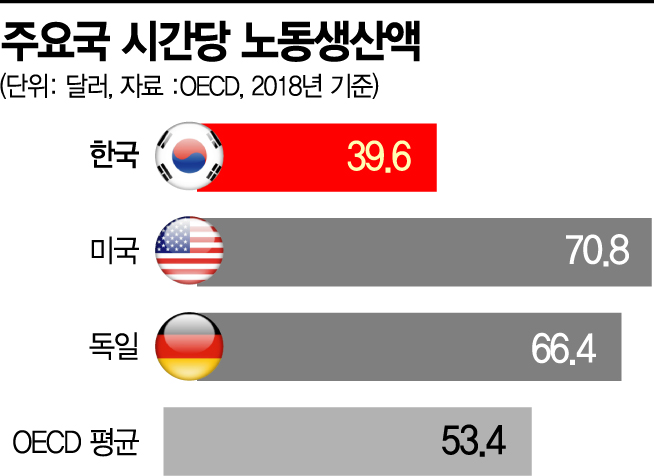
Wage levels and rigid labor issues in Korea are representative factors that make foreign investors hesitate.
According to a survey conducted by the Korea Industrial Alliance Forum (KIAF) targeting 155 foreign-invested companies with more than 100 employees, foreign-invested companies that responded that Korea's labor market is rigid answered that the wage levels at Korean workplaces are "similar (60%) or higher (15%) compared to their home countries and other overseas workplaces." In fact, 1.3% of foreign-invested companies said that the wage level at Korean workplaces exceeds 120% compared to their home countries and overseas workplaces. This means that Korea's wage levels are higher than those of developed countries, making it a market without wage competitiveness compared to other countries.
In this regard, Christophe Butte, Chief Financial Officer (CFO) of Renault Samsung, pointed out, "Within the Renault Group, the Busan plant and the Valladolid plant in Spain are in competition with each other, but the hourly wage at the Valladolid plant in Spain is only 62% of that at the Busan plant."
High labor rigidity compared to developed countries is also cited as a burden for foreign-invested companies. Foreign-invested companies attribute Korea's high labor rigidity to the absence of autonomous regulation between labor and management and legal enforcement (48%), frequent institutional changes (24%), unique regulations only in Korea (16%), and imbalance between labor and management (12%). In particular, they pointed out that the difficulty of dismissing regular workers and the restrictions on dispatch industries and difficulties in worker reassignment are unique regulations only Korea has. Jung Manki, chairman of KIAF, criticized Korea's labor rigidity issue, saying, "Labor rigidity is said to be due to government systems rather than labor-management issues," and added, "Isn't that an unusual answer?"
Kaher Kazem, president of GM Korea, also cited the example that Korea has a one-year negotiation cycle while the U.S. has a four-year cycle, stating, "Adversarial labor relations, short negotiation cycles, and uncertain policy changes lead to increased costs, which affect investment decisions. Korea has too low barriers to strikes and disputes, leading to continuous conflicts that reduce investment motivation." He added, "Flexibility available in other markets is not secured in Korea, so there are constraints."
Along with this, government labor policies also appeared as key factors that make foreign-invested companies reluctant to invest. Foreign-invested companies cited difficulties related to labor policies such as reduced working hours (47.7%), expansion of ordinary wages (18.1%), minimum wage (11.9%), and strict dismissal systems (9.8%). Regarding this, Chairman Jung pointed out, "Korea's labor regulations differ from global standards," adding, "In cases of violations, many criminal or civil lawsuits are filed, and in such cases, CEOs become targets of criminal prosecution, leading many CEOs to avoid assignments in Korea." For example, Kaher Kazem, president of GM Korea who participated as a speaker on this day, prevented Korea GM's court receivership by concluding labor-management-government negotiations but was indicted on charges of illegal dispatch in July last year and is currently under travel ban.
Foreign-invested companies hold the view that labor market flexibility is necessary to revitalize investment in Korea. Chairman Jung explained that foreign-invested companies suggested guaranteeing autonomy in employment and dismissal, lifting dispatch prohibition regulations, appropriate minimum wage increases and ensuring working hour flexibility, and reforming the strike-centered union culture.
© The Asia Business Daily(www.asiae.co.kr). All rights reserved.
![Clutching a Stolen Dior Bag, Saying "I Hate Being Poor but Real"... The Grotesque Con of a "Human Knockoff" [Slate]](https://cwcontent.asiae.co.kr/asiaresize/183/2026021902243444107_1771435474.jpg)















