Government Temporarily Recommends Until June... Voluntary Dividends Thereafter
"COVID-19 Uncertainty High, Need to Strengthen Loss Absorption Capacity"
Banks Say "Excessive Regulation"... Concerns Over Shareholder Departure and Stock Price Impact
[Asia Economy Reporter Kwangho Lee] Financial authorities have officially recommended banks to reduce dividends. They have temporarily advised financial holding companies and banks, which are expected to post record-high earnings, to limit dividends to within 20% of net profit. This is 5-7 percentage points lower than last year, and it is the first time that a dividend recommendation has been issued officially rather than verbally. Although it is a 'recommendation,' financial companies, who ultimately have no choice but to accept it, express concerns about shareholder dissatisfaction and defections while empathizing with the reality caused by the novel coronavirus disease (COVID-19).
On the 28th, the Financial Supervisory Service (FSS) plans to send the 'Capital Management Recommendation for Banks and Bank Holding Companies in Response to COVID-19,' which was approved at the regular meeting with the Financial Services Commission the previous day, to each bank in writing.
The main point is to recommend that dividends be paid within 20% of net profit temporarily until the end of June this year. The recommendation applies until the end of June, after which dividends can be paid autonomously as before within the scope of maintaining capital adequacy. Dividends paid by banks belonging to domestic bank holding companies to the holding companies are an exception. Policy financial institutions such as the Korea Development Bank, Industrial Bank of Korea, and Export-Import Bank of Korea, which compensate for government losses, are also excluded from the recommendation.
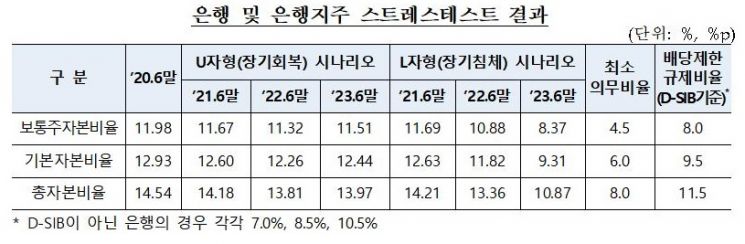
Earlier, from October to December last year, the FSS conducted stress tests on eight bank holding companies including Shinhan, KB, Hana, Woori, NH, BNK, DGB, and JB, as well as six banks including SC, Citi, Industrial, Corporate, Export-Import, and Suhyup banks. The stress tests assumed a crisis situation greater than the 1997 foreign exchange crisis and measured scenarios divided into a U-shaped recovery from negative growth in 2021 to recovery in 2022, and an L-shaped scenario with zero growth continuing in 2022.
As a result, under both U- and L-shaped scenarios, all banks' capital ratios exceeded the minimum mandatory ratio, but in the L-shaped scenario, a significant number of banks failed to exceed the dividend restriction regulatory ratio. The dividend restriction regulatory ratio is the minimum mandatory ratio plus 1% for systemically important banks. The standard for the total capital ratio item is 11.5%. In reality, banks' ratios declined from 14.21% in 2021 to 10.87% in 2023. This means that while banks generally maintain loss absorption capacity, some banks may not have sufficient capital capacity if COVID-19 prolongs.
Financial authorities hold the view that proactive capital expansion efforts are necessary to respond to economic uncertainty. However, they recommend that if the dividend restriction regulatory ratio is exceeded under the L-shaped scenario, dividends may be paid autonomously but should be decided cautiously considering the impact of COVID-19 on the economy.
Nonetheless, banks' dissatisfaction is significant. Bank stocks have long been considered representative high-dividend stocks. The four major bank holding companies?Shinhan, KB, Hana, and Woori?showed dividend payout ratios of 25-27% last year. Woori was the highest at 27%, KB and Hana at 26%, and Shinhan at 25%. In other words, if shareholders express dissatisfaction with such tightening and defect, it is inevitable that stock prices will be adversely affected.
On the day the stock market opened, Woori Financial Group's stock price was stagnant at 9,180 won. Shinhan Financial Group and KB Financial Group were also on a downward trend.
A bank official said, "Foreign ownership of major financial holding companies exceeds 50%," adding, "We need to pay appropriate dividends to enhance shareholder value, but the situation is frustrating."
Another official pointed out, "The series of tightening measures that hinder autonomous management, such as dividend suppression recommendations, profit-sharing pressure, and household loan regulations, have left us groggy. Especially, it is against financial common sense to reduce dividends even though banks' performance and soundness are excellent."
In fact, petitions such as "Oppose the reduction of year-end dividends for financial stocks" and "Stop government-controlled finance for listed financial companies" have been posted on the Blue House's public petition board.
A financial authority official requested restraint, saying, "Currently, the financial soundness of domestic banks is at a good level despite COVID-19, and last year's business performance is expected to be similar to previous years, but the COVID-19 situation has not completely ended."
© The Asia Business Daily(www.asiae.co.kr). All rights reserved.
![Clutching a Stolen Dior Bag, Saying "I Hate Being Poor but Real"... The Grotesque Con of a "Human Knockoff" [Slate]](https://cwcontent.asiae.co.kr/asiaresize/183/2026021902243444107_1771435474.jpg)
















