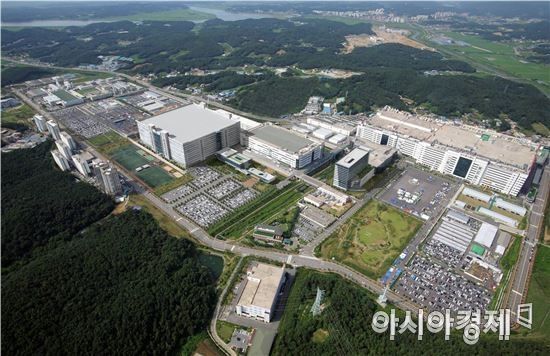
[Asia Economy Reporters Heungsun Kim and Suyeon Woo] LG Display has given a positive evaluation of organic light-emitting diode (OLED), which contributed to achieving results that exceeded market expectations last year. The company plans to continue its upward trend by setting a target of shipping 8 million OLED TV panels this year.
LG Display announced on the 27th that its sales in the fourth quarter of last year increased by 16% year-on-year to 7.4612 trillion KRW, and operating profit turned positive to 685.5 billion KRW. Although the company recorded losses for six consecutive quarters from the first quarter of 2019, the spread of remote work culture due to COVID-19 increased demand for TVs and IT products, resulting in two consecutive quarters of profit from the third quarter of last year.
Annual sales rose 3.2% to 24.2301 trillion KRW compared to 23.4756 trillion KRW in 2019, and operating loss was reduced significantly to 29.1 billion KRW compared to a loss exceeding 1.35 trillion KRW in 2019.
The company explained that strong demand for TVs and IT products due to the spread of remote work culture, increased shipments of large OLED TVs and plastic (P)-OLEDs led to a 5% increase in shipment area and a 12% increase in price per unit area compared to the previous quarter, boosting sales.
Regarding the increase in operating profit, LG Display evaluated that the steady shipment and price trends, along with the three major strategic tasks?mainstreaming OLED, strengthening the POLED business foundation, and structural innovation of liquid crystal display (LCD)?have gradually shown results.
LG Display CFO (Chief Financial Officer) Executive Director Donghee Seo said at the earnings conference call, "OLED TV panel shipments in the fourth quarter of last year increased by 50% year-on-year to about 1.6 million units," adding, "The unique value of OLED in terms of picture quality and eye health has been highlighted due to COVID-19, and we are targeting shipments of 7 to 8 million units this year." He also mentioned that if OLED panel shipments exceed 8 million units this year, expansion of the Guangzhou plant could be considered.
Regarding the planned withdrawal from domestic TV LCD panel production, the company now intends to respond flexibly considering the recent rise in LCD panel prices. Seo said, "When Chinese competitors' 10th generation plants become fully operational, the supply and demand situation for LCD panels will improve from the second half of this year, leading to price fluctuations," adding, "The Paju 7th generation plant producing TV LCDs will be operated flexibly within current manpower and production capacity without additional investment." The Paju 8th generation plant is being prepared to switch to producing IT products.
Regarding POLED used in small products such as smartphones, he said, "There were concerns about whether we could compete with competitors in terms of stable quality, cost, and yield, but we operated stably last year," and predicted, "There will be significant improvements compared to the previous year."
LG Display expects demand for TVs and IT products to remain relatively favorable in the first quarter of this year despite seasonal effects. While shipment area is expected to be similar to the previous quarter, average selling price per unit area is forecasted to decline to the high single-digit range, resulting in a slight decrease in sales.
© The Asia Business Daily(www.asiae.co.kr). All rights reserved.
![Clutching a Stolen Dior Bag, Saying "I Hate Being Poor but Real"... The Grotesque Con of a "Human Knockoff" [Slate]](https://cwcontent.asiae.co.kr/asiaresize/183/2026021902243444107_1771435474.jpg)
















