Recognition of Limited History Management and Diverse Family Forms
Detailed Plans to Be Announced Gradually in Q2
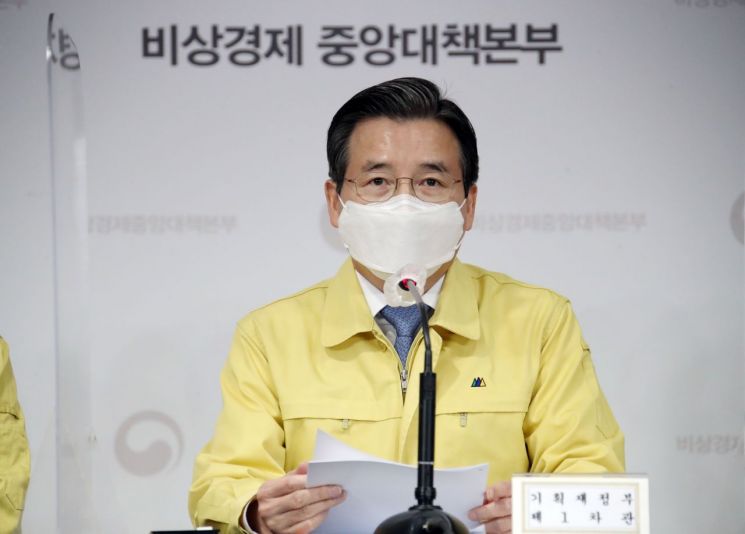 Kim Yong-beom, First Vice Minister of Strategy and Finance and head of the 3rd Population Policy Task Force (TF), briefing after the 28th Emergency Economic Central Disaster and Safety Countermeasures Headquarters meeting and the 1st Innovation Growth Strategy meeting of 2021 held at the Government Seoul Office Building on the 27th. (Photo by Yonhap News)
[Asia Economy Reporter Moon Chaeseok] The government has launched the 3rd Population Policy Task Force (TF) to respond to the 'population cliff.'
The TF is an inter-ministerial organization led by Kim Yong-beom, the 1st Vice Minister of the Ministry of Economy and Finance, with participation from first-level officials of related ministries.
It will begin full-scale activities from next month and plans to gradually announce detailed policies starting in the second quarter.
On the 27th, Deputy Prime Minister and Minister of Economy and Finance Hong Nam-ki stated, "We intend to focus on four major areas: mitigating the shock of the population cliff, responding to a shrinking society, addressing regional extinction, and enhancing social sustainability."
This was announced during an Emergency Economic Central Countermeasures Headquarters meeting combined with an Innovation Growth Strategy meeting held at the Government Seoul Office.
The TF will first create measures to address the decline in the school-age population by strengthening university competitiveness.
This takes into account the increasing number of universities facing limits due to low enrollment caused by low birth rates and aging.
To enhance university competitiveness, the TF will promote role-sharing between national/public and private universities and prepare comprehensive management plans for struggling private universities.
It will respond to the increasing demand for talent in advanced fields by rationalizing the university quota system.
Customized measures will be prepared for industries with severe workforce aging, such as the root industry.
The family system and legal/institutional foundations will be reformed to recognize diverse family types, including de facto marriages, unmarried cohabitation, and unmarried childbirth households.
Policies to alleviate women's career interruptions will be reviewed, including improvements to the elementary school care industry. This aims to mitigate the shock of the population cliff.
This year marks the year when the eldest of the baby boom generation born between 1955 and 1963, those born in 1955, turn 65.
To slow the labor market exit of the baby boom generation, plans will be made to support senior entrepreneurship and career development for the elderly.
The TF will also address labor shortages in simple labor sectors caused by the aging of foreign workers and promote the development of new types of visas to attract excellent foreign professionals. A migrant social integration TF will also be formed.
The TF will prepare preemptive measures to address regional extinction. This is to resolve the intensified 'concentration' phenomenon as the population outside the metropolitan area moves to the metropolitan area.
Incentives will be strengthened to promote the relocation of metropolitan residents and companies to local areas, and integrated support programs will be developed.
Development strategies will be established to concentrate core functions such as administration and education in hub cities within regions by creating urban convergence special zones.
Particularly, in agricultural, fishing, and mountainous areas, 'compressed urbanization' will be promoted. Comprehensive management plans will be created to renovate underused or aging infrastructure.
Incentives for attracting and investing private companies in innovation cities will be expanded.
Concerns have arisen about the deterioration of the soundness of the National Pension and Health Insurance due to overlapping social structural factors such as low birth rates and aging, as well as policy factors like strengthening health insurance coverage. The TF will also establish countermeasures for this.
The National Pension will be improved to enhance fund management profitability and expertise by setting long-term target returns and improving asset allocation systems.
Health Insurance will seek expenditure efficiency by reforming the fee system and strengthening non-covered service management.
To prepare for a super-aged society with a rapidly increasing elderly population, the health and medical delivery system will be reorganized, and elderly care service capabilities will be strengthened.
To support population policies, Statistics Korea and the Ministry of Land, Infrastructure and Transport will expand and improve population-related data, and national research institutes such as the Korea Development Institute (KDI) will establish a dedicated population response system.
© The Asia Business Daily(www.asiae.co.kr). All rights reserved.
![Clutching a Stolen Dior Bag, Saying "I Hate Being Poor but Real"... The Grotesque Con of a "Human Knockoff" [Slate]](https://cwcontent.asiae.co.kr/asiaresize/183/2026021902243444107_1771435474.jpg)















