Last Year's Employment Decline Indicator Worst Since Foreign Exchange Crisis
Employment Minister: "Full Effort to Mitigate Q1 Employment Shock"
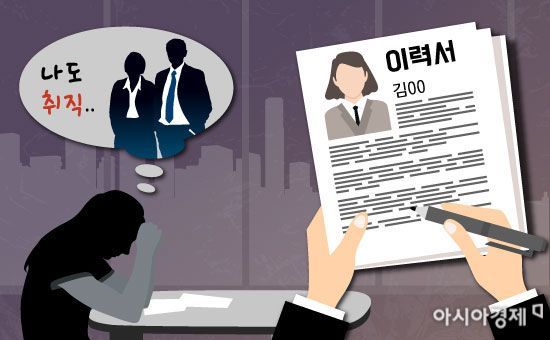
[Asia Economy Reporter Moon Chaeseok] To reduce the number of young people who are "resting" without any job-seeking activities, the government will announce employment measures next month.
The Ministry of Employment and Labor stated on the 27th that measures are needed as the number of young people losing motivation to work and entering the economically inactive population has surged due to the prolonged COVID-19 pandemic.
On the morning of the 27th at 8:30 AM, Minister Lee Jae-gap of the Ministry of Employment presided over the "Employment Crisis Response Team Meeting" to review youth employment policies and the progress of job creation projects. Fourteen vice ministers from ministries including the Ministry of Economy and Finance attended the meeting.
Last year, South Korea's employment indicators were the worst since the International Monetary Fund (IMF) foreign exchange crisis.
The number of employed people decreased by 218,000, the largest drop since the 1,276,000 decrease in 1998 during the IMF foreign exchange crisis. In December alone, 628,000 jobs were lost due to the third wave of COVID-19.
Employment recorded negative growth for 10 consecutive months, setting the longest record since the 16 consecutive months of negative growth from January 1998 to April 1999.
In particular, the number of young people who answered that they were "resting" reached 448,000, a 24.4% increase from 360,000 in 2019. The "resting" population refers to young people in the economically inactive group who did not seek jobs for reasons other than studying or household duties.
The increase in the "resting" population is considered a serious factor weakening future growth potential, not just a simple employment decline.
Minister Lee said, "Through this meeting, the government will closely examine the current youth employment situation and review the progress of youth employment measures across ministries."
Earlier, on the 25th, Hong Nam-ki, Deputy Prime Minister and Minister of Economy and Finance, mentioned at the expanded senior officials meeting of the Ministry of Economy and Finance that "employment activation measures should be prepared by early to mid-next month before the graduation season ends."
The government plans to provide livelihood stabilization funds to 90% of eligible recipients (small business owners, special employment workers, freelancers, care workers, etc.) before the Lunar New Year holiday. The remaining 10% of new applicants will receive funds by March at the latest.
Minister Lee emphasized, "In response to the third wave of COVID-19, we will faithfully implement the employment stabilization measures jointly prepared by ministries in December last year to secure momentum for job recovery this year by concentrating all capabilities."
In the first quarter, when the employment shock is expected to be the greatest, public sector jobs will be expanded. The government will provide 80% (830,000) of direct jobs and 44% (28,000) of social service jobs.
As of the 15th, 542,000 direct jobs and 10,800 social service jobs have been filled. This accounts for 52.1% of the annual target of 1,042,000 direct jobs and 17% of the target of 63,000 social service jobs.
Minister Lee said, "The government will promptly provide 80% of direct jobs and 44% of social service jobs in the first quarter, when the employment shock will be the greatest, so that the public sector can be a support for vulnerable groups."
© The Asia Business Daily(www.asiae.co.kr). All rights reserved.
![Clutching a Stolen Dior Bag, Saying "I Hate Being Poor but Real"... The Grotesque Con of a "Human Knockoff" [Slate]](https://cwcontent.asiae.co.kr/asiaresize/183/2026021902243444107_1771435474.jpg)










