3,967 Cardiac Arrest Emergency Patients Transported Last Year... Pre-Hospital Return of Spontaneous Circulation Rate 11.9%, Up 0.2%p from Previous Year
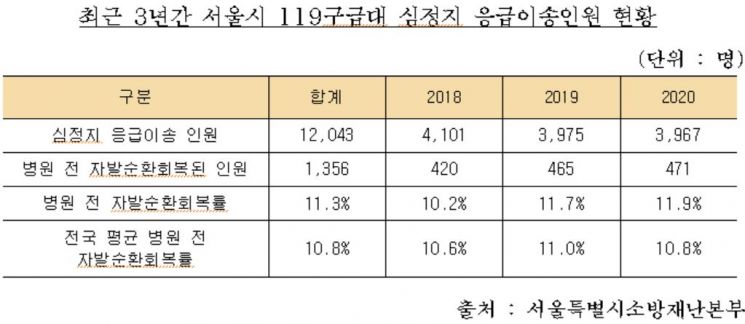
[Asia Economy Reporter Lim Cheol-young] Last year, 119 ambulance teams provided emergency treatment and simultaneously transported 3,987 cardiac arrest patients, among whom 471 recovered cardiac function before being handed over to medical personnel.
According to the Seoul Fire & Disaster Headquarters on the 27th, the pre-hospital return of spontaneous circulation (ROSC) rate for cardiac arrest patients transported by 119 ambulance teams last year was 11.9%, an improvement of 0.2 percentage points compared to the previous year. The pre-hospital ROSC rate refers to the proportion of cardiac arrest patients transported by 119 ambulance teams who recover cardiac function before being handed over to the hospital through emergency treatment.
The pre-hospital ROSC rate of cardiac arrest patients emergency transported by Seoul Fire 119 ambulance teams was 10.2% in 2018, but has steadily increased since then, surpassing the national average from 2019 onward.
So far, the Seoul Fire & Disaster Headquarters has continuously promoted measures to increase the survival rate of cardiac arrest patients, including hiring qualified professionals, strengthening emergency treatment job training, and operating special ambulance teams. The special ambulance teams operate 24 units across Seoul, staffed by members who have completed special training courses and hold qualifications as nurses or level 1 emergency medical technicians.
In addition, the Fire & Disaster Headquarters systematically manages the quality of ambulance services by evaluating and feeding back ambulance activity information from the reporting stage to transportation. In particular, emergency medical specialists such as emergency medicine doctors participate in the evaluation of ambulance activities related to cardiac arrest and severe trauma, and share necessary improvements with 119 ambulance teams and the medical community.
According to the "Key Results of Acute Cardiac Arrest Survey" announced last year through cooperation between the Korea Disease Control and Prevention Agency and the National Fire Agency, the rate of bystander cardiopulmonary resuscitation (CPR) in Seoul increased by about 34 percentage points from 3.1% in 2008 to 37.0% in 2018.
A representative of the Seoul Fire & Disaster Headquarters said, "Research shows that the survival rate drops below 10% if four minutes pass after cardiac arrest," adding, "In case of witnessing a cardiac arrest situation nearby, prompt 119 reporting, performing CPR, and using an automated external defibrillator are very important."
CPR training can be applied for at nearby fire stations, and currently, due to the maintenance of social distancing level 2.5 in the metropolitan area, training is available online in a non-face-to-face format.
Choi Tae-young, head of the Seoul Fire & Disaster Headquarters, said, "We will further strengthen the professionalism of the 119 ambulance system to save more lives," and "We also ask for citizens' interest and cooperation in promoting CPR."
© The Asia Business Daily(www.asiae.co.kr). All rights reserved.
![Clutching a Stolen Dior Bag, Saying "I Hate Being Poor but Real"... The Grotesque Con of a "Human Knockoff" [Slate]](https://cwcontent.asiae.co.kr/asiaresize/183/2026021902243444107_1771435474.jpg)
















