Ruling Party Says "Voluntary Participation," but "Most Still Operating at a Deficit"
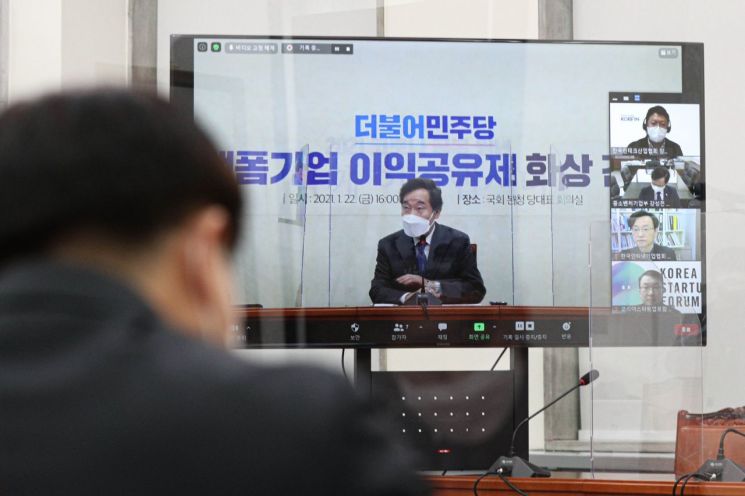 Lee Nak-yeon, leader of the Democratic Party of Korea, is speaking at a video conference for win-win cooperation with platform companies held at the National Assembly in Yeouido, Seoul, on the afternoon of the 22nd. Photo by Yonhap News
[Asia Economy Reporter Kiho Sung] "Most fintech companies are operating at a loss. In fact, the fintech industry is in a situation where it needs support from the profit-sharing system."
As the profit-sharing system promoted by the Democratic Party of Korea is expanding comprehensively, the fintech industry is becoming increasingly tense. Although the ruling party emphasized "voluntary participation," fintech companies, which are already engaging in various forms of mutual growth, are expressing dissatisfaction, fearing they might be forced into compliance. There are also concerns that if resources intended for investment and hiring are diverted to the profit-sharing system amid a challenging market environment, it could lead to a decline in the overall competitiveness of the industry.
According to the financial industry on the 26th, the Democratic Party's 'Post-Corona Inequality Resolution Task Force (TF)' recently held a private video conference with platform company organizations such as the Korea Fintech Industry Association, Internet Enterprise Association, and Korea Startup Forum. The Democratic Party explained immediately after the meeting that the profit-sharing system is not mandatory but a policy to strengthen incentives and support for companies.
However, fintech companies observing the meeting expressed a sense of "bewilderment." A fintech industry official said, "I don't understand the basis for claiming that the fintech industry has greatly benefited from the COVID-19 pandemic," and expressed dissatisfaction, saying, "Most companies are operating at a loss, so what profits are we supposed to share?"
In fact, looking at the operating profits in 2019, Kakao Bank barely made a profit of 13.3 billion KRW, while Viva Republica, which operates Kakao Pay and Toss, recorded losses of 65.1 billion KRW and 115.4 billion KRW, respectively. Although last year's performance is expected to be announced soon, the general view is that it is difficult to expect profits due to increased user numbers during the COVID-19 pandemic and the high costs of facility investments.
Additionally, the industry has consistently requested deregulation and institutional improvements, but both the government and political circles have ignored these demands while encouraging participation in the profit-sharing system, which is met with incomprehension.
Professor Gunhee Lee of Sogang University Graduate School of Business said, "Among the COVID-19 recovery policies implemented by the government, the systems built by fintech companies were a great help," and pointed out, "The profit-sharing system is excessive when the entire industry is working on jobs and investments for the future."
© The Asia Business Daily(www.asiae.co.kr). All rights reserved.
![Clutching a Stolen Dior Bag, Saying "I Hate Being Poor but Real"... The Grotesque Con of a "Human Knockoff" [Slate]](https://cwcontent.asiae.co.kr/asiaresize/183/2026021902243444107_1771435474.jpg)















