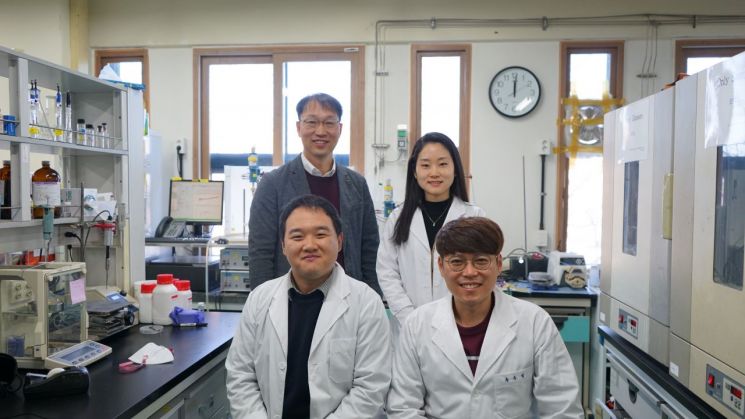
[Asia Economy Honam Reporting Headquarters Reporter Lee Gwan-woo] The research team led by Professor Lee Jae-young of the Department of Earth and Environmental Engineering at Gwangju Institute of Science and Technology (GIST) announced on the 26th that they have improved the performance and durability of lithium-sulfur batteries, a next-generation energy storage technology.
Lithium-sulfur batteries are a next-generation battery technology closest to commercialization among existing next-generation batteries, with an energy density per unit weight of up to 2100 Wh/kg, offering a theoretical capacity 5.4 times greater than lithium-ion batteries, making them ultra-high capacity next-generation batteries.
The research team introduced cobalt oxalates as an electrochemical catalyst for the first time at the lithium-sulfur battery cathode interface, elucidated the electrochemical catalytic reactions during charge-discharge processes, and succeeded in securing continuous performance durability based on this.
Lithium-sulfur batteries not only theoretically have five times higher energy density than conventional lithium-ion batteries but also use economical and eco-friendly materials, drawing attention as next-generation batteries that can replace lithium-ion batteries.
They can be used not only in medium-to-large energy storage devices such as electric vehicles but also in portable electronic devices and ultra-lightweight, ultra-compact special equipment, leading to fierce competition worldwide for their development.
However, the low lifespan caused by sulfur’s non-conductive properties and the dissolution of lithium polysulfides generated during charge-discharge processes remains a major obstacle to commercialization.
Recently, catalytic research to improve lithium-sulfur battery performance has been underway, but for more efficient performance enhancement, high-efficiency conversion of sulfur, which is non-conductive and low-cost, is necessary. Research to elucidate the electrochemical reaction mechanisms enabling such conversion is insufficient.
The research team synthesized cobalt oxalate as an electrochemical oxidation-reduction reaction catalyst using a very simple chemical precipitation method, enabling gram-scale production, and applied it to the cathode of lithium-sulfur batteries.
The cobalt oxalate electrochemical catalyst-based cathode adsorbed the generated lithium polysulfides onto the catalyst and cathode surface, minimizing self-discharge caused by lithium polysulfides circulating inside the cell.
Additionally, compared to conventional lithium-sulfur batteries, the cell performance was maintained without degradation due to self-discharge even after leaving the battery unused for about a week, approximately 1.5 times longer.
Professor Lee Jae-young said, “This research achievement is significant in that it secured capacity improvement and durability of lithium-sulfur batteries capable of realizing high energy density at low cost through electrochemical catalytic reactions,” adding, “We expect that through follow-up research, the durability of lithium-sulfur batteries will gradually improve, making a great contribution to the advancement of next-generation energy storage technologies.”
This research was conducted with support from the GIST Research Institute (GRI) and was published as a cover paper on the 19th in ‘ChemSusChem,’ a world-renowned journal in the field of green technology and sustainable energy.
© The Asia Business Daily(www.asiae.co.kr). All rights reserved.
![Clutching a Stolen Dior Bag, Saying "I Hate Being Poor but Real"... The Grotesque Con of a "Human Knockoff" [Slate]](https://cwcontent.asiae.co.kr/asiaresize/183/2026021902243444107_1771435474.jpg)















