"Delayed Vaccination in Developing Countries Could Cause $4.4 Trillion Production Loss"
Reports of AstraZeneca and Pfizer Vaccine Supply Delays in the EU

[Asia Economy Reporter Hyunwoo Lee] International organizations such as the International Chamber of Commerce (ICC) and the World Bank (WB) have issued warnings that the monopolization of COVID-19 vaccines by some advanced countries and delays in vaccine supply to developing countries could slow the global economic recovery. Considering the current international economic system connected through global supply chains, it is meaningless for only some advanced countries to overcome the COVID-19 crisis in terms of global economic recovery. There is an analysis that the world economy could face the worst-case scenario where the growth rate falls to less than half of the previously expected level. However, even the advanced countries that secured vaccines are concerned about delays in vaccine distribution as vaccine manufacturers have announced potential supply disruptions.
According to major foreign media such as The New York Times (NYT) on the 24th (local time), the ICC’s research report, scheduled to be released on the 25th, warns that if more than half of the population in developing countries fail to receive vaccines by the end of this year, international trade and intermediate goods supply chains will be damaged, resulting in production losses exceeding $4.4 trillion (approximately 4,859 trillion KRW). As a result, global goods production could decrease by about 5.7 percentage points, and economic recovery may proceed more slowly than previously forecasted.
Sevnem Kalemli Ozkan, a professor at the University of Maryland and the main author of the report, explained in an interview with major foreign media, "Developing and advanced countries are closely connected through the export and import of goods. Delays in vaccine supply to developing countries will ultimately lead to delays in the recovery of intermediate goods supply chains needed by advanced countries, and demand for goods will also decrease, so the damage could be directly transferred to advanced countries."
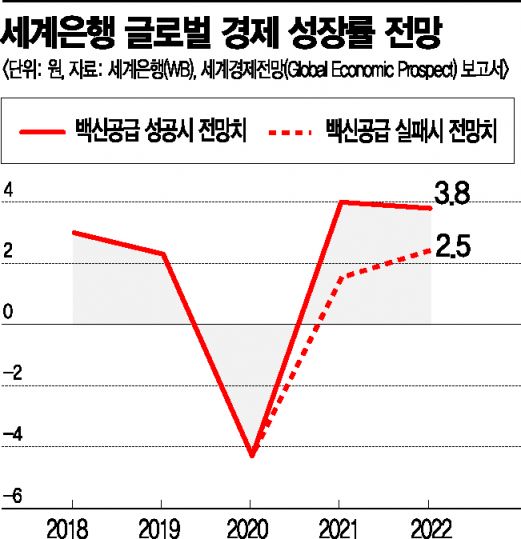
The WB also released the ‘Global Economic Prospects’ report recently, presenting different economic growth forecasts based on two scenarios: success or failure of global vaccine distribution. If vaccine distribution succeeds and the COVID-19 pandemic ends within this year, the global economic growth rate is projected to be 4.0% this year and 3.8% next year. However, if vaccine distribution fails and COVID-19 continues to spread, the growth rate forecast could drop significantly to 1.6% this year and 2.5% next year.
However, even advanced countries that secured vaccines are on high alert due to repeated reports of supply disruptions from vaccine manufacturers. According to the Associated Press (AP), Charles Michel, President of the European Council, warned in a press briefing that "legal measures will be taken to ensure that pharmaceutical companies comply with the vaccine supply contracts they signed," and added, "Pharmaceutical companies must transparently disclose the reasons for supply delays," in a stern tone.
Earlier, AstraZeneca and Pfizer informed the EU that the volume of vaccines scheduled for delivery to the EU by the first quarter of this year might be reduced. According to the German daily Bild, AstraZeneca reported to the European Union (EU) Commission on the 22nd that the initial supply volume of its vaccine would be lower than planned. Major foreign media quoted EU Commission officials saying that AstraZeneca’s initial supply volume in the first quarter would be about 31 million doses, approximately 60% less than the previously promised amount. AstraZeneca had previously contracted to supply 80 million doses to the EU by the first quarter of this year.
AstraZeneca explained that delays are expected due to vaccine adjustments caused by variants emerging in the UK, South Africa, and Brazil, a fire at a contract manufacturing plant in India, and expansions related to increased production capacity. Pfizer also reported to the EU on the 15th that a temporary decrease in vaccine shipments is expected due to the expansion of its Belgian factory to increase production capacity.
© The Asia Business Daily(www.asiae.co.kr). All rights reserved.
![Clutching a Stolen Dior Bag, Saying "I Hate Being Poor but Real"... The Grotesque Con of a "Human Knockoff" [Slate]](https://cwcontent.asiae.co.kr/asiaresize/183/2026021902243444107_1771435474.jpg)
















