Announcement of COVID-19 Vaccination Plan on the 28th
First Vaccine: AstraZeneca or Pfizer?
High Possibility of Pfizer's Initial Introduction via 'COVAX'
First Vaccination for Elderly or Medical Staff?
Higher Chance of Medical Staff if Pfizer is First Introduced
 On the 24th, when the domestic situation of the novel coronavirus infection (COVID-19) showed a gradual decline, medical staff were collecting specimens at a temporary screening clinic set up at Seoul Station Plaza. The Central Disease Control Headquarters of the Korea Disease Control and Prevention Agency announced that as of midnight, 392 new COVID-19 cases were confirmed, bringing the total to 75,084. Photo by Moon Honam munonam@
[Asia Economy Reporter Lee Chun-hee] With the first COVID-19 vaccine scheduled to be introduced domestically next month, attention is focused on which vaccine will be administered first and to whom.
According to the government on the 24th, the 'COVID-19 Vaccination Response Promotion Team,' which includes the Korea Disease Control and Prevention Agency and related ministries, plans to officially announce the COVID-19 vaccination implementation plan on the 28th.
Currently, the government has finalized vaccine purchase contracts for a total of 56 million doses. These include AstraZeneca (10 million doses), Janssen (6 million doses), Pfizer (10 million doses), Moderna (20 million doses), and an additional 10 million doses from the international vaccine joint procurement and distribution project, the 'COVAX Facility,' for which the vaccine type has not yet been finalized. Furthermore, negotiations are underway to secure an additional 20 million doses from Novavax.
The vaccines expected to be introduced the earliest are AstraZeneca and Pfizer. In particular, AstraZeneca is currently the only vaccine undergoing the government's approval process.
The Ministry of Food and Drug Safety will hold a verification advisory committee meeting on the AstraZeneca vaccine on the 31st. Before approving COVID-19 vaccines and treatments, the ministry conducts a three-tier advisory review process involving the ▲Verification Advisory Committee ▲Central Pharmaceutical Review Committee ▲Final Inspection Committee. Approval is expected to be decided within next month.
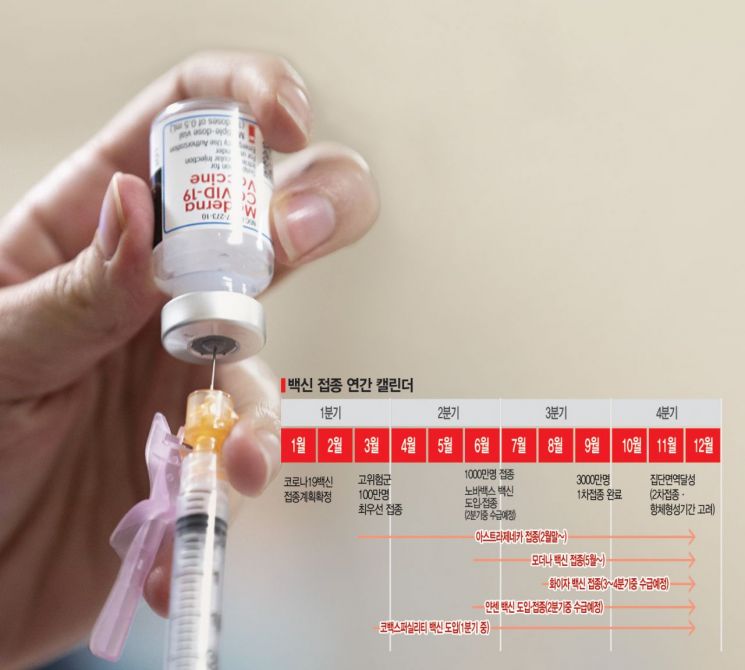
However, recently, the possibility of Pfizer becoming the first vaccine introduced domestically has been increasing. Initially, Pfizer was scheduled for introduction in the third quarter. But with the initial supply of 50,000 doses procured next month through the COVAX Facility narrowed down to Pfizer, the likelihood of it being the first vaccine has increased.
Prime Minister Chung Sye-kyun's visit on the 20th to a production site for ultra-low temperature freezers essential for the ultra-cold 'cold chain' distribution below minus 70 degrees Celsius supports this outlook. The Pfizer vaccine, an mRNA (messenger RNA) vaccine, must be distributed through a cold chain to maintain efficacy. Although this imposes significant logistical challenges, its preventive effectiveness is known to be 95%, higher than AstraZeneca's 70%.
The government is preparing to administer mRNA vaccines like Pfizer and Moderna at separate vaccination centers equipped with ultra-low temperature freezers to maintain the required ultra-cold conditions. They plan to establish 250 such centers nationwide. Other vaccines like AstraZeneca will be administered at entrusted medical institutions, with about 10,000 locations planned.
However, even if the Pfizer vaccine is introduced immediately, it is uncertain whether the government can meet its targeted vaccination timeline. Unlike AstraZeneca, Pfizer is still in the pre-review stage before the approval process. Pfizer Korea has stated, "We plan to apply for approval from the Ministry of Food and Drug Safety as soon as possible."
Accordingly, industry experts predict that a 'special import' procedure may be applied to Pfizer to meet the vaccination schedule. This system allows the import of unapproved medicines in Korea to respond to emergency situations. If the Korea Disease Control and Prevention Agency and related ministries request this from the Ministry of Food and Drug Safety and special import is approved, importation can proceed without product approval. This procedure was also applied when Gilead Sciences' remdesivir, a COVID-19 treatment, was introduced in June last year.
At that time, the government explained, "We considered that remdesivir was allowed for use during the COVID-19 pandemic in the US, Japan, and the UK." Currently, Pfizer vaccines are being administered in the UK, US, Canada, Saudi Arabia, Israel, and other countries.
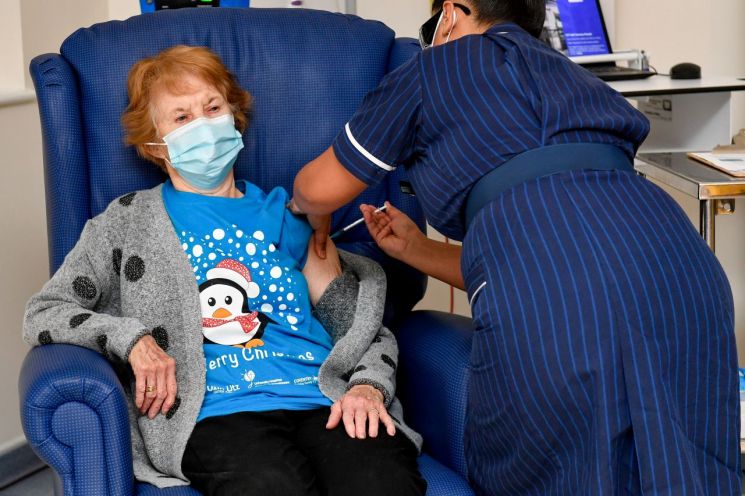 On the 8th of last month, Margaret Keenan from the UK, the world's first general recipient of the novel coronavirus disease (COVID-19) vaccine, received the vaccination. Ms. Keenan was administered the Pfizer vaccine. [Image source=Reuters Yonhap News]
There is also interest in which groups will receive vaccinations first. Elderly residents of nursing hospitals and facilities (about 566,000 people) and workers at COVID-19 medical institutions and nursing hospitals/facilities (about 1,033,000 people) are considered the highest priority groups. Other countries have similar priorities. The US prioritizes healthcare workers, nursing facility residents, elderly residents in long-term care facilities, and long-term care workers.
In addition, the government has prioritized ▲elderly aged 65 and over (about 8.36 million) ▲adults with chronic diseases (about 11.65 million) ▲education and childcare facility workers (about 675,000) ▲first responders to COVID-19 (about 90,000) ▲adults aged 50-64 (about 12.525 million) ▲police, firefighters, and military personnel (about 745,000) ▲inmates and staff of correctional facilities and treatment centers (about 20,000).
A variable is which vaccine arrives first. If Pfizer is chosen over AstraZeneca, the initial recipients are likely to be healthcare workers. Since Pfizer vaccines can only be administered at vaccination centers, recipients must visit these centers themselves. However, many elderly residents in nursing hospitals and facilities have limited mobility, making vaccination difficult. Considering this, if Pfizer is introduced first, it is likely that healthcare workers, who have more mobility, will receive Pfizer vaccines first, while elderly groups will be vaccinated later with AstraZeneca vaccines, which are easier to administer.
© The Asia Business Daily(www.asiae.co.kr). All rights reserved.
![Clutching a Stolen Dior Bag, Saying "I Hate Being Poor but Real"... The Grotesque Con of a "Human Knockoff" [Slate]](https://cwcontent.asiae.co.kr/asiaresize/183/2026021902243444107_1771435474.jpg)

















