[Asia Economy Reporter Minji Lee] There is growing anticipation that the Central Bank of the Republic of Turkey (TCBM) will strengthen its tightening policy by further raising the benchmark interest rate in the first quarter, but opinions suggest that it will take time to create a favorable investment environment.
According to the financial investment industry on the 23rd, TCBM held a policy decision meeting on the 21st (local time) and decided to maintain the benchmark interest rate at 17%. On December 24 last year, TCBM raised the benchmark interest rate by 200 basis points (1bp=0.01%) to 17% to curb inflation and defend the exchange rate of the lira. As a result, the 10-year government bond yield closed at 13%, down 9bp from the previous day. The exchange rate also fell 0.72% to 7.37 lira against the dollar, influenced by the intensified tightening stance.
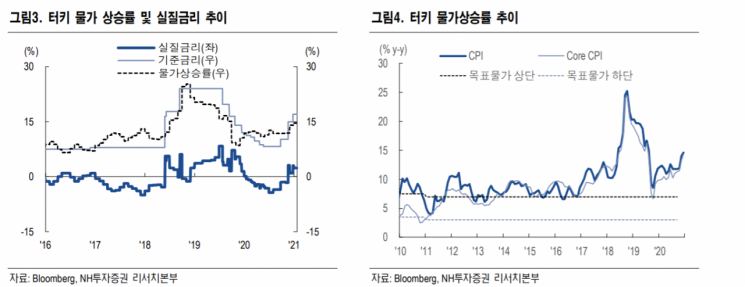
Earlier, NH Investment & Securities expected the benchmark interest rate to be raised this month as well, considering the bank’s proactive stance on interest rate changes and the expanding inflation rate for four consecutive months. However, due to the need to verify the effects of the sharp hike at the end of last year and the improving pace of economic recovery, the decision was made to keep the rate unchanged.
Although the benchmark interest rate was held steady, TCBM’s stance on tightening policies is expected to become stronger. In this meeting, the phrase added in December last year, “maintain tightening policy until inflation shows a stable trend,” was retained, and new phrases such as “consider additional tightening measures” and “formulate policies considering private financial costs” were added. Sungsoo Kim, a researcher at NH Investment & Securities, explained, “The overall tightening stance appears to have intensified,” adding, “They will seek additional hikes during the first quarter.”
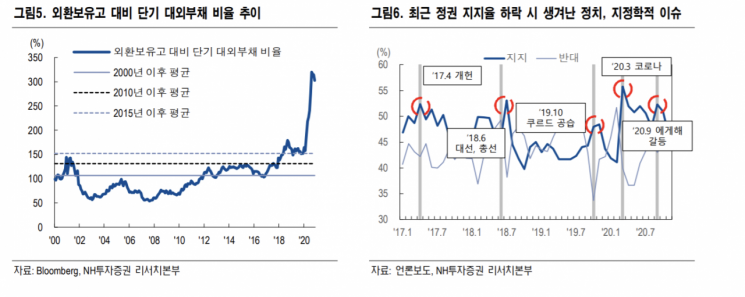
Despite President Erdo?an expressing dissatisfaction with the tightening policy, TCBM plans to strengthen its stance on tightening by securing policy independence. However, unstable internal politics, geopolitical issues, and weak debt repayment capacity are still expected to act as obstacles to investment in Turkey.
There is also an opinion that the recently stagnant approval ratings of the administration could lead to additional political noise. Furthermore, the ratio of short-term external debt to foreign exchange reserves has reached an all-time high of approximately 302.5%. Researcher Sungsoo Kim stated, “While policy management aligned with market and economic logic is positive, the investment environment in Turkey is considered unfavorable,” adding, “It is expected to take time before the overall investment environment improves.”
© The Asia Business Daily(www.asiae.co.kr). All rights reserved.
![Clutching a Stolen Dior Bag, Saying "I Hate Being Poor but Real"... The Grotesque Con of a "Human Knockoff" [Slate]](https://cwcontent.asiae.co.kr/asiaresize/183/2026021902243444107_1771435474.jpg)

















