Possibility of Stock Market Waiting Funds Surpassing 130 Trillion This Year... "Will Firmly Support the Era of 3000"
[Asia Economy Reporter Minwoo Lee] Although volatility has increased since the KOSPI surpassed 3000, individual investors' buying momentum remains intact. It is analyzed that the abundant liquidity environment and individual standby funds will firmly support the stock market.
Individual Supply and Demand Emerges as a Key Indicator for the Stock Market
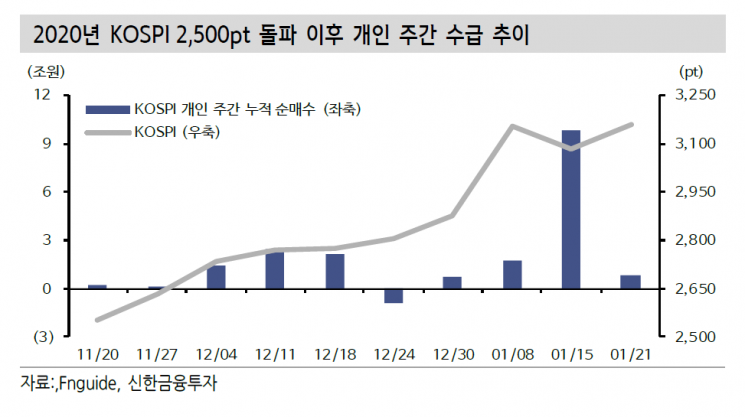
On the 23rd, Shinhan Financial Investment analyzed that the return of individual investors, who had continuously reduced their stock holdings during the box market from 2011 to 2019, is a positive signal for the overall market. Individual supply and demand has emerged as an important indicator to gauge the direction of the stock market.
Even after the KOSPI closed above 3000 points for the first time on the 7th, the investment enthusiasm of individual investors has not cooled since the rebound in March last year. On the 11th, when the KOSPI recorded an intraday all-time high of 3266.23, the trading volume reached 44 trillion KRW, and the net buying amount by individuals hit a record high of 4.4921 trillion KRW.
Since then, concerns about inflation and the possibility of early normalization of monetary policy have increased volatility around the 3100 level, but individual supply and demand has remained solid. Since the beginning of the year, the combined net buying amount by individuals in the KOSPI and KOSDAQ markets is about 14.5 trillion KRW. The cumulative amount since the 12th is approximately 6.5 trillion KRW. Despite the sideways movement of the stock market, the buying momentum remains unchanged.
Record-Breaking Individual Funds
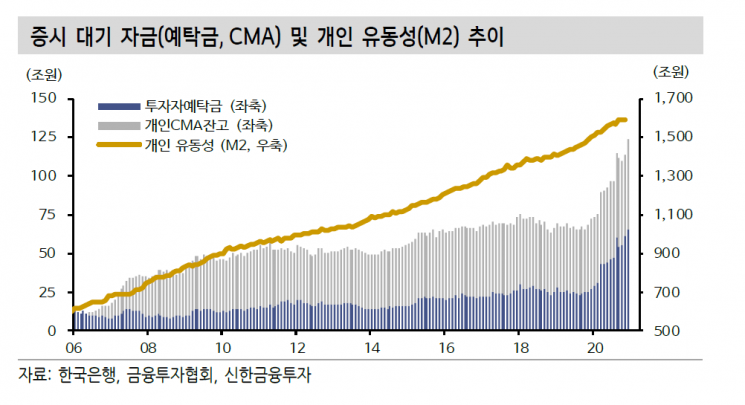
Individual investors' standby funds in the stock market are generally estimated as the sum of investor deposits and balances in securities firms' Comprehensive Asset Management Accounts (CMA). After the COVID-19 pandemic last year, as the stock market continued its rally, the scale of funds waiting to buy increased proportionally to the personal funds flowing into the stock market. Last year, the cumulative net buying amount by individuals in the KOSPI and KOSDAQ was about 63.8 trillion KRW. During the same period, investor deposits increased by approximately 38.1 trillion KRW, and total standby funds rose by about 51.5 trillion KRW. These figures represent increases of 139% and 71% compared to the previous year, respectively.
The relative proportion compared to total liquidity also rose to a higher level than the historical average. As of the end of last year, the ratio of standby funds to household liquidity (M2) was in the 7% range, marking the highest level since statistics began in 2002. The ratio of standby funds to market capitalization, which had remained in the 4% range since 2011, rose to the mid-5% range. Except for the sharp index drops at the end of 2008 and early last year, this is practically a historical high.
Potential for Further Expansion of Stock Market Standby Funds... "Will Firmly Support the Market"
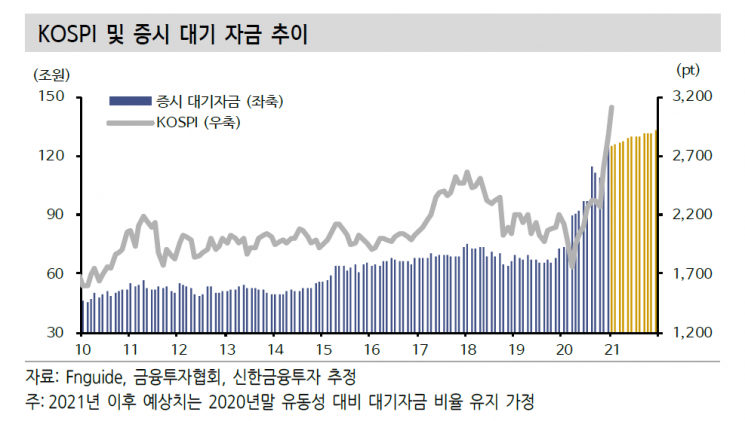
The 2007 bull market was led by institutions, and the 2017 bull market was led by foreigners. This bull market has been centered on individuals, with a change in perception toward stocks as the background. Dami Kim, a researcher at Shinhan Financial Investment, explained, "From the perspective of individual asset management, the low interest rates and increased accessibility to stock information have reduced the opportunity cost of stock investment. Funds that could not find suitable investment destinations in the era of historically low base interest rates have massively flowed into the stock market."
Although some profit-taking was observed mainly among individual investors who felt burdened by the short-term peak near KOSPI 3150, there is analysis that additional fund inflows are possible. Researcher Kim predicted, "Due to the decline in expected returns, it has become difficult to respond with aggressive buying similar to last year, but at the current point where the KOSPI has settled at 3000, the elevated level of standby funds can lead to further fund inflows."
In particular, the abundant liquidity environment and individual standby funds are expected to firmly support the stock market. Researcher Kim emphasized, "Assuming the growth rate of individual liquidity (M2) is at the average level of interest rate cuts and the ratio of standby funds to liquidity maintains the current level (around 7%), the stock market standby funds could expand to the 130 trillion KRW range by the end of this year. Monetary policy coordination to support the expansionary fiscal policy of the Joe Biden administration in the United States is still necessary."
© The Asia Business Daily(www.asiae.co.kr). All rights reserved.
![Clutching a Stolen Dior Bag, Saying "I Hate Being Poor but Real"... The Grotesque Con of a "Human Knockoff" [Slate]](https://cwcontent.asiae.co.kr/asiaresize/183/2026021902243444107_1771435474.jpg)

















