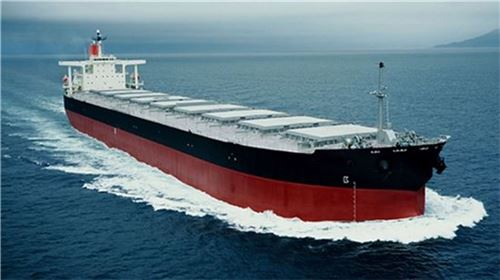
 ▲Bulk carrier (reference photo)
[Asia Economy Reporter Dongwoo Lee] The key indicators of the shipping industry, the container index and the bulk index, are diverging. While the bulk freight index showed strength due to port congestion caused by the COVID-19 pandemic and concentrated coal demand in China, the container freight index turned downward as freight rates were adjusted ahead of the Chinese Lunar New Year.
According to the shipping industry on the 23rd, the Baltic Dry Index (BDI), which serves as the benchmark for bulk shipping rates, recorded 1,837 points as of the 21st. This figure rebounded after continuing a downward trend following the peak of 1,856 points on the 13th. It rose 38.8% compared to the lowest point in the past month (1,323 points).
The sharp rise in the BDI is attributed to the Chinese government's lifting of coal import quotas to overcome winter power shortages, as well as increased iron ore imports by other East Asian countries such as Japan and Taiwan.
In fact, the Baltic Capesize Index (BCI), which reflects the freight rates of Capesize bulk carriers (vessels over 80,000 DWT) mainly transporting iron ore, rose 69.1% from the recent low of 1,819 points to 3,077 points during the same period. The expansion of iron ore exports from Australia and port operation disruptions caused by cold waves in East Asia also contributed to the freight rate increase.
Seongbong Park, a researcher at Hana Financial Investment, forecasted, "On an annual basis, the expansion of iron ore imports by countries other than China and the recovery of industrial power demand due to the rise in global manufacturing operating rates will drive a significant increase in coal cargo volume, supporting the strength of the BDI."
On the other hand, the Shanghai Containerized Freight Index (SCFI), a global container ship freight rate indicator, turned downward after 15 weeks.
According to the Shanghai Shipping Exchange, the SCFI stood at 2,868.95 points as of the previous day, down 16.05 points from the previous week. This is the first time in about four months that the SCFI has turned downward since it recorded 1,438 points on October 9 last year.
Freight rates on major routes such as Asia to Northern Europe fell by $19 to $4,394 per TEU (one 6-meter container) compared to the previous week. The Asia to North America West Coast route freight rate dropped $59 to $3,995 per FEU (one 12-meter container). The South Africa route freight rate to Durban decreased by $147 to $3,152 per TEU during the same period.
The industry analyzed that container ship freight rates have entered some adjustment after sustaining a recent upward trend. Some expect that cargo volume has decreased as the long holiday period begins ahead of the Chinese Lunar New Year holiday.
However, the government expects that the reduction in maritime freight rates will not be significant this year compared to previous years due to delays in overseas port handling of export vessels, and plans to continue deploying temporary vessels. On this day, HMM urgently deployed one 4,600 TEU-class vessel, and next month, SM Shipping will urgently deploy a total of two vessels, one 3,400 TEU-class and one 6,500 TEU-class.
© The Asia Business Daily(www.asiae.co.kr). All rights reserved.
![Clutching a Stolen Dior Bag, Saying "I Hate Being Poor but Real"... The Grotesque Con of a "Human Knockoff" [Slate]](https://cwcontent.asiae.co.kr/asiaresize/183/2026021902243444107_1771435474.jpg)














