'Selective Integrated CSAT'... Expansion of Elective Subject Range
Mathematics and Inquiry Areas, Mandatory to Check Required Subjects for Applied Departments
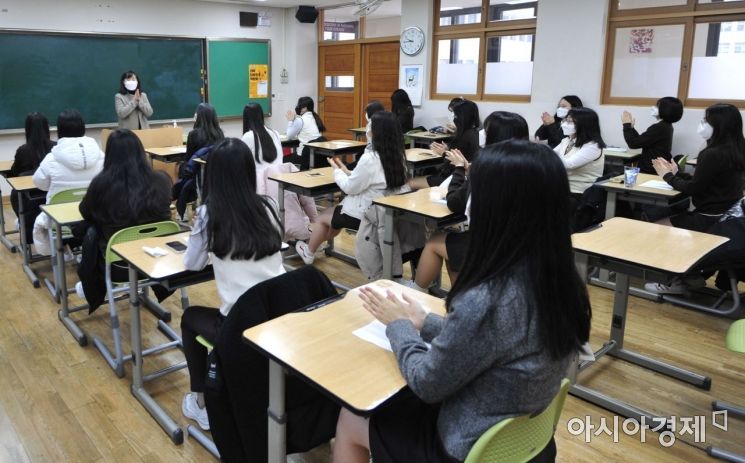 On the morning of the 23rd, the distribution day of the 2021 College Scholastic Ability Test (CSAT) score reports, students at Haeseong Girls' High School in Dongdaemun-gu, Seoul, applauded each other in encouragement after receiving their CSAT score reports. Photo by Joint Press Corps
[Asia Economy Reporter Han Jinju] The 2022 academic year College Scholastic Ability Test (CSAT), scheduled for November 18, is now 299 days away. This year, elective subjects have been introduced in the Korean language and mathematics sections, making it important to strategize from the start of exam preparation.
Checking Elective Subjects in Mathematics and Inquiry Areas Before Applying to Departments is Essential
From the 2022 CSAT, the Korean language section requires all students to solve the same questions in the common subjects 'Reading' and 'Literature,' but they must choose one between ‘Speech and Composition’ and ‘Language and Media.’ In the mathematics section, 'Mathematics I' and 'Mathematics II' are common subjects, but students must select one subject from ▲Geometry and Vectors ▲Calculus ▲Probability and Statistics. For the inquiry section, previously students had to choose two subjects either from social studies or science studies, but from this year, they can select any two subjects without distinction and take the exam accordingly.
There are no restrictions on university applications based on the Korean language subject chosen, but mathematics and inquiry areas differ. Depending on the elective subjects, students may be unable to apply to their desired universities. For natural science departments at highly preferred universities, students must take either 'Calculus' or 'Geometry and Vectors' in the mathematics section. In the inquiry section, it is common to have to select two subjects from science inquiry. It is advisable to check the 2022 CSAT sample questions on the official CSAT website.
Check the Number of Allowed University Applications in Advance
The number of applications allowed differs between early admission (Susi) and regular admission (Jeongsi). For four-year universities, six applications are allowed for Susi and three for Jeongsi. Additional applications are possible for special universities such as military academies, police universities, KAIST, science and technology universities, and industrial universities. For Susi at four-year universities, multiple applications to different departments within the same university and admission track are not allowed. Some universities also restrict simultaneous applications to certain admission tracks even if the tracks differ. For Jeongsi, there is a restriction against multiple applications within the same selection group, so it is essential to verify before applying. There are no application limits for junior colleges, and some universities allow multiple applications within the same admission track. Although competition is very high, the acceptance rate for junior college Susi and Jeongsi is also high.
This year, the proportion of Jeongsi admissions will expand to about 40%. If a student is accepted in Susi, they cannot apply for Jeongsi. Even if they do not register after acceptance in Susi, they are still ineligible to apply for Jeongsi. Students accepted in Susi at junior colleges cannot apply for Jeongsi at four-year or junior colleges. If a student is found to have violated multiple application rules after being accepted in Jeongsi, their admission will be nullified, so caution is required.
Correlation Between Mock Exams and CSAT
Provided there are no variables such as those caused by COVID-19, six mock exams will be held this year on March 25, April 14, June 3, July 7, September 1, and October 12. Among these, the March, April, July, and October mock exams are administered by local education offices, while the June and September mock exams are conducted by the Korea Institute for Curriculum and Evaluation (KICE). The KICE-administered mock exams include participation from both current high school seniors and graduates, which helps objectively assess one’s standing.
According to a survey by JinHakSa, 82.3% of students responded that their CSAT scores this year would be similar to or higher than their June mock exam scores. An analysis of statistics comparing the 2019 June mock exam and CSAT scores showed that 58.2% of students experienced a drop of 5 or more percentile points in Korean, mathematics, and inquiry averages. The proportion of students who maintained or improved their scores was 41.8%. For natural science students, the decline was more pronounced due to the influx of top graduates interested in medical fields. Even if students perform well in mock exams, they should not become complacent.
Student Record Comprehensive Screening, Early Admission, and School Grades?
The Student Record Comprehensive Screening (Haksaengbu Jonghap Jeonhyeong) incorporates school grades as an evaluation factor. However, unlike the Student Record Curriculum Screening or essay screening, it does not select students by numerically ranking grades or assigning ranks. Instead, it comprehensively evaluates factors such as improvement, suitability for the major, various activities, and passion for academics. However, there is a minimum passing criterion for early admission. Even if a student has high curriculum grades and essay scores, they cannot be admitted if they fail to meet the minimum CSAT score requirements. It is important to carefully check the standards of the university you are applying to.
The second semester of the third year is not evaluated for current students in early admission. However, for repeaters, the second semester of the third year may be included in the student record evaluation. Some universities that use student records in regular admission also consider grades from the second semester of the third year. Although the weighting may not be high, students should pay attention to final exams taken after the CSAT.
© The Asia Business Daily(www.asiae.co.kr). All rights reserved.
![Clutching a Stolen Dior Bag, Saying "I Hate Being Poor but Real"... The Grotesque Con of a "Human Knockoff" [Slate]](https://cwcontent.asiae.co.kr/asiaresize/183/2026021902243444107_1771435474.jpg)















