Last Year, Japan's Share of Material and Component Imports at 16%... Trade Deficit with Japan Expands to 15.37 Billion
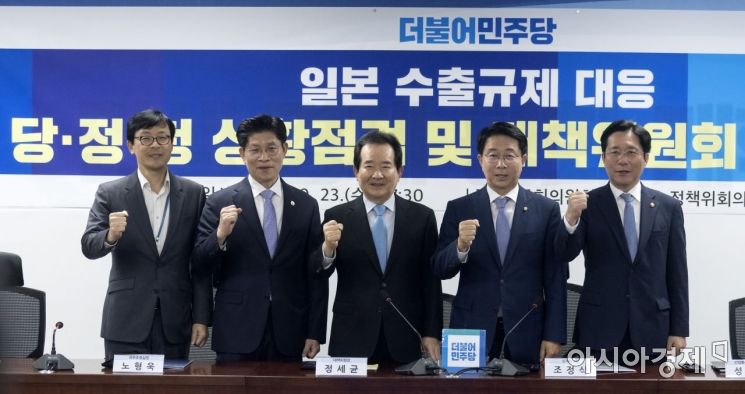 On the 23rd, the 'Party-Government-Cheongwadae Situation Check and Countermeasure Meeting for Responding to Japan's Export Regulations' was held at the National Assembly. Attending the meeting, Lee Ho-seung, Senior Secretary for Economic Affairs to the President (from left), Noh Hyung-wook, Director of the Office for Government Policy Coordination, Jeong Se-gyun, member of the Democratic Party of Korea, Cho Jung-sik, Chairman of the Policy Committee, and Sung Yun-mo, Minister of Trade, Industry and Energy, are shouting "Fighting for the SoBuJang industry." Photo by Yoon Dong-ju doso7@
[Asia Economy Reporter Kwon Haeyoung] Despite the government’s full-scale efforts to localize materials and components following Japan’s export restrictions, the proportion of materials and components imported from Japan last year slightly increased compared to the previous year. The trade deficit in materials and components with Japan also widened.
According to the Ministry of Trade, Industry and Energy’s 'Materials and Components Comprehensive Information Network' on the 23rd, among the $167.8 billion worth of domestic materials and components imports in 2020, Japanese products accounted for $26.79 billion, representing a 16% share. This is a slight increase compared to 15.8% in 2019.
The trade deficit in materials and components with Japan increased to $15.37 billion from $14.15 billion in 2019. Although imports from Japan decreased by 0.8%, exports to Japan also sharply declined by 11.2%, resulting in a larger deficit.
By item, imports of Japanese electronic components rose 8.9% year-on-year to $6.6 billion. Among electronic components, imports of memory semiconductors and digital integrated circuit semiconductors decreased by 9.9%, while imports of diodes, transistors, and similar semiconductor devices increased by 10%. Imports of general machinery parts, electrical equipment parts, and rubber and plastic products also increased by 9%, 1.2%, and 6.3%, respectively, last year.
Meanwhile, imports of textile products decreased by 2%, chemical substances and chemical products by 4.6%, primary metal products by 13.4%, and precision instrument parts by 9.3%.
By country, the import share of Chinese products fell from 30.5% in 2019 to 29.3%. The share of U.S. products also declined by 0.38 percentage points from 11.4% to 11.02% during the same period. In contrast, Taiwan’s share rose by 1.5 percentage points from 7.2% to 8.7%. This was due to a sharp 24.5% increase in imports of Taiwanese electronic components, centered on electronic integrated circuits, printed circuit boards, and electronic component mounting boards, reaching $12.42 billion compared to the previous year.
© The Asia Business Daily(www.asiae.co.kr). All rights reserved.
![Clutching a Stolen Dior Bag, Saying "I Hate Being Poor but Real"... The Grotesque Con of a "Human Knockoff" [Slate]](https://cwcontent.asiae.co.kr/asiaresize/183/2026021902243444107_1771435474.jpg)















