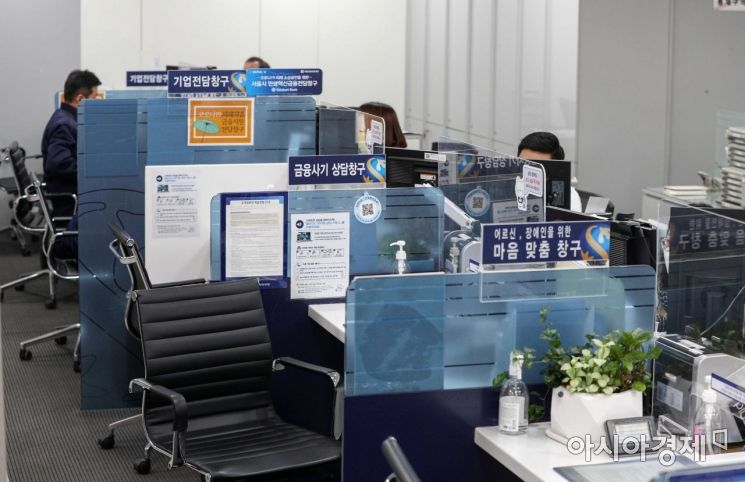
 A customer visiting a bank loan counter in Seoul is receiving consultation regarding a loan. Photo by Jinhyung Kang aymsdream@
[Asia Economy Reporter Kwangho Lee] As the so-called 'Yeongkkeul' (borrowing to the limit, even one's soul) and 'Bittou' (borrowing to invest) for real estate purchases and stock investments have surged sharply since the new year, financial authorities are tightening regulations on high-value unsecured loans. This is an ultra-strong regulation that requires monthly installment repayments of both principal and interest and halves the loan maturity period. The financial authorities plan to finalize and announce the detailed measures by March. However, considering market impact, they intend to implement the measures with a sufficient grace period.
According to financial authorities on the 23rd, the Financial Services Commission has decided to introduce a method of repaying the principal in installments for high-value unsecured loans taken by high-income earners.
Currently, unsecured loans require only monthly interest payments until maturity, but under the new rule, both principal and interest must be repaid monthly. For example, if one takes an unsecured loan of 100 million KRW at an annual interest rate of 3% with a one-year maturity, currently, only 250,000 KRW interest is paid monthly. However, under the new method, approximately 8.58 million KRW, including principal, must be repaid monthly.
The financial authorities have stated that the specific threshold amount for applying installment repayments has not yet been determined.
However, some speculate that it will apply to unsecured loans exceeding 100 million KRW. This is because borrowers with an annual income exceeding 80 million KRW who have total unsecured loans over 100 million KRW are subject to a debt service ratio (DSR) regulation of 40% (60% for non-bank sectors), leading to the logic that the high-value threshold might be 100 million KRW.
The financial authorities are known to emphasize setting criteria tailored to individual circumstances such as annual income rather than a uniform amount. For instance, if a customer with an annual income of 100 million KRW takes an unsecured loan of 300 million KRW, only the 200 million KRW exceeding the annual income would be repaid in installments.
Minus accounts (Ma-tong), which are overdraft accounts with a set limit, are expected to be excluded from this regulation. Since they allow borrowing up to a limit as needed, the concept of installment repayment cannot be applied.
A financial authority official said, "Specific details such as the detailed tasks, criteria, and implementation timing of the management plan will be discussed and reviewed thoroughly through future consultations with the financial sector."
As financial authorities tighten unsecured loan regulations, banks are rushing to suspend new loans and reduce limits.
Shinhan Bank reduced the maximum limit per loan for four unsecured loan products targeting office workers, including 'Elite Loan I & II' and 'Solpyeonhan Office Worker Loan S I & II,' by 50 million KRW each?from 200 million KRW to 150 million KRW, and from 150 million KRW to 100 million KRW, respectively.
Woori Bank resumed sales of the 'Woori WON Office Worker Unsecured Loan' while reducing the maximum limit of minus accounts from 100 million KRW to 50 million KRW.
KakaoBank also lowered the maximum limit of its high-credit office worker unsecured loan product from 150 million KRW to 100 million KRW, and Suhyup Bank suspended new minus account loans for its 'Sh The Dream Unsecured Loan' product.
© The Asia Business Daily(www.asiae.co.kr). All rights reserved.
![Clutching a Stolen Dior Bag, Saying "I Hate Being Poor but Real"... The Grotesque Con of a "Human Knockoff" [Slate]](https://cwcontent.asiae.co.kr/asiaresize/183/2026021902243444107_1771435474.jpg)















