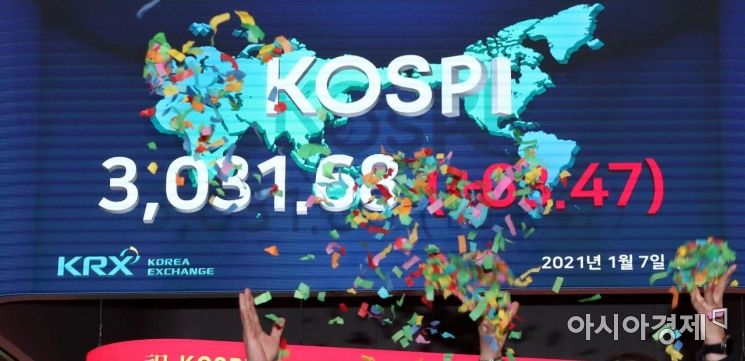
 The KOSPI closed at 3,031.68, up 63.47 points (2.14%) from the previous day, marking the first time it has surpassed 3000 based on the closing price. On the 7th, a message celebrating the KOSPI breaking 3000 was displayed on the electronic board at the Korea Exchange in Yeouido, Seoul. Photo by Kim Hyun-min kimhyun81@
[Asia Economy Reporter Junho Hwang] "Is KOSPI 3100 a bubble? Or is it somewhere in the middle of a bull market?"
On the 22nd, KB Securities cast a vote that it might not be a bubble in response to investors' curiosity. KB Securities stated this in a report titled "Checking Korea's Asset Price Bubble: More Potential for Growth than Risk."
The Era of KOSPI 3000, More Than a Bubble...
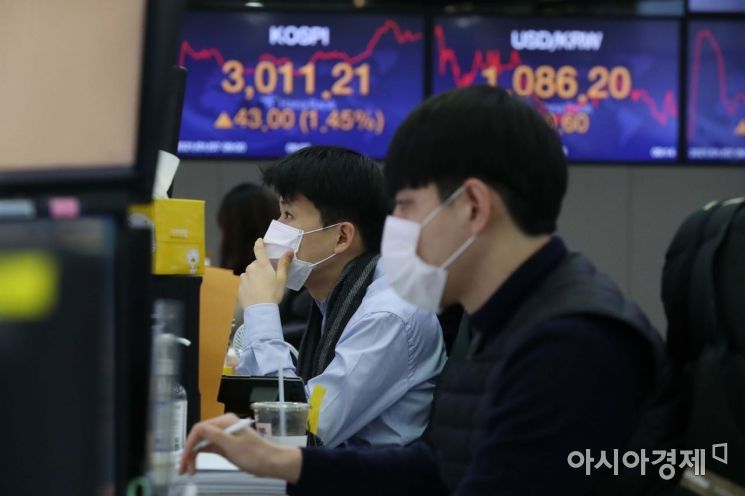 On the 7th, as the KOSPI index started higher, dealers were working in the Hana Bank dealing room in Euljiro, Seoul. On that day, the KOSPI opened at 2,980.75, up 12.54 points (0.42%) from the previous trading day. Photo by Moon Honam munonam@
KB Securities focused on the price-to-book ratio (P/B) of KOSPI. Recently, KOSPI's P/B can be seen as being at the historical average level. In the past, KOSPI's P/B peaked around 1.8 to 1.9 times, but currently, it is about 1.2 times. Judging by past market trends, this can be interpreted as being somewhere in the middle of a bull market.
Along with KOSPI reaching historically high levels, KOSPI's price-to-earnings ratio (P/E) has also soared to record highs. The reason P/B remains low is due to changes in return on equity (ROE). This change reflects the structural transformation of Korean companies. Representative examples include Samsung Electronics' success in expanding non-memory semiconductors and Hyundai-Kia Motors envisioning the future of IT companies and electric hydrogen vehicles. In less than a decade, the market has shifted from heavy and chemical industries to new businesses such as bio, secondary batteries, and non-memory semiconductors, causing the P/B figures to show a different pattern compared to previous bull markets.
The Rapid Increase in Debt Needs Monitoring...
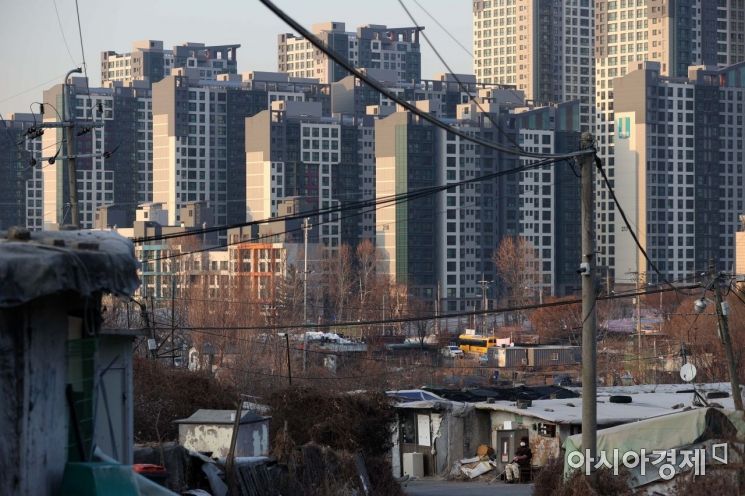 The real estate issue shook South Korea in 2020. Contrary to President Moon Jae-in's confident declarations about having control over the real estate problem, it was a year marked by growing public frustration over homeownership. The government announced 24 policies to curb the volatile housing prices, but each time, prices rose even further. Guryong Village, the last shantytown in the Gangnam area of Seoul, stands in stark contrast to the dazzling high-rise apartments. In the New Year of the Year of the Ox, there is hope for stabilization in the housing market. Photo by Moon Honam munonam@
Regarding real estate, the analysis suggests it is difficult to consider it a bubble since prices are moving in line with fundamentals. Real estate prices entered an overvalued zone reflecting additional price increases and income declines in 2020. However, compared to Japan and the United States, the degree of overvaluation is minimal.
Nonetheless, KB Securities emphasized the need to continuously monitor the rapid increase in debt. Although interest burden has not significantly increased due to falling interest rates, attention should be paid to economic and inflation movements that could affect the pace of interest rate hikes.
© The Asia Business Daily(www.asiae.co.kr). All rights reserved.
![Clutching a Stolen Dior Bag, Saying "I Hate Being Poor but Real"... The Grotesque Con of a "Human Knockoff" [Slate]](https://cwcontent.asiae.co.kr/asiaresize/183/2026021902243444107_1771435474.jpg)

















