One Year Since Liquor Tax Law Revision
Last Year's Sales Near 100 Billion Won
500% Increase in Convenience Stores Among Home Drinkers
Craft Beer Sales Drive Growth
Mixed Fortunes in Can Production Capacity
Small Businesses Except Top 10 Face Crisis
Direct Hit from COVID-19, Facing Collapse Risk
[Asia Economy Reporter Lim Hye-seon] One year after the revision of the Liquor Tax Act, the domestic craft beer market has grown to a scale of 100 billion KRW. This is thanks to the rapid growth of the craft canned beer market centered around convenience stores despite the COVID-19 pandemic.
The Era of 100 Billion KRW Craft Beer
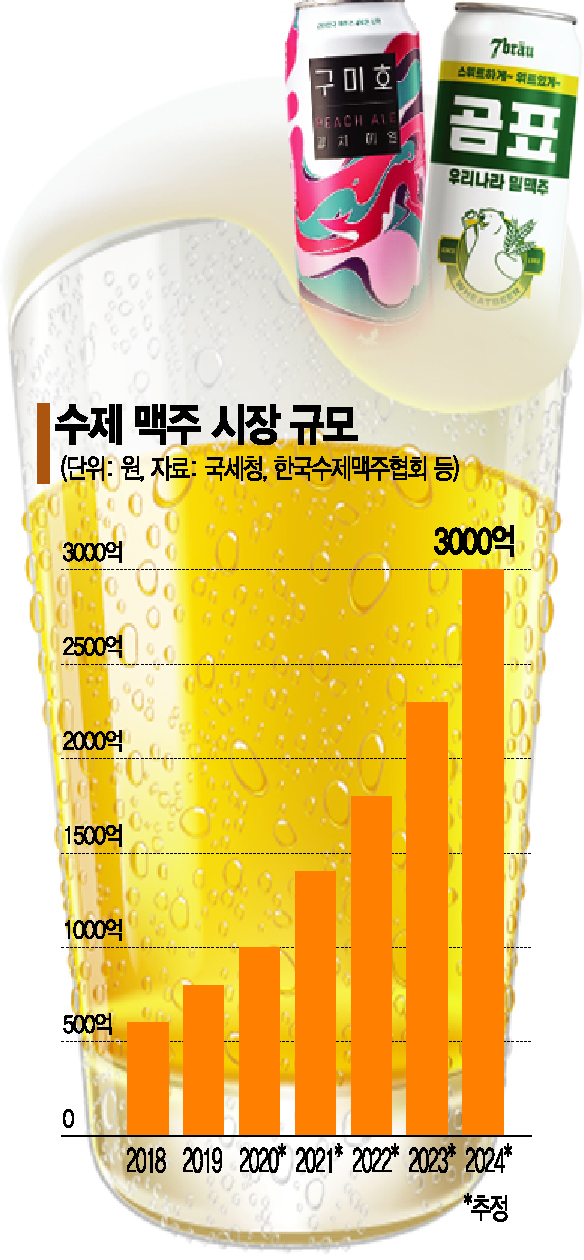
According to the National Tax Service and the Korea Craft Beer Association on the 22nd, the number of licenses for small-scale craft beer manufacturing reached about 150 last year, a 177% increase compared to 54 in 2014. The market size is estimated to have grown from 60 billion KRW in 2018 to 89 billion KRW in 2019, and nearly 100 billion KRW last year. The Korea Craft Beer Association expects the craft beer market to grow by 30% annually and reach 300 billion KRW by 2024. It is expected to account for 6.2% of the total beer market, including imported beers.
The craft beer market gained attention in 2015 when first-generation companies like Kabrew entered the market, but growth was limited due to high taxes. However, after the revision of the Liquor Tax Act, the beer tax system changed from an ad valorem tax (based on price) to a specific tax (based on production volume), allowing companies to sell products at prices more than 20% cheaper than before, thus opening the market widely.
Kabrew, which produces craft beers such as Gumiho, Namsan, and Gyeongbokgung, surpassed 10 billion KRW in sales last year, a 28% increase from the previous year. Jeju Beer’s sales also doubled, with popular products including Jeju Wit Ale and Jeju Pelong Ale. Gompyomil Beer, launched in collaboration between convenience store CU and Seven Bro, sold over 2 million cans since its release in May last year. Amazing Brewing Company’s ‘First Love IPA’ and ‘Seongsu-dong Pale Ale,’ as well as the collaboration product ‘Yudong Golbaengi Beer’ by Seven Eleven and The Salight Brewing, are also popular.
Expansion of the Canned Beer Market through Convenience Stores
As craft canned beers gained popularity in convenience stores, 15 to 20 new products were launched last year. The increase in home drinking due to COVID-19 also drove the rise in craft beer sales through convenience stores. Sales of craft beer at the three major convenience store chains surged by 500% compared to the previous year. At CU, the sales share of craft beer even exceeded 10% of domestic beer sales last year.
Investment in production facilities is also ongoing. Kabrew is expanding its brewery in Gapyeong, Gyeonggi Province, and is building the largest brewery in the craft beer industry. The brewery, officially opening in June, will have an annual production capacity of over 35 million cans. Jeju Beer increased the annual production capacity of its Jeju brewery fourfold to 18 million cans. The Hand and Malt, acquired by OB Beer, established a brewery in Icheon, Gyeonggi Province. Seven Bro, which produces Gompyomil Beer, completed can manufacturing facilities in May last year and plans further expansion in the first half of this year.
Jeju Beer is also pursuing an initial public offering (IPO). Jeju Beer recorded sales of 24.2 billion KRW up to the third quarter of last year, more than doubling compared to 10.9 billion KRW in the same period the previous year. The securities industry expects Jeju Beer to be valued at 100 billion KRW.
Small Businesses Struggle Due to COVID-19
Except for about 10 top companies capable of can production, around 140 small craft beer manufacturers are struggling due to COVID-19, deepening polarization in the industry. These companies mainly relied on draft beer sales in entertainment venues, so the reduction in business hours due to the pandemic hit them hard. After the government imposed a ban on gatherings of five or more people, many craft beer businesses decided to temporarily close or shut down permanently. According to the National Tax Service, as of October last year, the number of hop specialty bars nationwide was 30,264, down by more than 3,000 from 34,777 at the beginning of the year. In Seoul alone, 1,000 establishments closed, decreasing from 7,000 to 6,000.
© The Asia Business Daily(www.asiae.co.kr). All rights reserved.
![Clutching a Stolen Dior Bag, Saying "I Hate Being Poor but Real"... The Grotesque Con of a "Human Knockoff" [Slate]](https://cwcontent.asiae.co.kr/asiaresize/183/2026021902243444107_1771435474.jpg)















