Small and Mid-Cap Stocks Set to Outperform Large Caps Soon
Short-Selling Resumption Fears Delay Investor Sentiment Recovery
Brokerage Firms Advise "Selecting Stocks with Stronger Fundamentals and Less Volatility"
[Asia Economy Reporter Lee Seon-ae] Although a large-cap stock market is unfolding without the January effect (a phenomenon where stock price increases are higher in January than in other months) for small and mid-cap stocks, forecasts that a small and mid-cap stock rally will soon come continue to emerge. Nevertheless, investor sentiment is slow to recover amid expectations that small and mid-cap stocks, which have been seriously neglected compared to large-cap stocks, will be further affected when short selling resumes.
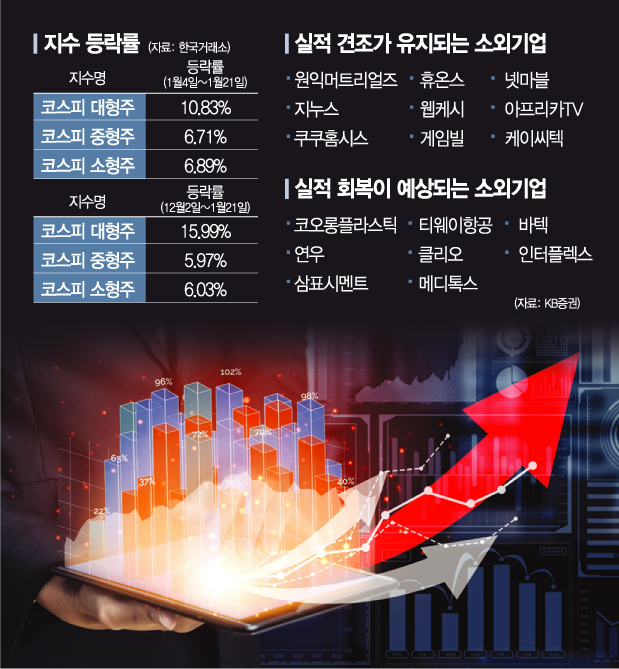
According to the Korea Exchange on the 22nd, the KOSPI large-cap index rose 15.99% over one month from December 21 to the 21st of this month, while the KOSPI mid-cap and small-cap indices increased by only 5.97% and 6.03%, respectively. Even this year, until the 21st, the large-cap index showed a 10.83% increase, whereas mid-cap and small-cap stocks remained in single digits at 6.71% and 6.89%. The proportion of large-cap stocks in domestic trading volume averaged 30.6% over the past year and increased to 41.6% on average this year. It is no exaggeration to say that market interest is focused on large-cap stocks.
However, from a mid- to long-term perspective, forecasts that a small and mid-cap stock market will unfold are gaining strength. This is thanks to the valuation of small and mid-cap stocks, which has fallen to the lowest level since 2011. Kim Sang-ho, a researcher at Shinhan Financial Investment, said, "The 12-month forward price-to-earnings ratio (PER) of small and mid-cap stocks relative to large-cap stocks averaged 1.1 times over the past 10 years, rising to 1.4 times in 2017 during a small and mid-cap stock rally phase. Currently, the relative PER is 0.83 times, the lowest in the past 10 years." He explained, "Based on past experiences when the relative PER of small and mid-cap stocks was low and then re-rated, the returns of small and mid-cap stocks and KOSDAQ significantly outperformed the KOSPI and large-cap stocks. Therefore, if a rebound occurs in the undervalued small and mid-cap stocks, the rebound will be substantial."
Since growth stocks constitute a large portion of small and mid-cap stocks, the premise that a purification of growth stocks will soon occur also supports the forecast of a small and mid-cap stock rally. However, Kim warned that if fundamentals do not improve, low valuations could instead pose a risk of further price declines. He advised, "Currently, individual funds are concentrated in large-cap stocks, so selective investment in small and mid-cap stocks seems appropriate. Attention should be paid to stocks whose price increases are not larger than the benchmark since the beginning of the year and whose earnings forecasts are being revised upward."
Although voices in the securities industry emphasize the need to prepare for a small and mid-cap stock market, the resumption of short selling appears to be a source of anxiety for individual investors. Roh Dong-gil, a researcher at NH Investment & Securities, explained, "When short selling resumes, small and mid-cap stocks, where the price gap between spot and futures is wider, will be more affected than large-cap stocks."
Accordingly, advice has emerged to avoid stocks that may be affected by the resumption of short selling and those vulnerable to the anxiety of leveraged investors ('debt investment'), while focusing on neglected stocks with solid fundamentals. KB Securities recommended selecting neglected stocks with lower returns than the market that did not experience price increases due to short covering (repurchasing borrowed and sold stocks) during the short selling ban and have low credit balances, thus posing less supply and demand risk. Since both the KOSPI and KOSDAQ indices plunged by over 4% in a single day when short selling resumed in 2011, stocks that rose due to short covering during the short selling ban should be excluded.
Kim Min-gyu, a researcher at KB Securities, said, "Short selling, which could affect the sentiment of small and mid-cap stocks, is about to resume, and the amount and proportion of margin loans have reached a record high of 21 trillion won and 0.95 relative to market capitalization, so it is true that buying because of undervaluation is uneasy." He analyzed, "It is better to re-evaluate neglected stocks with solid fundamentals, focusing on companies with both good past and future performance or those that were poor in the past but are expected to recover this year."
Wonik Materials, KC Tech, and Webcash were cited as recommended stocks. According to FnGuide, the average operating profit estimates by securities firms for Wonik Materials, Webcash, and KC Tech are 54.1 billion won, 174.4 billion won, and 71.9 billion won, respectively, with year-on-year growth rates expected to reach 23%, 27.9%, and 37.2%. Interflex is expected to turn its operating profit positive this year, achieving 26.1 billion won.
© The Asia Business Daily(www.asiae.co.kr). All rights reserved.

















