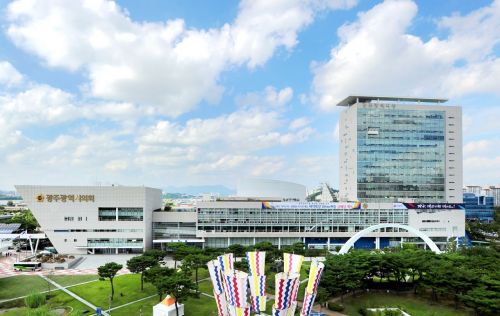
[Asia Economy Honam Reporting Headquarters Reporter Park Seon-gang] Gwangju Metropolitan City announced on the 21st that it has set this year’s transportation construction policy directions as ▲Improving traffic flow efficiency ▲Enhancing citizen convenience ▲Future urban competitiveness ▲Reducing traffic accidents, and will actively promote 10 major priority tasks to achieve these goals.
The city will promote ‘signal system synchronization’ for faster communication between Sangmu District and the Culture & Arts Center.
There has been a need to introduce ‘signal system synchronization’ for the entire section between the new town (Sangmu District) and the old town (Culture & Arts Center), which is a chronic traffic congestion area.
Accordingly, the city plans to consult with the National Police Agency, conduct a detailed field survey of the target section, remove synchronization obstacles such as illegal parking, and then introduce signal synchronization to dramatically improve traffic flow efficiency. In addition, the city plans to evaluate the results of this pilot project and consider expanding the synchronized sections.
Optimize intersection signals to harmonize traffic flow and pedestrian convenience.
After consulting with the National Police Agency, the city will investigate intersections where signal cycle durations are excessively long or short, negatively affecting both traffic flow and pedestrians, and improve operations with reasonable signal cycles.
Focus on traffic measures around Songjeong Station due to the construction of a new parking building.
In cooperation with Korail, the operator of Songjeong Station parking lot, the city will secure alternative parking lots and implement measures for convenient use by citizens.
Elevate existing roads to resolve bottlenecks and improve road efficiency.
For some intersections experiencing bottlenecks and long signal waiting times due to heavy traffic, the city plans to actively promote grade separation construction at points where changing from at-grade intersections to grade-separated intersections is necessary based on traffic characteristic analysis.
Introduce a rational on-street parking policy that decisively resolves issues where needed and strictly enforces no-parking zones.
By analyzing road functions and characteristics, the city will actively allow on-street parking in road sections without significant obstacles to ‘flow’ and ‘safety’ to enhance citizen parking convenience, while concentrating enforcement in prohibited zones to improve enforcement effectiveness.
Designate ‘bicycle priority lanes’ to promote bicycle use.
In consultation with the National Assembly, the city plans to actively promote institutional improvements to designate the shoulder lanes of roads with good flatness as bicycle priority lanes.
Expand bicycle parking lots around key stations of Urban Railway Line 2.
Recognizing that Urban Railway Line 2, which has a transportation influence zone of over one million people, requires bicycle infrastructure between homes/offices and subway stations for efficient operation, the city plans to establish new bicycle parking lots near key stations with large populations and transportation hubs.
Prepare a plan for the expansion of Gwangju Songjeong Station building and reflect it in government plans.
For Gwangju Songjeong Station, currently under government review for expansion, the city will utilize the 120 million KRW budget secured this year for the expansion and surrounding traffic system improvement to review desirable expansion plans, scale, and functions suitable for local conditions, and propose them to the government to ensure a future-oriented station expansion.
Drastically innovate traffic culture for a safe Gwangju free of traffic accidents.
The city will conduct an in-depth analysis of the causes of serious traffic accidents involving injury or death and vigorously promote facility improvements and traffic culture innovations responding to these causes.
Significantly improve visibility in children protection zones.
To enable drivers to easily recognize children protection zones, the city will promote a pilot project to improve visibility by paving the entire road surface of protection zones in dark red.
Gwangju City has prepared a draft of 10 major priority tasks in the transportation construction sector that will contribute to citizen convenience and urban development, finalized the tasks after internal discussions and consultations with traffic experts, held ‘Signal System Synchronization TF’ meetings with the National Police Agency from early this year, and accelerated work by starting detailed execution plans for each department.
Park Nam-eon, Director of the Transportation Construction Bureau, said, “We will solidly and swiftly promote the 10 core tasks in the transportation construction sector this year to create an advanced traffic city, Gwangju, where ‘flow’ and ‘safety’ are harmonized and citizens can feel the improvements in their daily lives.”
© The Asia Business Daily(www.asiae.co.kr). All rights reserved.
![Clutching a Stolen Dior Bag, Saying "I Hate Being Poor but Real"... The Grotesque Con of a "Human Knockoff" [Slate]](https://cwcontent.asiae.co.kr/asiaresize/183/2026021902243444107_1771435474.jpg)















