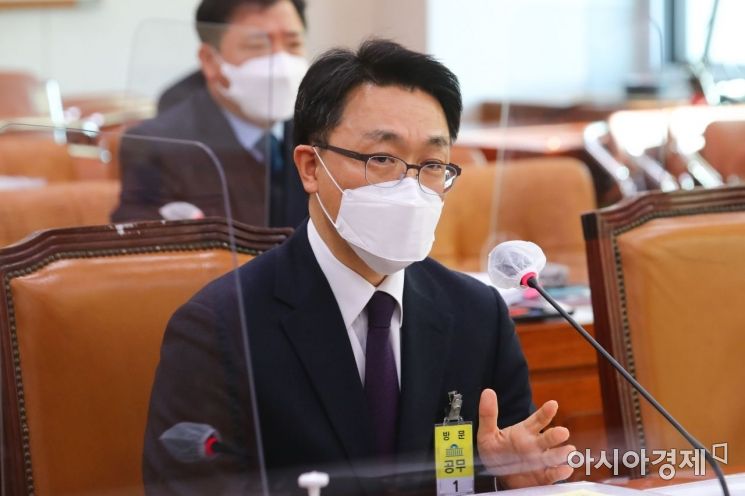
 Kim Jin-wook, the first nominee for the Chief of the High-ranking Officials' Crime Investigation Agency (Gong-su-cheo), is attending the confirmation hearing held by the National Assembly's Legislation and Judiciary Committee on the 19th, responding to questions from lawmakers. Photo by Yoon Dong-joo doso7@
[Asia Economy Reporter Choi Seok-jin] The High-ranking Officials' Crime Investigation Agency (HOSA), which will investigate corruption crimes committed by high-ranking officials such as members of the National Assembly, judges, and prosecutors, will officially launch on the 21st.
It has been 25 years since the Citizens' Coalition for Economic Justice petitioned for legislation including the High-ranking Officials Corruption Investigation Agency (HOCIA) in 1996, and 19 years since the late President Roh Moo-hyun made the establishment of HOCIA a presidential election pledge in 2002.
With the full implementation of the prosecution and police investigation authority adjustment laws starting this year, and the launch of HOSA on this day, the investigative landscape has completely changed, including the collapse of the prosecution's exclusive right to indict for the first time in 67 years since the Criminal Procedure Act was enacted in 1954.
President Moon to Present Appointment Letter This Morning... Inauguration and Plaque Ceremony in the Afternoon
Following the adoption of the confirmation hearing report on Kim Jin-wook, the first candidate for HOSA chief, by the National Assembly's Legislation and Judiciary Committee through bipartisan agreement the previous day, President Moon Jae-in will present the appointment letter to Kim at 11 a.m. at the Blue House main building.
HOSA is a key institutional symbol of President Moon's election pledge and the 'prosecutorial reform.'
Earlier, on the 10th of last month, when the HOSA-related law was passed in the National Assembly plenary session, President Moon welcomed it, saying, "The establishment of HOSA is a long-cherished wish and a promise to the people for investigation and inspection without sanctuary for power-type corruption, checks and balances among power institutions, and a corruption-free society."
After the appointment ceremony, Director Kim will hold an inauguration ceremony and attend the plaque unveiling ceremony at the HOSA office in the Government Complex Gwacheon at 3:30 p.m. on the same day.
Changing Investigation Landscape... Attention on the First Investigation Target
HOSA has investigative authority over various corruption crimes such as bribery, solicitation, dereliction of duty, and abuse of power committed by high-ranking officials of grade 3 or higher?including former and current presidents, members of the National Assembly, Supreme Court justices, Constitutional Court justices, ministers and vice ministers, prosecutors general, judges, prosecutors, police officers of rank superintendent or higher, and generals?and their families.
It also has the authority to directly indict crimes committed by the Chief Justice and justices of the Supreme Court, prosecutors general, judges, prosecutors, police officers of rank superintendent or higher, or their families. This marks the first time in constitutional history that the prosecution's exclusive right to indict has been broken.
Since January this year, with the enforcement of the amended Prosecutors' Office Act Article 4 and the Presidential Decree on the Scope of Prosecutors' Investigation Initiation, the scope of direct investigations by prosecutors has been drastically reduced to six major crimes including corruption crimes and crimes committed by police officers.
Additionally, prosecutors' authority to direct police investigations has been abolished, and the police now have the authority to conclude first-instance investigations.
With the addition of HOSA as the highest-level investigative agency, there has been a significant change in the investigative landscape.
Other investigative agencies such as the prosecution and police must immediately notify HOSA of any high-ranking official crimes discovered during investigations, and even ongoing cases must be transferred to HOSA upon request by the HOSA chief.
Meanwhile, attention is focused on the first investigation target, which will serve as a gauge of the newly established HOSA's status and role.
Various speculations about the 'first investigation target' have circulated in political and legal circles, including cases related to Prosecutor General Yoon Seok-youl, the Wolseong Nuclear Power Plant Unit 1 case, Deputy Minister of Justice Lee Yong-gu's case, and Kim Hak-ui's illegal deportation case. However, since Director Kim has pledged 'careful consideration,' it is also quite possible that newly raised suspicions after the full establishment of HOSA's organization will become the first investigation target.
◆ Deputy Director Appointment and Prosecutor Appointment... Remaining Tasks Pile Up
Starting his three-year term today, Director Kim must steadily proceed with procedures necessary for HOSA's operation, such as promulgating HOSA regulations, appointing the deputy director, and forming a personnel committee for appointing HOSA prosecutors.
The most notable task is the appointment of the deputy director. Since Director Kim, a former judge, has virtually no investigative experience except for a dispatch to the 'Korea Minting and Security Printing Corporation Special Prosecutor Team' about 20 years ago, it is highly likely that the deputy director will take charge of the actual investigative command at HOSA.
Director Kim, who has the right to recommend the deputy director, has stated during the confirmation hearing that he is considering candidates both from prosecution and non-prosecution backgrounds.
In the process of recommending up to 23 HOSA prosecutors excluding the director and deputy director, securing cooperation from the opposition party is key.
Earlier, when the ruling party faced difficulties in recommending a HOSA chief candidate due to the opposition's veto power, it amended Article 6 of the HOSA Act to nullify the opposition's veto power in the HOSA Chief Candidate Recommendation Committee. However, Article 9 of the HOSA Act stipulates that two opposition party recommended members must be included in the personnel committee recommending HOSA prosecutors.
Given that Director Kim has stated he will not appoint active prosecutors as HOSA prosecutors, attention is also focused on how many prosecutors from organizations such as the Lawyers for a Democratic Society (Minbyun) or the Citizens' Coalition for Economic Justice, which have produced many key officials in the current government, will be selected as HOSA prosecutors.
As the Constitutional Court is currently reviewing constitutional complaints and injunction applications regarding the HOSA Act and its amendments, controversy over the constitutionality of HOSA is expected to continue, mainly led by the opposition party.
© The Asia Business Daily(www.asiae.co.kr). All rights reserved.

















