Samsung R&D Investment Ranking in Semiconductors
Rising from 4th in 2017 to 2nd in 2020, TSMC Remains 6th for 3 Years
Concerns Over Being Overtaken in R&D Investment to Secure Future Growth
[Asia Economy Reporter Suyeon Woo] Last year, Samsung Electronics increased its semiconductor research and development (R&D) investment, widening the gap with competitor TSMC. However, concerns are growing that Samsung's aggressive R&D stance may be shaken due to the sudden absence of its top executive.
According to market research firm IC Insights on the 21st, Samsung Electronics' semiconductor R&D investment last year was $5.6 billion (approximately 6.16 trillion KRW), a 19% increase from the previous year. TSMC, Samsung's direct competitor in the foundry sector, invested $3.7 billion (4.06 trillion KRW), a 24% increase during the same period. Looking at the industry rankings over the past three years, Samsung aggressively increased its investment, rising from 4th place in 2017 to 2nd place last year, while TSMC remained in 6th place, the same as three years ago.
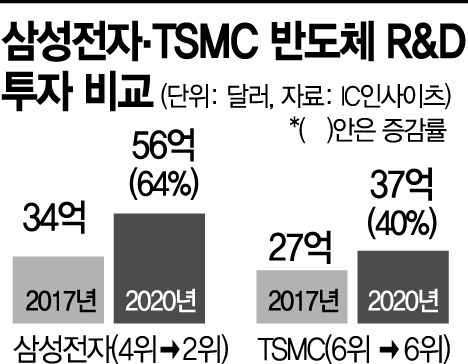
The reason Samsung Electronics recently significantly increased its R&D investment is to develop advanced logic processes below 5nm in the foundry industry to counter competitor TSMC. Although TSMC holds the top position in the overall foundry market, both companies possess similar technological capabilities in ultra-fine processes below 5nm. As the linewidth (the width of the transistor gate through which electrons move) narrows, smaller and higher-performance semiconductors can be produced. Securing ultra-fine process technology below 5nm beyond the 7nm process requires proactive R&D investment.
To secure future growth through large-scale R&D investment, responsible management by the top executive is essential. Decisions to pour massive funds, exceeding trillions of won, into R&D that may not yield immediate profits have limitations if made solely by management.
Meanwhile, TSMC announced its largest-ever capital expenditure plan this year, ranging from $25 billion to $28 billion (approximately 27 trillion to 31 trillion KRW), continuing its expansion strategy. Most of the capital investment will focus on ultra-fine processes below 5nm. Because of this, concerns arise that Samsung Electronics, seeking future growth in the foundry ultra-fine process market, may miss the appropriate investment timing and fall behind in the market.
An industry insider said, "Global semiconductor companies are continuing aggressive R&D and capital investment strategies, so Samsung could suffer significant damage from even a single missed opportunity," adding, "TSMC's announcement of a record investment plan this year is seen as a determination to secure a clear technological advantage over Samsung."
Meanwhile, global semiconductor industry R&D investment last year reached $68.4 billion (75.18 trillion KRW), a 5% increase from the previous year, setting a new record. IC Insights forecasts that global semiconductor industry R&D investment will grow at an average annual rate of 5.8% from this year through 2025, reaching $89.3 billion (98.15 trillion KRW).
© The Asia Business Daily(www.asiae.co.kr). All rights reserved.
![Clutching a Stolen Dior Bag, Saying "I Hate Being Poor but Real"... The Grotesque Con of a "Human Knockoff" [Slate]](https://cwcontent.asiae.co.kr/asiaresize/183/2026021902243444107_1771435474.jpg)

















