The Proportion of Non-Employed Women, Which Had Decreased Since 2014, Has Increased Since Last Year
Wage, Working Conditions, and COVID-19-Induced Restructuring Make Labor Market Entry Difficult
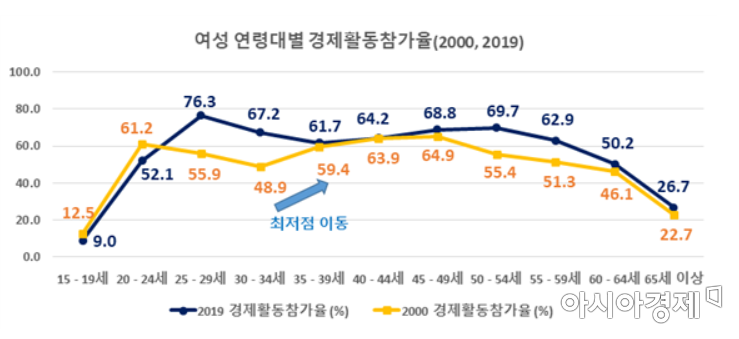
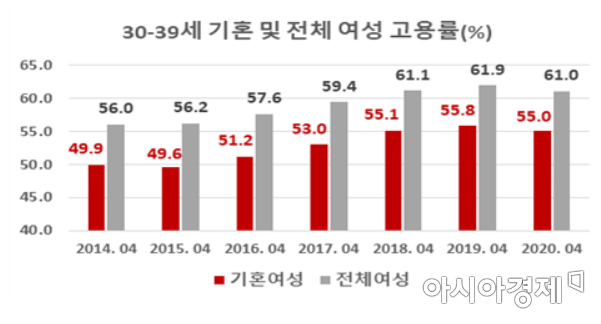
[Asia Economy Reporter Han Jinju] The employment rate of married women in their 30s and 40s is lower than that of all women in the same age group, and career interruptions due to childcare remain a serious issue. To make matters worse, the proportion of married women not working reversed to an upward trend last year due to the impact of the novel coronavirus disease (COVID-19).
On the 21st, the Ministry of Gender Equality and Family will hold the "3rd Expert Meeting on Analysis of Women's Employment Status and Policy Task Development" at 2 p.m. at the Government Seoul Office, together with the Ministry of Employment and Labor and the Korean Women's Development Institute. The analysis of women's employment status utilized the "Status of Career-Interrupted Women" from the regional employment survey by Statistics Korea and the National Statistical Portal.
In the first half of last year, the total number of career-interrupted women was recorded at 1,506,000. The employment rate of married women in their 30s and 40s is lower than that of all women in the same age group. In particular, the proportion of career-interrupted women in their 40s increased to 38.5% compared to the previous year, while the proportion in their 30s decreased by 46.1%. This is because the age at first marriage has increased, raising the age group experiencing career interruptions as well.
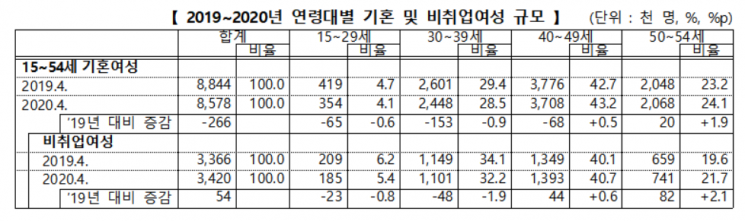 Proportion of Married Women by Age Group and Scale of Employed Women (Source: Ministry of Gender Equality and Family)
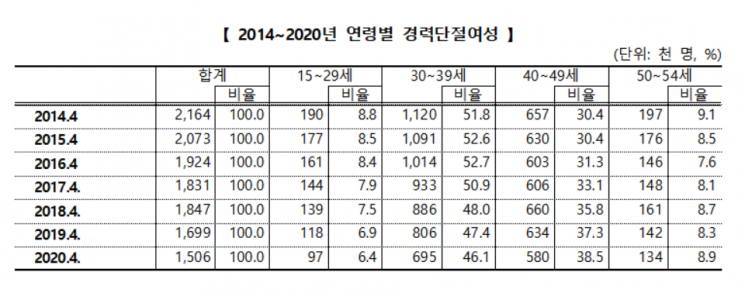 Scale and Proportion of Career-Interrupted Women by Age Group (Source: Ministry of Gender Equality and Family)
One notable point is that the proportion of non-employed married women increased last year due to the impact of COVID-19. Especially, the number of non-employed women aged 40 to 54 surged. Although the proportion of career interruptions among non-employed women decreased, this was due to the shrinking job market beyond the usual reasons for career breaks. The Ministry of Gender Equality and Family explained that the increase in career interruptions or difficulties entering the labor market was caused more by wages, working conditions, and COVID-19-related restructuring than by marriage, pregnancy, childbirth, or childcare.
The main reason for career interruptions was "childcare," accounting for 42.5%, the highest proportion. The share of those citing "childcare" rose by 13.3 percentage points compared to the previous year, which can also be interpreted as an increased childcare burden due to COVID-19. Following that were marriage (27.5%), pregnancy and childbirth (21.3%), family care (4.6%), and children's education (4.1%). Notably, half of the career interruptions among women in their 30s were due to "childcare."
The Ministry of Gender Equality and Family stated, "The largest employment rate gap between married and all women is in their 30s, and the significantly high proportion of childcare as a reason for career interruptions in this age group suggests that married women face many career interruption risks due to difficulties in maintaining work-life balance."
The educational level of career-interrupted women has also increased. Last year, the highest proportion of career-interrupted women had a college degree or higher (41.9%), contrasting with 2014 when the highest proportion was high school graduates (40.0%). Employment rates also varied by major, with non-employed women more likely to have majored in humanities and arts. Coupled with the employment shock from COVID-19, the decrease in employed women with arts majors (-150,000) was more pronounced than the overall decrease in married women (-220,000).
Meanwhile, as of the first half of 2020, among women aged 15 to 54 (14,112,000), married women accounted for 60.8% (8,578,000), a figure that has been declining annually since 2014.
The Ministry of Gender Equality and Family plans to expand employment support policies for career-interrupted women and increase institutions and dedicated personnel providing lifecycle career interruption prevention services from pregnancy to return to work for employed women. The National Employment Support System, introduced this year, will increase support for low-income and employment-vulnerable groups, and the Saeil Women's Internship Program will be expanded to 7,777 participants annually.
Kim Kyung-sun, Vice Minister of the Ministry of Gender Equality and Family, said, "This year, we will significantly expand the budget for promoting women's economic activities to strengthen career interruption prevention support projects that help women avoid career breaks in advance. With the introduction of the '3+3 Parental Leave System' and the expansion of parental leave subsidies for small and medium-sized enterprises, we will strive to spread work-life balance and family-friendly culture so that both men and women can actively utilize parental leave."
© The Asia Business Daily(www.asiae.co.kr). All rights reserved.
![Clutching a Stolen Dior Bag, Saying "I Hate Being Poor but Real"... The Grotesque Con of a "Human Knockoff" [Slate]](https://cwcontent.asiae.co.kr/asiaresize/183/2026021902243444107_1771435474.jpg)

















