Ministry of Science and ICT Work Plan
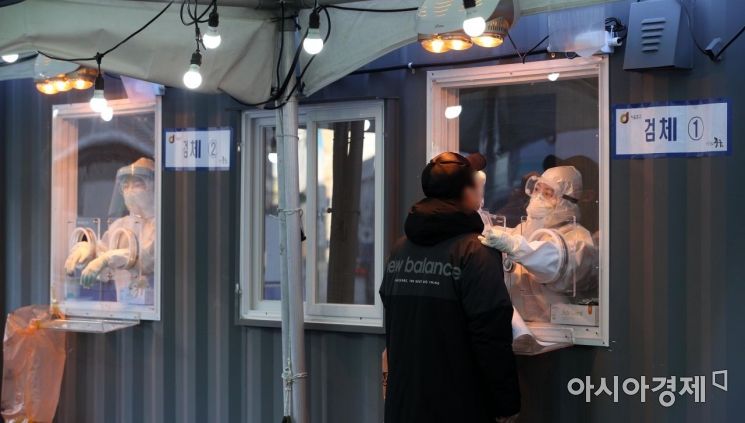 Medical staff are collecting specimens at a temporary screening clinic for COVID-19 set up at Seoul Station Plaza on the 19th. The 20th marks exactly one year since the first confirmed case of COVID-19 in South Korea. Photo by Hyunmin Kim kimhyun81@
[Asia Economy Reporter Seulgina Jo] In March, the world's first semiconductor diagnostic kit capable of determining COVID-19 infection status within 3 minutes using only saliva will be commercialized. A ‘modular negative pressure isolation room’ that can resolve the shortage of hospital beds caused by the spread of COVID-19 will be introduced within this year. It is characterized by the ability to establish four rooms for severe patients and various support facilities in just five days.
On the 20th, the Ministry of Science and ICT announced the ‘Recovery, Inclusion, and Leap Korea 2021’ work plan, which centers on overcoming COVID-19 early and advancing as a leading nation through scientific and technological innovation and the digital new deal.
First, the Ministry plans to end COVID-19 in the shortest time by securing the so-called three sets?rapid diagnostic kits, therapeutics, and vaccines?using only domestic technology. The semiconductor diagnostic kit, which can detect infection within 3 minutes using only saliva, aims for commercialization in March. This is expected to reduce the burden on frontline medical personnel, lower costs, and enable proactive quarantine effects.
Therapeutics developed with domestic technology will also begin field administration within the first half of the year. Among the therapeutic candidates discovered through drug repositioning, promising drugs include Nafamostat and Camostat. Separately from importing already released overseas vaccines, the Ministry has decided to fully develop domestic vaccines. To strengthen capabilities against novel and variant viruses, the Korea Virus Research Institute will also be established.
Modular negative pressure isolation rooms, designed like toy Lego blocks to shorten movement and installation time, are also nearing commercialization. The modular negative pressure isolation room, developed first in the world by KAIST, is expected to contribute to resolving the shortage of rooms for severe patients in the future. Negative pressure isolation rooms refer to special isolation rooms configured to prevent pathogens inside the hospital from spreading outside. When not in use, they can be stored with weight and volume reduced by more than 70%, and the time required to assemble the basic configuration is only 15 minutes. Minister Choi Ki-young of the Ministry of Science and ICT visited the Korea Institute of Radiological & Medical Sciences immediately after the work report to inspect the modular negative pressure ward currently in pilot operation.
Additionally, this year’s work plan includes building 150 types of AI training data to enable more people to utilize diverse data and developing core technologies to secure leadership in 6G. Based on the so-called D.N.A (Digital, Network, AI), it aims to accelerate digital transformation across the economy and society. The Ministry also set future technological innovation, including achieving ‘carbon neutrality by 2050,’ as a key task.
Minister Choi emphasized, "We will steadily and swiftly carry out key tasks for early COVID-19 recovery, acceleration of digital transformation, scientific and technological innovation, and realization of an inclusive society."
© The Asia Business Daily(www.asiae.co.kr). All rights reserved.
![Clutching a Stolen Dior Bag, Saying "I Hate Being Poor but Real"... The Grotesque Con of a "Human Knockoff" [Slate]](https://cwcontent.asiae.co.kr/asiaresize/183/2026021902243444107_1771435474.jpg)
















