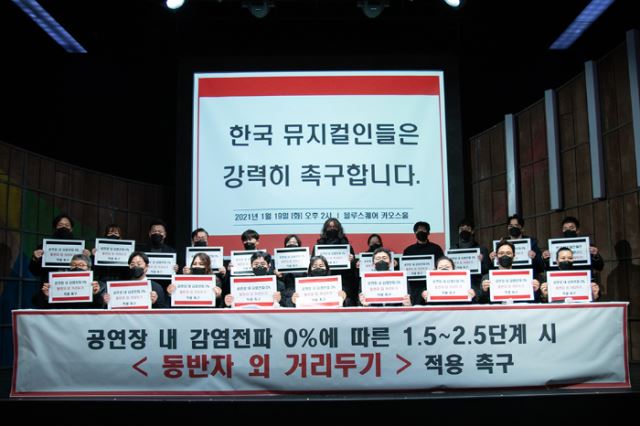
 The Korea Musical Association issued an appeal on the 19th at the Blue Square Chaos Hall in Yongsan-gu, Seoul, urging the application of 'distancing for companions only' within performance venues.
[Asia Economy Reporter Donghyun Choi] Korean musical industry workers have issued an appeal to relax the guideline of 'two seats apart' in performance venues mandated under social distancing level 2.5.
On the 19th, musical artists including the Korea Musical Association released an appeal titled “Adjustment of Social Distancing Guidelines in Performance Venues from Levels 1.5 to 2.5,” urging, "The current standard of spacing seats one or two apart should be revised to apply distancing only between non-companions, reestablishing quarantine rules accordingly."
According to current distancing policies, performance venues must follow seating operation guidelines starting from level 1.5. At this stage, companions may sit together while maintaining one seat apart from other groups. At level 2, a uniform 'one seat apart' rule applies to all seats, including companions. At level 2.5, the 'two seats apart' rule applies to all seats. At level 3, performance venues face closure measures such as 'gathering bans.' Although authorities eased some gathering bans and operational restrictions on multi-use facilities on the 16th, the two-seat spacing rule in performance venues remains, sparking fairness debates. Continuing the two-seat spacing rule inevitably leads to deficits as more performances are staged.
Lee Yuri, Chairperson of the Korea Musical Association, stated, "The musical community has maintained continuous monitoring and a proactive quarantine system under the belief that 'performances must continue,' even amid an unprecedented pandemic." She added, "Despite our utmost efforts, the nationwide spread of COVID-19 intensified from mid-November last year, and with the elevation to social distancing level 2.5, the performance industry has endured a de facto shutdown through a long winter."
Lee also criticized, "Most performance audiences attend with family or acquaintances. They live together, eat together, and use the same transportation to the venue, but once inside, they must sit spaced apart, which is ineffective."
She continued, "In fact, performance venues operate under strict monitoring where everyone wears masks, avoids contact or conversation with others, and faces forward. The Korean performance industry has maintained a 0% COVID-19 transmission rate within venues over the past year," emphasizing this point.
Lee added, "Distancing only between non-companions creates the minimum conditions for performances to proceed, allowing producers to responsibly preserve staff and actors’ wages and sustain performances. We hope for thoughtful decisions regarding government quarantine guidelines," she concluded.
Below is the full text of the appeal.
Appeal from Korean Musical Artists
The performance industry entering 2021 will be remembered as one of the harshest and coldest winters ever. Regardless of field or genre, all workers in the performance industry have faced significant trials amid waves of cancellations and reschedulings. The musical community has maintained continuous monitoring and a proactive quarantine system under the belief that 'performances must continue,' even amid an unprecedented pandemic. However, despite these efforts, the nationwide spread of COVID-19 intensified from mid-November, and with the elevation to social distancing level 2.5, the performance industry has endured a de facto shutdown through a long winter.
Currently, the musical industry is experiencing an unprecedented decline so severe that its end is hard to predict. According to the Korea Performing Arts Integrated System (KOPIS), in December 2020, when the level 2.5 distancing guidelines were implemented, musical genre sales dropped by over 90% compared to December 2019. Accelerated bankruptcies and unemployment have naturally followed. If distancing guidelines continue, the first half of this year will see no improvement.
Of course, predicting COVID-19’s spread is very difficult, and the need for strong government quarantine guidelines is still understood. Therefore, the musical industry has cooperated with government quarantine rules to the fullest extent. Large, medium, and small musical venues and producers have voluntarily unified entrance routes, implemented health questionnaires, temperature checks, mask-wearing, refrained from cheering, prohibited close contact among audience members, and banned contact events, maintaining exemplary quarantine-compliant operations and venue safety.
Agencies, actors, and staff have also accepted pay cuts and sacrifices to sustain the industry. Moreover, audiences visiting venues during these difficult times have not been mere spectators but active participants in completing performances, strictly adhering to quarantine rules. As a result, even while the global musical market was shut down, Korea safely continued performances, with the world-famous musical “The Phantom of the Opera” being the only one performed worldwide, earning recognition as a quarantine model case by global media such as The New York Times and BBC. Additionally, over the past year, the transmission rate of COVID-19 within venues has remained at 0%, with no infection cases linked to performances. This achievement was made possible by venues, producers, actors, staff, and audiences working together.
Despite active cooperation with COVID-19 quarantine guidelines, the musical industry faces a desperate situation where it is difficult to survive due to the prolonged level 2.5 distancing rules. The Korea Musical Association and musical workers deeply feel the need for tailored, pinpoint quarantine policies suited to the performance industry’s characteristics and unite their voices to urge the reestablishment of quarantine rules applying
The guideline best suited to the performance industry’s environment and characteristics is
Most audiences attend performances accompanied by family, lovers, or acquaintances, and the performance experience is recognized as an emotional community beyond mere viewing. They live together, eat together, and use the same transportation to the venue, so the act of spacing seats apart once inside is ineffective, as audiences themselves feel. In fact, venues operate under strict monitoring where there is no contact or conversation with others, everyone wears masks, and all face forward. The Korean performance industry has maintained a 0% COVID-19 transmission rate within venues over the past year. This has become a basic standard for venue operation and proves that venues are not infection sources.
Musicals are performed by more than ten times the number of staff compared to actors on stage. From as few as about 30 to as many as 300 people are mobilized for a single production. Over the past year, countless musical workers have lost jobs due to cancellations and suspensions, and those who have lived by this profession have had to leave the industry for part-time or daily jobs, struggling to make a living.
The musical industry, which accounts for 60% of sales in the Korean performance market, supports the livelihoods of approximately 10,000 performance workers. Like other professional workers, performance industry workers deserve guaranteed rights to livelihood. In the ongoing shutdown situation, sharing pain and enduring hardship within musicals alone cannot prevent accelerated unemployment and bankruptcy.
The Korea Musical Association and Korean musical workers request
All Korean musical workers earnestly request that social distancing guidelines within performance venues from levels 1.5 to 2.5 be adjusted to
We look forward to thoughtful decisions regarding government quarantine guidelines.
January 19, 2020, All Korean Musical Workers
© The Asia Business Daily(www.asiae.co.kr). All rights reserved.
![Clutching a Stolen Dior Bag, Saying "I Hate Being Poor but Real"... The Grotesque Con of a "Human Knockoff" [Slate]](https://cwcontent.asiae.co.kr/asiaresize/183/2026021902243444107_1771435474.jpg)















