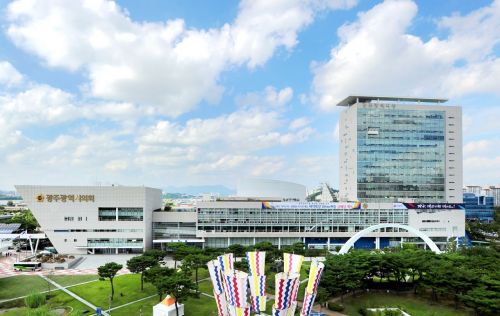
[Asia Economy Honam Reporting Headquarters Reporter Park Seon-gang] Gwangju Metropolitan City has introduced various policies integrating artificial intelligence into administration.
The discovery of the ‘One Institution One AI Policy’ was promoted to move away from face-to-face administration of the industrial society and to enhance citizen convenience, reduce budget, and improve work efficiency by utilizing IoT, big data, and more.
Accordingly, not only the main office but also business sites have prepared AI policies and started implementation.
According to Gwangju City on the 19th, the Planning and Coordination Office is building a ‘Digital Integrated Situation Room’ that collects, integrates, and analyzes data across the city administration to support data-driven decision-making, and is creating a ‘Digital Organization Chart’ that guides visitors to City Hall on department locations, meeting and event information, etc.
Additionally, it is establishing AI-based traffic and air quality big data and building an integrated resident participation system including online resident ordinances and resident voting.
The Job and Economy Office is investing 20 billion KRW by 2025 targeting 100 small and medium-sized manufacturing companies in the area to promote qualitative advancement of smart factories based on AI and data.
In particular, by applying artificial intelligence algorithms, introducing 5G solutions, and distributing affordable 5G terminals, it aims to strengthen the competitiveness of local manufacturing companies and lay the foundation for the transition to 5G and AI smart factories.
The Artificial Intelligence Industry Bureau plans to introduce an AI medical support platform, big data platform, and elderly health management demonstration equipment at autonomous district health centers and Bitgoeul Health Town by the end of the year to provide AI health management services that citizens can experience.
It will also implement projects to build and demonstrate AI-based healthcare platforms at Jeon-dae Hospital, Jo-dae Hospital, and Dong-gu Startup Center.
The Citizen Safety Office is establishing an AI-based safety management system and disaster prediction and response system to actively respond to disasters and strengthen citizen safety.
The Welfare and Health Bureau will pilot AI and IoT-based elderly health management services this year and provide ICT-based emergency safety services for solitary elderly and disabled persons.
The Women and Family Bureau will open an AI-based matchmaking platform for unmarried men and women in July and build an AI platform to improve pregnancy success rates for women of childbearing age and infertile couples, accelerating the creation of a ‘Gwangju that is good for having and raising children.’
The Environment and Ecology Bureau plans to analyze heat waves, fine dust, and other factors based on AI big data to utilize in urban planning and policy decisions.
The Transportation and Construction Bureau will introduce AI smart intersections that control traffic signals in real time based on collected traffic information to improve congestion and develop a taxi demand prediction system to enhance citizen convenience.
The Autonomous Administration Bureau is building a non-face-to-face smart building guidance system platform that allows visitors to City Hall to access various building information using screen touch.
In addition, the following projects are being promoted: ▲Urban Regeneration Bureau’s ‘Housing Information AI Integrated Platform Construction’ ▲Military Airport Relocation Promotion Headquarters’ ‘Military Airport Relocation Project Homepage with Chatbot Communication’ ▲Culture, Tourism and Sports Office’s ‘AI and Content Convergence Creative Lab Construction and Operation’ ▲Youth Policy Officer’s expansion of ‘AI Video Interview Service for Job-Seeking Youth Employment Support’ ▲Fire Safety Headquarters’ ‘AI-based Intelligent 119 Report Reception System Construction’ ▲Civil Servant Training Institute’s ‘Education Operation in Future Technology Fields including AI’ ▲Health and Environment Research Institute’s ‘AI-based COVID-19 Rapid Testing System Construction’ ▲Agricultural Technology Center’s ‘Operation of Control System for Agricultural Big Data Infrastructure’ ▲Waterworks Headquarters’ ‘AI-based Waterworks Big Data Analysis Project’ ▲Comprehensive Construction Headquarters’ ‘Integrated Management of Special Bridge Measurement System and Seismic Accelerometer Measurement System’ ▲Urban Railway Construction Headquarters’ ‘Urban Railway Line 2 AI Power Control System Construction’ ▲Economic Free Zone Authority’s ‘AI-based Investment Proposal Provision’ ▲Work-Family Balance Support Headquarters’ ‘Operation of Vocational Competency Development Education Program for AI-related Talent Cultivation’ ▲City Library’s ‘Collection Expansion Using Big Data’.
Mayor Lee Yong-seop said, “It is important to discover AI policies in administration as we move away from face-to-face and analog administration of the past industrial society to digital and non-face-to-face capabilities,” and added, “AI policies of major offices and business sites should not remain just discoveries but should be continuously revised and supplemented to enhance policy completeness so that they help improve citizen convenience and work efficiency.”
© The Asia Business Daily(www.asiae.co.kr). All rights reserved.
![Clutching a Stolen Dior Bag, Saying "I Hate Being Poor but Real"... The Grotesque Con of a "Human Knockoff" [Slate]](https://cwcontent.asiae.co.kr/asiaresize/183/2026021902243444107_1771435474.jpg)















