Regional Universities' Regular Admission Competition Rate Drops from 4.4% to 2.7% Over 5 Years... Students Don't Come Despite Various Benefits
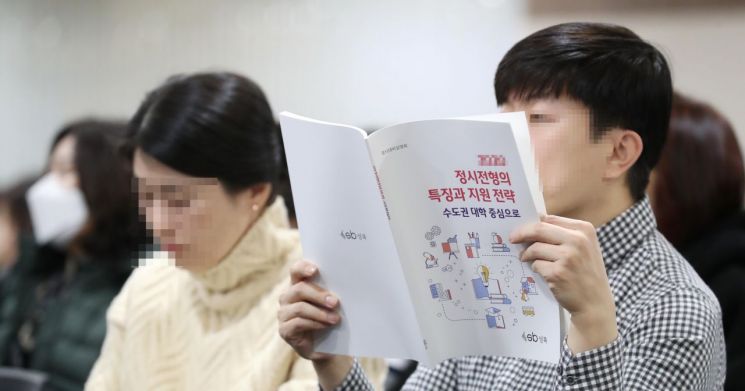 On November 26 last year, at the multipurpose hall of Seongbuk-gu Office in Seoul, examinees and their parents are listening to an admissions expert's explanation at the 2020 Regular Admission Strategy Entrance Exam Briefing. Photo by Moon Honam munonam@
[Asia Economy Yeongnam Reporting Headquarters Reporter Park Saeyan] Regional universities are fighting a 'battle' to fill their quotas. Even with all kinds of incentives, students do not come. The harsh prophecy that universities will disappear in the order of cherry blossoms blooming is becoming a reality.
The average competition rate for regular admissions at regional universities has fallen from 4.4% to 2.7% over the past five years, raising concerns about their survival.
Admissions experts point out that the decline in the school-age population combined with the concentration in the metropolitan area will inevitably lead to the extinction of regional universities.
Universities in the Gyeongnam region also completed regular admissions on the 11th and could not avoid the report card of under-enrollment.
According to Jongno Academy Sky Education, a survey of regular admission competition rates at regional universities over five years showed a decline from 3.9% last year to 2.7% this year.
Among them, for four-year private universities in the Gyeongnam region with a competition rate below 3:1 in regular admissions, Gaya University dropped from 2.3% to 1.8%, Changshin University from 2.3% to 1.9%, Gyeongnam University from 2.5% to 1.3%, and Inje University from 2.6% to 1.3%.
Since applicants can apply up to three times per person in regular admissions, considering the exclusion of multiple applications, a competition rate below 3:1 is practically ‘under-enrollment’.

Given this situation, universities facing survival crises are putting great effort into securing new students. With government policies and the COVID-19 situation, raising tuition fees is out of the question, leaving them in a real dilemma.
Measures such as tuition reductions and scholarship offerings to fill seats and attract external support from the government and others are currently the survival strategies at universities. One university in Busan is offering a 50% tuition reduction for one year to all new students and waiving admission fees for transfer students. Similarly, a university in Changwon plans to provide full scholarships for one year to all new students.
However, these drastic benefits alone are insufficient to attract the attention of prospective students.
A 20-year-old prospective student, A, said, “There are so many extensive benefits offered here and there that it makes it difficult for examinees to decide,” adding, “It’s not possible to choose a university based solely on benefits.”
An admissions official, B, from a university said about under-enrollment, “It is difficult for examinees to decide on regional universities based on simple benefits,” and added, “Policy-wise, the metropolitan universities should reduce the number of students admitted through equal opportunity selection.”
Experts diagnose the causes of the decline in students at regional universities as ▲concentration of universities in the metropolitan area ▲university hierarchy ▲sustainability and competitiveness of regional universities.
Professor Kim Seong-yeol of the Department of Education at Gyeongnam University argued, “The government should push for structural reform, such as uniformly reducing the recruitment quotas of universities nationwide in line with the declining student population.”
He also pointed out, “Efforts should be made to reduce the quality gap by providing various cultural facilities comparable to those in the metropolitan area,” adding, “For that, university and regional development must progress together.” The concentration of cultural facilities in the metropolitan area is also one of the causes.
Some voices suggest that other universities should follow the integration steps like Jinju Science and Technology University and Gyeongsang National University did. However, it is also pointed out that this was possible because it was a merger between national universities.
Regarding this, Professor Kim said, “For the co-prosperity of national and private universities, division of labor is necessary,” diagnosing, “National universities should solidify an education system centered on basic sciences, while private universities should establish an education system focusing on neglected departments as a ‘downsizing’ measure.”
Above all, an admissions expert warned that if new university policies are not implemented, regional universities may become the ‘dead stones’ on the Go board that must die for metropolitan universities.
© The Asia Business Daily(www.asiae.co.kr). All rights reserved.
![Clutching a Stolen Dior Bag, Saying "I Hate Being Poor but Real"... The Grotesque Con of a "Human Knockoff" [Slate]](https://cwcontent.asiae.co.kr/asiaresize/183/2026021902243444107_1771435474.jpg)
















