Decrease in Jeonse and Increase in Monthly Rent in 2 Years
Jeonse Price Surge and Lease Contract Expiration
Increase in Cases Switching to Monthly Rent and Semi-Jeonse
Government's Strong Regulations and Tax Strengthening
Only Increased Burden on Tenants
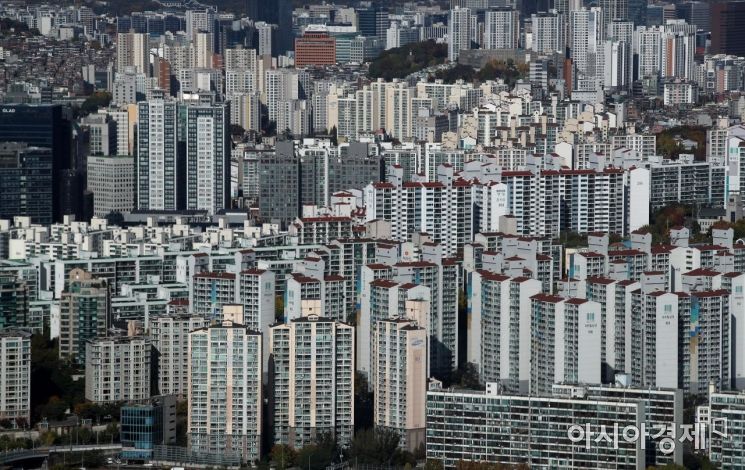
[Asia Economy Reporter Lee Chunhee] Due to the government's successive strengthening of real estate tax policies and the impact of the two lease laws, the number of jeonse (long-term deposit lease) transactions for apartments in Seoul has decreased, while monthly rent transactions such as quasi-jeonse have increased.
According to the Seoul Real Estate Information Plaza on the 19th, in November last year, monthly rent transactions for Seoul apartments amounted to 4,740 cases, accounting for 39.6% of the total lease transactions of 11,979 cases. This was the highest figure of the year. On the other hand, jeonse accounted for 60.4% (7,239 cases), marking the lowest proportion of the year. Although the registration period for December transactions is still ongoing, it is expected to show a similar trend to November.
Among monthly rent transactions, the proportion of quasi-jeonse transactions, where the deposit exceeds 20 years' worth of monthly rent, noticeably increased. Both monthly rent (deposit less than or equal to 12 months of rent) and quasi-monthly rent (deposit between 12 months and 20 years of rent) transactions decreased compared to the previous month, but quasi-jeonse transactions rose from 1,777 cases in October to 2,716 cases in November, increasing by about 1,000 cases in just one month.
This decrease in jeonse and increase in monthly rent is even more pronounced when considering that the typical lease contract period is two years, comparing the lease contract situation from two years ago. In November last year, jeonse transactions were 7,239 cases, down by about 2,400 cases from 9,648 cases in November 2018. Meanwhile, quasi-jeonse transactions increased by about 800 cases from 1,935 to 2,716. After the two-year lease contracts expire, cases of switching from new jeonse contracts to monthly rent or quasi-jeonse are increasing.
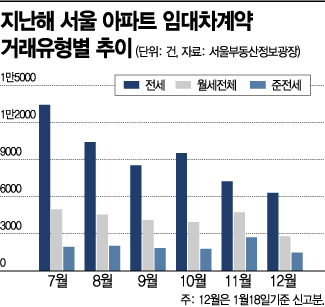
The overall lease transactions in the second half of the year showed a similar trend. In the second half of 2018, jeonse accounted for 71.9% of Seoul apartment lease transactions, while monthly rent accounted for 28.1%. Quasi-jeonse accounted for 11.6%. However, in the second half of last year, the proportion of jeonse decreased to 68.8%, and monthly rent increased to 31.2%. Most of the increase in the monthly rent proportion was due to the rise in quasi-jeonse to 14.6%.
Industry experts analyze that the decrease in jeonse and increase in quasi-jeonse is ultimately a result of the government's strong regulatory measures. As the government has introduced successive tax strengthening policies targeting high-priced homes and multiple homeowners, the increased tax burden is being passed on to tenants.
There is also a view that due to the impact of the two lease laws, not only landlords but also tenants are increasingly choosing quasi-jeonse. A representative from real estate agency A in Daechi-dong, Gangnam-gu, said, "From the tenant's perspective, it is often difficult to prepare several hundred million won immediately for the sharply increased jeonse prices, so there are cases where they ask if part of it can be converted to monthly rent first."
© The Asia Business Daily(www.asiae.co.kr). All rights reserved.
![Clutching a Stolen Dior Bag, Saying "I Hate Being Poor but Real"... The Grotesque Con of a "Human Knockoff" [Slate]](https://cwcontent.asiae.co.kr/asiaresize/183/2026021902243444107_1771435474.jpg)
















