Hanacard Also Enters Installment Finance Market This Year
Intense Competition in Business Diversification Due to Merchant Fee Reduction

[Asia Economy Reporter Ki Ha-young] The competition among credit card companies to dominate the domestic auto installment financing market, valued at 40 trillion won, is expected to be fierce again this year. With Hana Card launching auto installment financing this year, six card companies now offer related services.
According to the industry on the 18th, Hana Card introduced an auto installment financing product as a new business on the 4th. The product is available for purchasing vehicles of all domestic and imported brands and comes in two types: 'Auto Halbu' and 'Auto Loan.' For Auto Halbu, customers can pay for their vehicle purchase with Hana Card and repay in installments for up to 60 months at an annual interest rate as low as 1.0%. Depending on the product, customers can receive cashback of up to 1.2% on the prepayment amount and 1.0% on the loan amount. Auto Loan is a product that can be used even by non-Hana Card members.
With Hana Card entering the auto installment financing market, all full-service card companies now handle auto installment financing products. Five companies?Shinhan, KB Kookmin, Samsung, Woori, and Lotte Card?have already entered the auto installment financing market. Hyundai Card operates its auto installment financing business through its affiliate Hyundai Capital, while BC Card mainly handles payment processing services.
Auto Installment Financing Revenue in Q3 Last Year Up 11.4% Year-on-Year
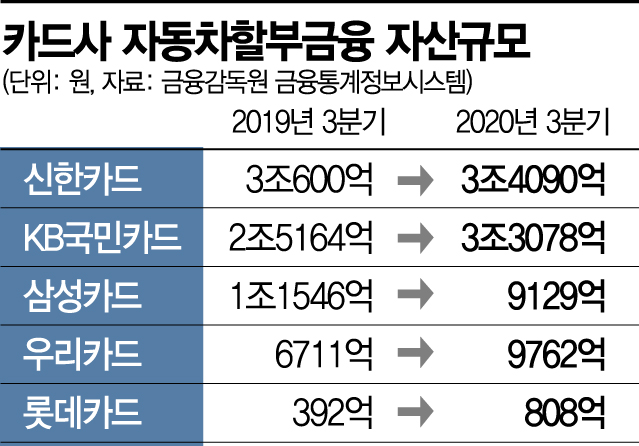
While card fee revenue has deteriorated due to reduced merchant commission rates, auto installment financing revenue is increasing. According to the Financial Supervisory Service's Financial Statistics Information System, as of the cumulative third quarter last year, the auto installment financing revenue of five card companies engaged in the business (Shinhan, Samsung, KB Kookmin, Woori, and Lotte Card) totaled 203.3 billion won, up 11.4% from the previous year. Shinhan Card maintained its lead with 95.562 billion won, followed by KB Kookmin Card with 69.67 billion won. Woori Card recorded 19.148 billion won and Lotte Card 1.407 billion won in revenue, increasing by 37.7% and 55.8% respectively compared to a year earlier. Samsung Card alone saw a 41.1% decrease, recording 17.54 billion won.
Auto installment financing assets are also steadily increasing. During the same period, auto installment financing assets reached 8.6866 trillion won, up 16.7% from 7.4414 trillion won in the same period last year. Shinhan Card held the top spot with assets of 3.409 trillion won, followed by KB Kookmin Card with 3.3078 trillion won. KB Kookmin Card's asset size surged 31.4% year-on-year, narrowing the asset gap between the two companies to 101.2 billion won.
The reason card companies are rushing into the auto installment financing market is due to deteriorating profitability. Business diversification is necessary to compensate for the worsening profitability caused by reduced merchant commission rates. In fact, according to data released by the Financial Supervisory Service, card companies' merchant commission revenue from card payments decreased by 94.5 billion won in the first half of last year alone.
An industry insider said, "In a situation where merchant commission revenue is steadily declining, the auto installment financing market is a market that card companies cannot afford to give up," adding, "The market is expected to expand from new cars to used cars and other areas."
© The Asia Business Daily(www.asiae.co.kr). All rights reserved.
![Clutching a Stolen Dior Bag, Saying "I Hate Being Poor but Real"... The Grotesque Con of a "Human Knockoff" [Slate]](https://cwcontent.asiae.co.kr/asiaresize/183/2026021902243444107_1771435474.jpg)
















