Adjustment of Social Distancing Levels Expected
Based on Trends Over the Next 2-3 Weeks
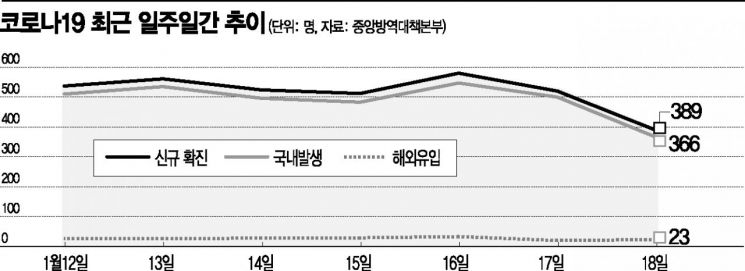
[Asia Economy Reporter Choi Dae-yeol] The newly confirmed cases of the novel coronavirus infection (COVID-19) confirmed on the 18th totaled 389. Among them, 366 cases are presumed to be domestic community infections, and 23 are imported cases. This is the first time in 54 days since late November last year that the daily new domestic cases have fallen below 400.
Although the decrease in diagnostic testing over the weekend had some impact, compared to the peak of the outbreak in late last month, the spread is considered to have entered a stabilization phase, according to health authorities. Some facilities that had been unable to operate or were operating under restrictions according to social distancing levels resumed operations from this day, and the trend of cases over the next 2 to 3 weeks will be crucial in adjusting social distancing levels going forward.
According to the domestic status announced by the Central Disease Control Headquarters as of midnight on the same day, about 38,000 diagnostic tests were conducted the previous day, including at temporary screening clinics. Considering that more than 90,000 tests were conducted daily in the early part of last week, this is less than half. Typically, many testing sites such as screening clinics or temporary testing centers do not operate over the weekend, resulting in a lower number of tests. The ratio of confirmed cases to the number of tests remains at a similar level to usual, and authorities view the situation as still not safe enough to be complacent.
Son Young-rae, head of the Social Strategy Division at the Central Disaster and Safety Countermeasures Headquarters, said at a briefing the previous day, "There is always a risk of the outbreak resurging," adding, "If no cluster infections occur at the multi-use facilities reopening this time, more livelihood facilities can expand operations based on the situation thereafter."
The key indicator used in assessing COVID-19 risk is the daily average number of newly confirmed domestic cases, which was 491 for the recent week (12th to 18th). Although this is less than half compared to over 1,000 cases in late last month, the current level still corresponds to social distancing level 2.5, so authorities are concerned about the possibility of the spread intensifying again after adjusting prevention measures. Although ‘pinpoint quarantine’ measures are applied where necessary based on the outbreak pattern, there is a risk that this could send a signal of relaxation to the general public.
According to authorities, mobility steadily decreased as social distancing levels were raised consecutively from mid-November last year, but it turned to an increasing trend last week. While weather and other factors may have influenced this, it is interpreted that fatigue from the prolonged measures over two months has reached its limit. As the number of cases has decreased and tension has eased, there is a greater possibility that mobility, i.e., contact among citizens, will increase. Considering that recent COVID-19 infections have increased sporadically through individual contact rather than cluster infections at specific facilities, this is a negative sign.
Although treatment drugs are expected to be available for some patients starting next month and vaccination is likely to begin, experts warn that these factors could loosen vigilance in prevention efforts. Prime Minister Chung Sye-kyun praised Celltrion’s antibody treatment, currently under review by the Ministry of Food and Drug Safety, as a "reliable ally," and expectations are high within and outside the government, but the treatment is limited to some patients and has not shown effects in reducing fatality rates or saving lives.
Vaccination will also begin targeting some groups such as medical personnel, but herd immunity is still nearly a year away, so basic measures such as mask-wearing and social distancing are likely to continue for at least several months. Professor Kim Woo-joo of the Infectious Diseases Department at Korea University Guro Hospital said, "(To achieve herd immunity by the end of the year) about 4 million people need to be vaccinated monthly, or about 200,000 people daily, and considering two doses, about 400,000 doses per day are required. Maintaining this for nine months is not an easy task," adding, "We must look at this realistically, considering possible suspension of vaccinations due to side effects and uncertainties in supply."
© The Asia Business Daily(www.asiae.co.kr). All rights reserved.
![Clutching a Stolen Dior Bag, Saying "I Hate Being Poor but Real"... The Grotesque Con of a "Human Knockoff" [Slate]](https://cwcontent.asiae.co.kr/asiaresize/183/2026021902243444107_1771435474.jpg)















