Real Estate Frenzy Sweeps Nationwide, Housing Prices Rise
Apgujeong-dong Average Transaction Price Approaches 3 Billion KRW
Number of Areas Exceeding 1 Billion KRW Surges to Over 100
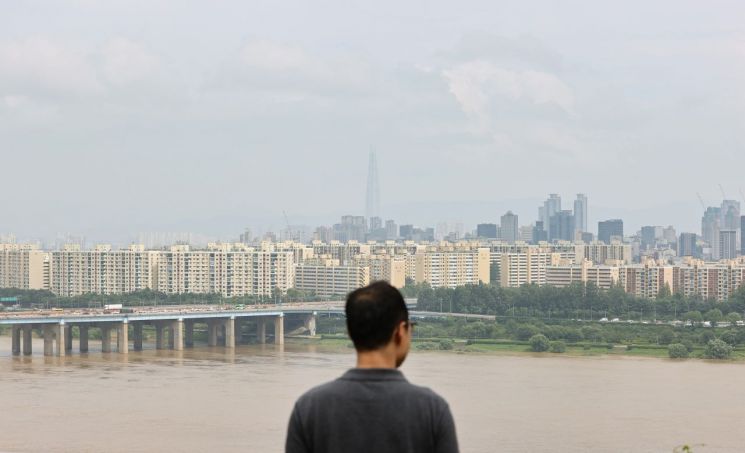
[Asia Economy Reporter Onyu Lim] It has been revealed that the average transaction price of apartments in Apgujeong-dong, Seoul, which experienced a nationwide real estate frenzy last year, nearly reached 3 billion KRW. Following the implementation of the new Lease Protection Act, the push-up effect of jeonse prices on sale prices and the panic buying by the 2030 generation caused the average price to exceed 1 billion KRW in over 100 areas. In the upper ranks of apartment prices, the traditional dominance of the Gangnam 3 districts?Gangnam, Seocho, and Songpa?was completely broken, with Gangnam, Seocho, Yongsan, and Gwacheon consolidating their positions.
Apgujeong-dong ranks first nationwide in housing prices... Areas over 1 billion KRW increased from 34 in 2017 to 113 last year
On the 18th, Zigbang analyzed 805,183 apartment sales transactions nationwide last year and found that Apgujeong-dong in Gangnam-gu, Seoul, recorded an average transaction price of approximately 2.99 billion KRW, ranking first nationwide.
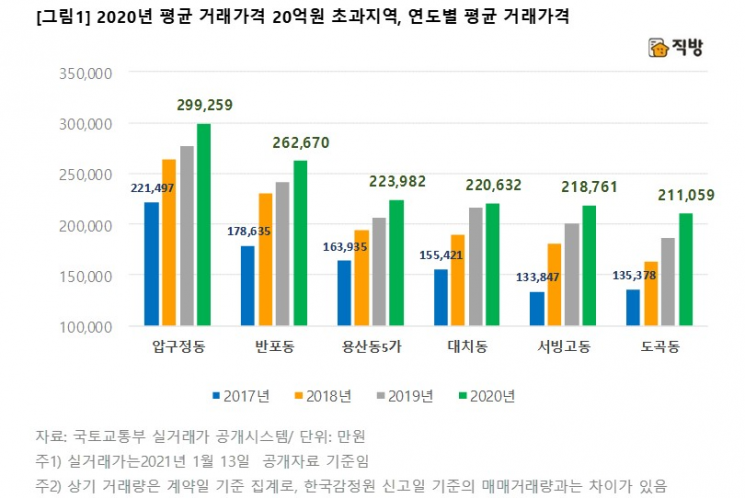
Areas with average transaction prices exceeding 2 billion KRW included not only Apgujeong-dong but also Banpo-dong in Seocho-gu, Yongsan-dong 5-ga in Yongsan-gu, Daechi-dong in Gangnam-gu, Seobinggo-dong in Yongsan-gu, Dogok-dong in Gangnam-gu, and Jamwon-dong in Seocho-gu. While there was only one such area, Apgujeong-dong, in 2017, the number expanded to seven last year. Ham Young-jin, head of Zigbang Big Data Lab, explained, "The transaction prices in Yongsan-dong 5-ga (Park Tower) and Seobinggo-dong (Shindonga) were heavily influenced by specific complexes, and in Daechi-dong and Dogok-dong, prices were high across both complexes awaiting reconstruction such as Eunma and Dogok Rexle, and completed complexes like Raemian Daechi Palace."
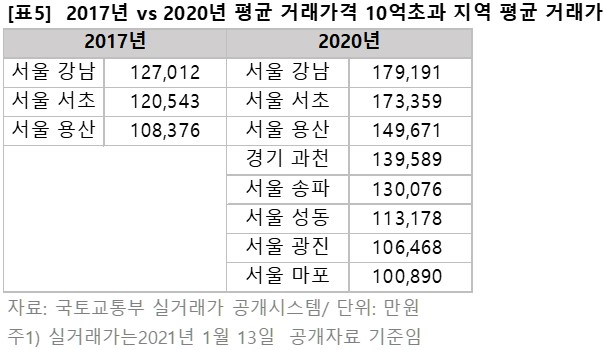
The number of areas with average transaction prices exceeding 1 billion KRW also increased more than threefold from 34 in 2017 to 113 last year. In particular, Seoul saw a sharp rise from 32 to 97 areas. Outside Seoul, the number of areas exceeding 1 billion KRW rose from 2 to 16 during the same period. Notably, the distribution of apartments priced over 1 billion KRW, which had been limited to areas like Gwacheon and Pangyo, expanded last year to include Bundang's old town, Wirye, Gwangmyeong Station area, and Gwanggyo. In non-metropolitan areas, only Suseong-dong 3-ga in Suseong-gu, Daegu, was included.
"Gangnam 3 districts of Gangnam, Seocho, Songpa broken; Gangnam, Seocho, Yongsan + Gwacheon consolidate"
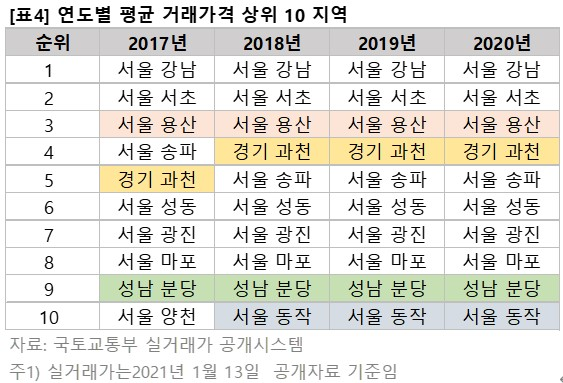
Lab head Ham said, "Gangnam, Seocho, and Songpa have long been called the Gangnam 3 districts, leading the apartment market and being highly preferred by investors and actual buyers, but now we need to consider a different combination." The reason is that when looking at the average transaction prices by 'districts and counties' nationwide since the real estate prices entered a rapid rise phase in 2017, a completely different picture emerges.
Gangnam and Seocho hold the top two spots firmly, but Yongsan has taken third place instead of Songpa, and Gwacheon newly entered fourth place. Songpa ranked fifth. In Yongsan, the conversion of Hannam The Hill to sale has pushed it to the top of the transaction price rankings, and with Nine One Hannam's conversion scheduled this year, it may threaten the rankings of Gangnam and Seocho. Lab head Ham analyzed, "Gwacheon broke the traditional Gangnam 3 districts by leading transaction prices with existing reconstruction complexes and those about to be occupied."
Excluding Seoul and Gwacheon, Bundang ranked ninth, embodying the saying 'Bundang under heaven,' and Dongjak, where Heukseok New Town?a rising upscale residential area known as 'Seobampo'?is located, surpassed Yangcheon, which includes Mok-dong, to enter the top 10.
Mapo, Gwangjin, Seongdong join the 1 billion KRW club; Suyeong, Haeundae, Suseong threaten Seoul's position
Excluding the traditional affluent Gangnam 3 districts and Yongsan, autonomous districts north of the Han River have seen their average transaction prices exceed 1 billion KRW for the first time. The protagonists are Mapo-gu, Gwangjin-gu, and Seongdong-gu. In Mapo and Seongdong, newly supplied apartment complexes through redevelopment projects have become landmark complexes within the area, driving prices. Gwangjin-gu succeeded in entering the 1 billion KRW club due to steady actual demand centered around excellent school districts in Gwangjang-dong and ongoing reconstruction.
Meanwhile, the area with the lowest average transaction price in Seoul this year was Dobong-gu, recording approximately 455 million KRW. Outside Seoul, 15 areas recorded higher transaction prices, including Gwacheon, Bundang, Hanam, Gwangmyeong, and Yongin?regions that showed significant price increases over the year. Gwacheon and Jungwon-gu in Seongnam are actively undergoing redevelopment projects, while Hanam and Sujeong-gu in Seongnam are areas where land development such as Wirye New Town has taken place. Bundang in Seongnam and Yeongtong in Suwon host second-generation new towns like Pangyo and Gwanggyo, and Suji in Yongin is leading price increases with new constructions near Seongbok Station and remodeling projects in Suji 1 and 2 districts.
Outside the metropolitan area, Suyeong-gu and Haeundae-gu in Busan, and Suseong-gu and Jung-gu in Daegu, recorded higher transaction prices than Dobong-gu in Seoul. Suyeong-gu, home to Namcheon Samik Beach, which recorded a record-breaking rise last year amid high reconstruction expectations, and Haeundae-gu, where the luxury residential complex LCT is located, led the price increases, followed by Daegu's Suseong-gu centered on Suseong-dong, Dusan-dong, and Beomeo-dong.
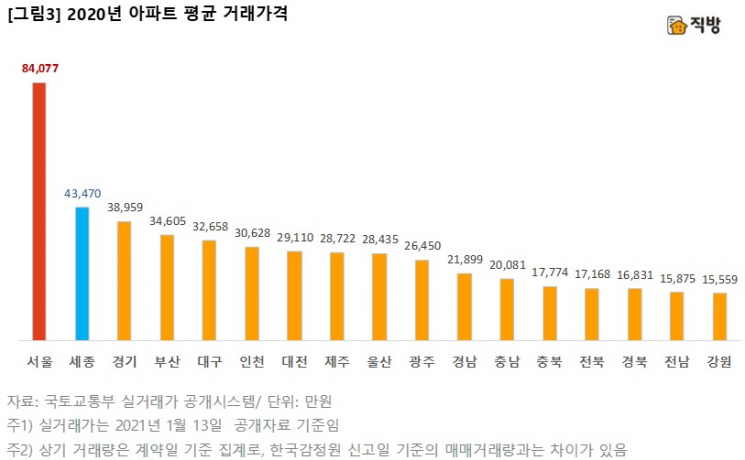
Seoul averages 840 million KRW, Sejong City pricier than Gyeonggi at 430 million KRW
Looking at the average apartment transaction prices by city and province this year, Seoul stands at 840 million KRW, showing a significant gap from other cities and provinces and occupying the highest position. It is followed by Sejong (430 million KRW), Gyeonggi (380 million KRW), Busan (340 million KRW), and Daegu (320 million KRW). Despite being designated a speculative area and subjected to all regulations since the 8.2 measures in 2017, when real estate regulations began in earnest, Sejong City became the second most expensive city after Seoul. Metropolitan cities such as Busan and Daegu ranked higher than Incheon, which is part of the metropolitan area.
Formed an unprecedented transaction market, but continuation through 2021 is uncertain
Lab head Ham forecasted, "Although the apartment market had a record-breaking year with average transaction prices exceeding 1 billion KRW in most areas of Seoul and major metropolitan cities, it seems difficult to continue this upward trend this year."
While prices surged due to demand exceeding supply, last year's large volume of transactions and absorption of actual demand suggest that transaction volume may decrease somewhat. For prices to rise further, investors, another type of demand, need to be attracted to the market, but there are many restrictions such as acquisition tax surcharges, loan limits, and holding taxes on previously owned homes that make it difficult for investors to enter. Lab head Ham predicted, "With the upcoming launch of the Real Estate Transaction Analysis Institute this year, it will be difficult for transactions with unclear funding sources or disguised gift forms to enter the market."
Areas traditionally preferred, such as the Gangnam region and those actively undergoing redevelopment projects, are likely to maintain a firm upward trend by absorbing actual demand, but areas that rode the market's rising sentiment without clear upward factors remain open to correction at any time.
© The Asia Business Daily(www.asiae.co.kr). All rights reserved.
![Clutching a Stolen Dior Bag, Saying "I Hate Being Poor but Real"... The Grotesque Con of a "Human Knockoff" [Slate]](https://cwcontent.asiae.co.kr/asiaresize/183/2026021902243444107_1771435474.jpg)

















