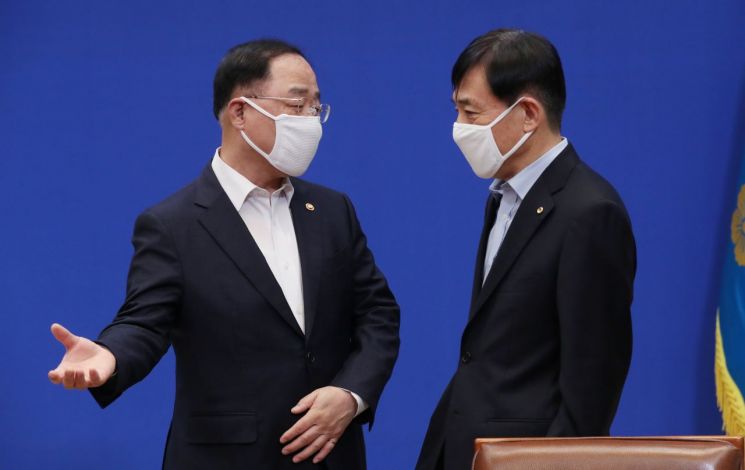
 Deputy Prime Minister and Minister of Economy and Finance Hong Nam-ki (left) and Bank of Korea Governor Lee Ju-yeol (right) [Image source=Yonhap News]
[Asia Economy Reporter Eunbyeol Kim] Economic leaders have consecutively voiced warnings over concerns of overheating in the stock market. The KOSPI index has been rising sharply, fueled by the largest liquidity ever released, with particular worries about 'debt investment' where investors borrow money to invest.
Lee Ju-yeol, Governor of the Bank of Korea, after maintaining the base interest rate at around 0.50% annually on the 15th, stated at a press conference, "The recent pace of stock price increases is significantly faster than in the past," adding, "The rise in asset prices is somewhat rapid compared to the real economy and income conditions, and borrowing has increased substantially in the process. Expansion of investment based on excessive leverage could cause losses at a level that investors would find difficult to bear if an unexpected shock leads to price adjustments, which is a cause for concern."
The Governor further said, "It is difficult to judge the recent sharp rise in the KOSPI as a bubble, but looking at stock price trends and indicators, it is true that the recent pace of increase is significantly faster than before," adding, "If it accelerates too much, even a small shock can cause instability." Such small shocks could be sudden changes in major countries' monetary policies, geopolitical risks, or vaccine supply disruptions, which could lead market participants to change their expectations and cause stock prices to adjust.
He also added, "Investment is a matter of investor choice, but investments made with so-called high leverage are always closely monitored, and investors should always keep such possibilities in mind."
Deputy Prime Minister and Minister of Economy and Finance Hong Nam-ki also mentioned the possibility of negative shocks appearing in the rapidly rising stock market in a similar context.
On the 10th, Deputy Prime Minister Hong said, "If the synchronicity between the real economy and financial markets weakens, there could be some negative shocks ahead." Although the KOSPI index continues its upward trend, the real economy is still affected by the aftermath of the novel coronavirus disease (COVID-19), causing serious imbalance. He stated, "We need to be vigilant about this aspect," and added, "The government will also closely review and respond accordingly."
Financial Services Commission Chairman Eun Sung-soo also commented on the recent stock prices, saying, "Anxiety and expectations are intersecting," emphasizing, "Investors should invest within their own investment capacity based on accurate analysis of corporate earnings." At a weekly work meeting on the 8th, Chairman Eun attributed the KOSPI market's performance largely to the recovery of our economy and corporate earnings, while stressing the need for sound individual investment.
He said, "Above all, it is important to invest within one's own investment capacity based on accurate analysis of corporate earnings," adding, "We will strive to establish the investment principle that investment is made under one's own responsibility and to foster a mature investment culture."
© The Asia Business Daily(www.asiae.co.kr). All rights reserved.
![Clutching a Stolen Dior Bag, Saying "I Hate Being Poor but Real"... The Grotesque Con of a "Human Knockoff" [Slate]](https://cwcontent.asiae.co.kr/asiaresize/183/2026021902243444107_1771435474.jpg)















