[Asia Economy Reporter Kim Hyewon] As discussions on the introduction of a profit-sharing system gain momentum mainly within the ruling party, the government and business circles have called for cautious consideration, arguing that it is an anti-market and unconstitutional act that infringes on property rights.
Although Lee Nak-yeon, leader of the Democratic Party of Korea, has emphasized 'voluntary participation' by the private sector in response to opposing public opinion, there are initial criticisms that it is effectively coercive since it is difficult for private companies to refuse President Moon Jae-in's pledge. Moreover, even if the controversy over unconstitutionality is avoided by citing voluntariness, it seems difficult to escape criticism of being a 'government-controlled donation.'
"Infringement of property rights, breach of trust, unclear profit calculation" ? a minefield in many areas
The so-called 'COVID-19 profit-sharing system,' justified as a means to resolve polarization caused by the COVID-19 pandemic, is generally viewed by the business community as potentially causing serious side effects in future corporate management.
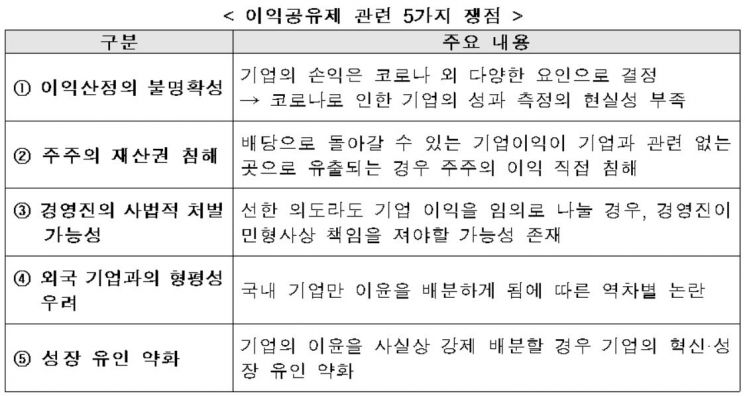
The Federation of Korean Industries (FKI) stated in its 'Five Issues of the Profit-Sharing System' report on the 17th that the profit-sharing system faces five key issues: ▲unclear profit calculation ▲infringement on shareholder equity ▲possibility of judicial punishment for management ▲fairness with foreign companies ▲weakening of growth incentives.
The justification for the COVID-19 profit-sharing system starts from the assumption that profit increases due to COVID-19 are clear. However, it is practically impossible to define the corporate performance caused by COVID-19. There is ambiguity regarding the scope of companies benefiting from COVID-19 and the calculation of profits and losses due to COVID-19.
This is because corporate profits and losses are determined by various factors beyond the COVID-19 situation, such as the global economy, product competitiveness, marketing capabilities, market trend changes, business conditions, and exchange rates. It is difficult to judge whether a company's profits are due to COVID-19 or other factors. Even if there is a correlation with COVID-19, it is even more difficult to determine the extent. A business official lamented, "Even for companies benefiting from COVID-19, it is hard to accept the demand to share profits simply based on environmental factors when the results are due to voluntary cost reductions, productivity improvements, and marketing efforts."
Currently, the targets for profit-sharing include large semiconductor and home appliance companies, as well as platform and non-face-to-face companies such as Naver, Kakao, and Baedal Minjok. The FKI cited the electronics sector as an example, stating that if these companies had not made prior investments in facilities and research and development (R&D) to prepare for the future, they would have been eliminated from competition rather than benefiting from COVID-19. In fact, leading domestic IT companies maintain a high growth rate in R&D investment despite declining sales. The increase in online platform sales cannot be explained without considering the distribution trend toward online shopping before the COVID-19 outbreak. This is why it is considered inappropriate to discuss only the COVID-19 special situation.
Although specific measures have not yet been proposed, there are growing voices criticizing the system as anti-market and infringing on the property rights of companies and shareholders. The performance-sharing system, widely implemented by large companies based on the Win-Win Cooperation Act, is a system that shares results from joint cooperation between large companies and partner companies, such as new product development, productivity improvement, and cost reduction. In contrast, the current profit-sharing system is a concept of sharing the profits of large companies, non-face-to-face, and platform companies benefiting from COVID-19 with small and medium-sized enterprises and small business owners who are suffering losses.
In a capitalist society, shareholders are the claimants of residual income generated from corporate activities, meaning they can possess net profits remaining after paying fair compensation for the inputs necessary for production. The FKI pointed out, "If part of the corporate profits that could be returned as dividends goes to unrelated companies or small business owners, it directly infringes on shareholder interests."
Even for companies benefiting from COVID-19, the entity generating profits is the company, and considering that shareholders are the beneficiaries of those profits, sharing profits with COVID-19-affected companies unrelated to the profit-generating companies constitutes an infringement of property rights. Recently, with the introduction of multiple derivative lawsuits and strengthening of minority shareholder rights, which make corporate management more difficult, there are concerns that the risk of lawsuits against companies may increase further.
Even with good intentions, arbitrarily dividing corporate profits could place management in situations where they bear civil and criminal liabilities. In fact, Supreme Court precedents state that when a director resolves to make a donation, failure to sufficiently review all conditions such as the nature of the donation, the company's purpose and public interest impact, the amount's appropriateness, and the relationship between the company and the donation recipient constitutes a breach of fiduciary duty.
'What is the profit-sharing system'... Opposition not only from business circles but also within the government
"It is worth discussing various ways in our society for sectors or groups that gain significant profits from COVID-19 to contribute some of their profits to help those who suffer greater damage."
The profit-sharing system, proposed by Lee Nak-yeon, leader of the Democratic Party of Korea, on the 11th, mainly suggests introducing a profit-sharing system centered on some companies that have enjoyed COVID-19 benefits. The purpose is to resolve polarization caused by increasing social inequality between sectors or groups due to COVID-19 and to achieve social and economic integration. The Democratic Party promptly launched a 'COVID-19 Inequality Resolution Task Force (TF)' and is pushing policy drives. As political circles showed signs of politicization, Lee requested on the 15th, "Lawmakers from both ruling and opposition parties, including members of the People Power Party, have submitted bills related to the profit-sharing system to the National Assembly. I ask the relevant standing committees to promptly review these bills."
When proposing the COVID-19 profit-sharing system, Lee emphasized three principles: voluntary participation by the private sector, the government as a sponsor, and platform-centered approaches. If the private sector acts voluntarily, the government will provide incentives based on autonomous win-win cooperation results. There is also a plan to create a social fund based on large corporations' resources to create social jobs.
However, the ruling party's plan to induce voluntary participation is being interpreted as pressure to reduce commissions on some platform companies such as Baedal Minjok. The idea of creating a social fund based on large corporations' resources is also perceived by large companies as coercion to donate.
Voluntary participation is seen as merely a means to avoid unconstitutionality but is effectively forcing donations, according to some voices. The Korea Industrial Federation Forum stated, "The COVID-19 profit-sharing system shifts the government's role of supporting affected sectors to companies and is highly likely to be unconstitutional," recommending its withdrawal.
Prime Minister Chung Sye-kyun has shown a somewhat cautious attitude toward the profit-sharing system. On the 14th, appearing on TBS Radio's 'Kim Eo-jun's News Factory,' when asked about the spirit of the profit-sharing system, he drew a line by saying, "I do not use that term." He added, "I actively support the spirit of coexistence between large, medium, and small enterprises, and between suppliers and consumers, but institutionalizing something should be done only after a national consensus is reached. Otherwise, it could become another source of conflict."
Profit-sharing system reveals limits after repeated failures... Business circles say "Reduction in investment and employment resources"
From the business perspective, the profit-sharing system is like an "ever-burning ember." It has repeatedly reappeared with debates on wealth taxation every time the administration changes. The system has been renamed several times?performance-sharing system in 2004, excess profit-sharing system in 2011, cooperative profit distribution system in 2012, and cooperative profit-sharing system in 2018?but the core idea of sharing excess profits of large companies remains the same. Most attempts have failed to establish or stabilize the system.
There are many disagreements even within central government ministries regarding the profit-sharing system. One ministry, when reviewing the cooperative profit-sharing system currently stalled at the legislative stage, took a conservative stance that it could only be introduced when limited to cash profits from specific project units with prior agreements. It also expressed opposition to a system targeting the entire operating profit of large companies.
The business community views the profit-sharing system as potentially weakening companies' profit-seeking and innovation incentives. The effectively compulsory profit recovery method dampens companies' motivation to pursue profits. American economist Ludwig von Mises criticized the profit-sharing system in his book "Socialism" as a socialist system that reduces the efficiency of the market economy.
There is also a risk of reverse discrimination against foreign companies. The current COVID-19 profit-sharing system is likely to exclude foreign companies such as YouTube, a video platform, and Netflix, a leader in online video services (OTT), applying only to domestic companies. This is to avoid potential international disputes. Domestic industries have already been voluntarily engaging in win-win activities with small business owners suffering from COVID-19 difficulties, such as returning advertising fees, reducing commissions, and providing technical support. If the profit-sharing system is additionally promoted, it could act like a quasi-tax limited to domestic companies, creating an uneven playing field with foreign companies. Domestic companies would inevitably be at a disadvantage in competition with foreign companies that already have overwhelming market shares.
The FKI pointed out, "Existing voluntary win-win activities may be weakened or traded off for uniform methods demanded by the political circles." An executive from a large company said, "I understand that the COVID-19 profit-sharing system, currently at the center of controversy, is being promoted through two proposals: incentives linked to reducing platform commissions and creating a fund based on large corporations' resources. However, it effectively acts as coercion, potentially reducing resources available for investment and employment. Measuring profits generated through cooperation between companies itself lacks practicality," he said.
© The Asia Business Daily(www.asiae.co.kr). All rights reserved.
![Clutching a Stolen Dior Bag, Saying "I Hate Being Poor but Real"... The Grotesque Con of a "Human Knockoff" [Slate]](https://cwcontent.asiae.co.kr/asiaresize/183/2026021902243444107_1771435474.jpg)
















