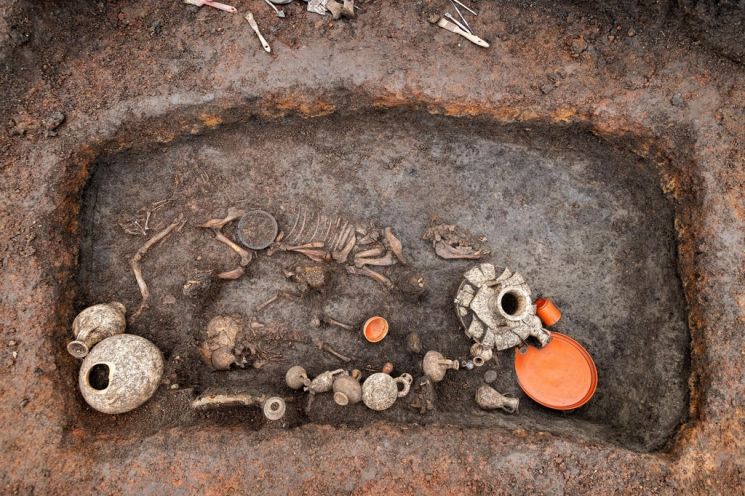
 A child's tomb from the early 1st century excavated at an airport construction site near Clermont-Ferrand in central France. Photo by Yonhap News
[Asia Economy Reporter Nana] In the central region of France, the remains of a wealthy child and a pet dog from the Roman Empire period who died 2,000 years ago, along with numerous accessories, have been discovered together.
The French National Institute for Preventive Archaeological Research (INRAP) announced on the 14th (local time) that skeletal remains believed to be of a child about one year old were unearthed at the airport construction site in Ornay near Clermont-Ferrand in central France.
The French archaeological community regards the buried remains excavated this time as the oldest and most significant case of child remains found in France.
INRAP stated, "The unearthed remains and artifacts are very special in both quantity and quality," and added, "Even compared to other excavation cases in this region and period, this is a very rare case."
The remains were presumed to have been inside a wooden coffin measuring 80 cm in length, placed within a rectangular grave 2 meters wide and 1 meter long.
According to INRAP, the owner of these remains is estimated to be a child from a wealthy family living in this area during the early 1st century Iron Age. It appears that the family buried the child, who died at about one year old, along with a copper necklace and a dog with a bell, toys, and funeral food.
More than 20 items, including small terracotta vases and glass bottles, as well as partial bones of chicken and pig believed to be food offerings, were found in the grave. The terracotta vases reportedly contained types of oil, beverages, and medicines.
Notably, the skeletal remains of a dog, presumed to be a pet, were also discovered in the grave. The dog’s neck had a copper necklace and a small bell attached.
Near the skull of the deceased child, a baby tooth believed to belong to the child’s older sibling was also found. Additionally, artifacts resembling toys such as hoops were excavated.
The early 1st century, when the buried child lived, corresponds to the Gallo-Roman period, during which the Gauls (Galli) living in what is now France were under Roman Empire rule.
During the Gallo-Roman period, adult Gauls typically cremated their remains after death, but it was customary to bury children on family private land.
INRAP considers the rarity of these remains and artifacts to be valuable materials for studying the social aspects of the Gallo-Roman era.
© The Asia Business Daily(www.asiae.co.kr). All rights reserved.
![Clutching a Stolen Dior Bag, Saying "I Hate Being Poor but Real"... The Grotesque Con of a "Human Knockoff" [Slate]](https://cwcontent.asiae.co.kr/asiaresize/183/2026021902243444107_1771435474.jpg)















