[Asia Economy Reporter Inho Yoo] The government has announced measures to revitalize public reconstruction, but the market response has been cold.
There are concerns that the impact on the market will not be significant as only standalone apartments are participating, excluding large-scale apartment complexes that hold the key to the success of public reconstruction revitalization.
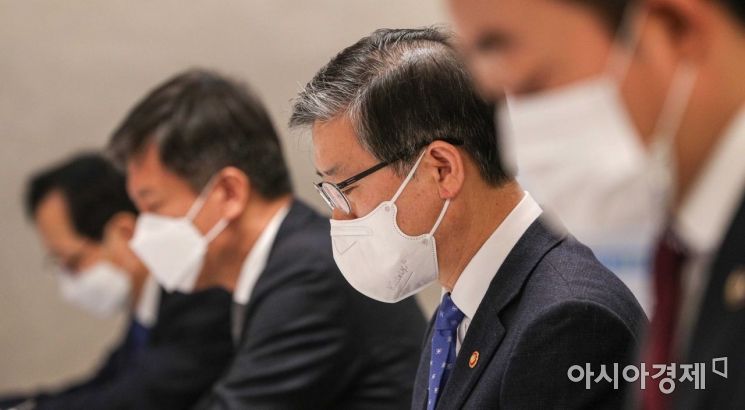 Minister of Land, Infrastructure and Transport Byeon Chang-heum is attending the "13th Real Estate Market Inspection Meeting of Related Ministers" held at the Government Seoul Office in Jongno-gu, Seoul on the 15th. Photo by Kang Jin-hyung aymsdream@
According to the industry on the 16th, there were a total of seven apartment complexes participating in the public reconstruction preliminary consulting announced by the Ministry of Land, Infrastructure and Transport the day before. These include Sillim Geonyeong 1st Complex in Gwanak-gu (492 households), Sanupin Apartment in Guro-gu (342 households), Junggok Apartment in Gwangjin-gu (270 households), Sinbanpo 19th Complex in Seocho-gu (242 households), Shinmi Apartment in Yeongdeungpo-gu (130 households), Mukdong Jangmi in Jungnang-gu (100 households), and Gangbyeon (146 households) and Gangseo (32 households) Apartments in Yongsan-gu.
LH, SH, and the Korea Real Estate Board jointly operate the 'Public Maintenance Integrated Support Center' to promote public reconstruction projects and have conducted preliminary consulting for public reconstruction. Accordingly, they received preliminary consulting applications from associations and others in August last year, with large complexes such as Eonma Apartment in Daechi-dong (4,424 households), Jamsil Jugong 5th Complex in Jamsil-dong (3,930 households), and Cheongnyangni Miju in Cheongnyangni-dong (1,089 households) participating in large numbers.
However, as the announcement of the preliminary consulting results was delayed beyond the scheduled time, all these major large complexes were excluded due to disagreements among residents within the complexes.
It is known that the major large-scale reconstruction associations continue to maintain their stance of non-participation even after the government’s public reconstruction preliminary consulting results were disclosed.
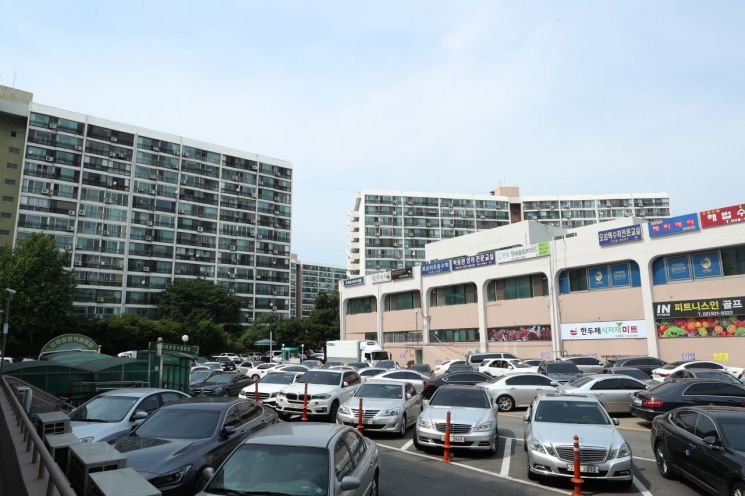
These associations argue that the incentives for public reconstruction proposed by the government, such as floor area ratio relaxation and an increase in the number of households, are not suitable for the reality of complexes pursuing a premium strategy.
Experts also believe that the possibility of these large complexes participating in public reconstruction is low.
Ham Young-jin, head of the Zigbang Big Data Lab, said, "If the area is upgraded to a semi-residential zone through public reconstruction, there is an advantage of increasing the number of general sale households through high-density development and lowering the contribution fee. However, if 50% of the increased floor area ratio is supplied as rental housing, the proportion of public housing in the reconstruction complex could be higher than that in private redevelopment complexes (10-15%), despite being a reconstruction complex. Therefore, there are limits to expanding to large complexes with high profitability."
Accordingly, some point out that groundbreaking incentives are needed to attract participation from medium-to-large complexes, which have a significant supply effect.
© The Asia Business Daily(www.asiae.co.kr). All rights reserved.
![Clutching a Stolen Dior Bag, Saying "I Hate Being Poor but Real"... The Grotesque Con of a "Human Knockoff" [Slate]](https://cwcontent.asiae.co.kr/asiaresize/183/2026021902243444107_1771435474.jpg)
















