5 Banks Opened 18,660 New Accounts by the 13th
Credit Loans Surge Again Amid Demand from Yeongkkeul and Others

[Asia Economy Reporter Kim Hyo-jin] This year, within just two weeks, the number of newly created overdraft accounts at major commercial banks has exceeded 18,600. This is interpreted as a result of a combination of factors, including the surge in the stock market, the rush of individuals trying to jump in before it's too late with 'debt investment (debt-financed investment),' and uncertainties in the loan market.
According to the banking sector on the 15th, from the 1st to the 13th of this month, a total of 18,660 overdraft accounts were newly opened at five major commercial banks: KB Kookmin, Shinhan, Hana, Woori, and NH Nonghyup. Considering it is the beginning of the year, this is considered unusual. Typically, in early January, year-end bonuses are deposited into accounts, leading to an increase in savings and deposit balances rather than loans. Especially given that only eight business days have passed, this is a considerably high figure.
An official from one bank said, "Compared to the same period last year, new account openings have increased by about 30%," adding, "This is an unusual level for the beginning of the year."
Another bank official diagnosed, "Overdraft accounts were usually opened by office workers to prepare emergency living funds or to purchase vehicles, but recently, it seems many are purely for stock investment purposes." He continued, "At least compared to last year, the increased amount suggests that more funds are flowing into the stock market."
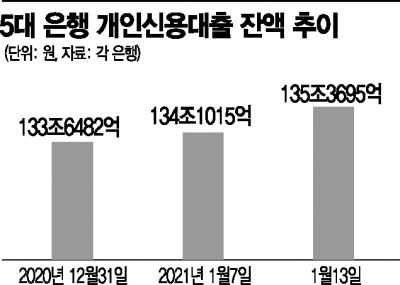
The demand for loans to cope with skyrocketing housing prices and jeonse (long-term deposit lease) prices, combined with stock investment, has also led to a sharp increase in the total personal credit loan balance in the banking sector. As of the 13th, the credit loan balance at the five banks stood at 135.3695 trillion won, up 1.7213 trillion won from the end of December last year (133.6482 trillion won). Simply calculated, this means an increase of about 130 billion won per day.
The financial authorities have been tightening the reins on loans continuously from September last year until the end of the year, aiming to limit the monthly increase in credit loans in the banking sector to a maximum of 2 trillion won.
Due to this policy, the high-intensity regulations, including the suspension of major loan products, caused the credit loan growth rate to sharply decline at the end of the year, but it has rapidly surged again as soon as the new year began and restrictions were loosened.
A financial authority official said, "We are viewing the recent trend seriously," adding, "It is necessary to manage excessive fund inflows into asset markets such as stocks and real estate, focusing on targeted regulations for high-income and high-credit groups."
Demand May Continue to Surge Amid Fears of 'Further Loan Tightening'
The government plans to introduce an 'Advanced Household Debt Management Plan' in the first quarter to establish a screening practice based on repayment ability. Considering the rapid increase in credit loans at the beginning of the year, there are expectations that a stronger-than-anticipated plan will be announced soon.
A bank official predicted, "Since it may soon become difficult to get loans again, demand to borrow as much as possible quickly is likely to continue steadily for the time being."
Meanwhile, according to the 'Financial Market Trends in December 2020' released by the Bank of Korea the day before, the household loan balance at banks as of the end of December last year was 988.8 trillion won, an increase of 100.5 trillion won compared to a year earlier. This is the largest increase since statistics began in 2004.
Among household loans, the balance of mortgage loans (including jeonse loans and other housing-related loans) and other loans (such as credit loans) at the end of last year were 721.9 trillion won and 266 trillion won, respectively, increasing by 68.3 trillion won and 32.4 trillion won over the year.
A Bank of Korea official explained, "The overall increase in housing transactions last year, combined with various living expense demands and funds for stock purchases such as public offering subscription payments, is estimated to have collectively influenced the increase in household loans last year."
© The Asia Business Daily(www.asiae.co.kr). All rights reserved.
![Clutching a Stolen Dior Bag, Saying "I Hate Being Poor but Real"... The Grotesque Con of a "Human Knockoff" [Slate]](https://cwcontent.asiae.co.kr/asiaresize/183/2026021902243444107_1771435474.jpg)
















