Expectations of Economic Stimulus Fund Inflows
Investment on Natural Gas Decline
Increased Investment in Economic-Sensitive Commodities
Silver and Nickel
[Asia Economy Reporter Minji Lee] Expectations for economic recovery are rising as COVID-19 vaccinations and strengthened stimulus measures from major countries are being rolled out. While cyclical stocks such as steel, semiconductors, and petrochemicals are showing strength in the stock market, investment funds are also flowing into products related to economic recovery in the Exchange Traded Note (ETN) market, which focuses on commodity investments.
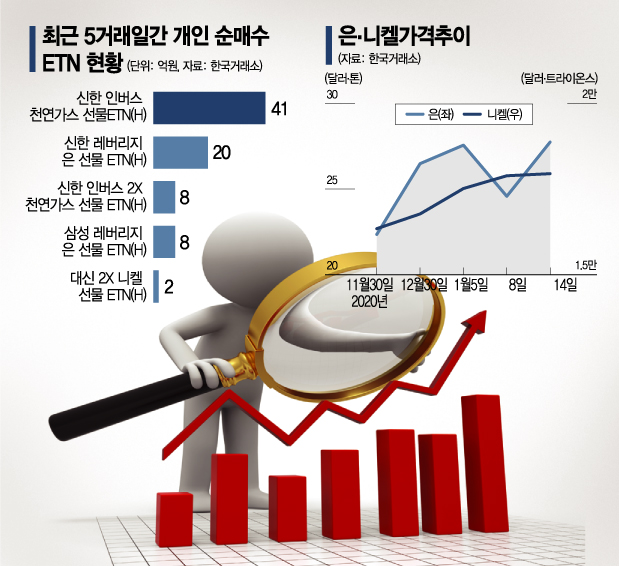
According to the Korea Exchange on the 15th, individual investors purchased 4.1 billion KRW worth of the ‘Shinhan Inverse Natural Gas Futures’ ETN over the past five trading days. In addition, they net bought 1.5 billion KRW worth of ‘Shinhan Inverse 2X Natural Gas Futures ETN (H)’, ‘Shinhan Inverse 2X Natural Gas Futures ETN’, and ‘Samsung Inverse 2X Natural Gas Futures ETN B’ products. These products are designed for investors expecting a decline in natural gas prices, and the leveraged (2X) versions provide returns twice the amount of the price drop.
According to the New York Mercantile Exchange (NYMEX), as of the previous day, February delivery natural gas futures fell 2.23% from the previous trading day to $2.67 per MMBtu. Considering that prices surged to $3.35 on October 30 last year, natural gas prices have been on a continuous downward trend.
Natural gas is classified as a commodity with low sensitivity to economic cycles. Unlike oil, whose demand fluctuates sharply depending on economic activities such as air transportation and petrochemical products, about 50% of natural gas is used for power generation and residential purposes, so the demand slowdown is not significant. Accordingly, in March last year, when COVID-19 caused a decrease in oil and natural gas drilling rigs and production declined, investors bet on rising natural gas prices and continued investing. Recently, oil prices, which had stayed around $30 per barrel for a long time, have recovered to the $50 range, production has increased, and heating demand in the U.S. has decreased, making natural gas relatively less attractive in terms of price.
Investments are increasing in ETNs related to silver and nickel, which are classified as economically sensitive commodities. Over the past five days, individuals have purchased a total of 2.8 billion KRW worth of ‘Shinhan Leverage Silver Futures ETN’ and ‘Samsung Leverage Silver Futures ETN’, and also net bought 200 million KRW worth of ‘Daishin 2X Nickel Futures’.
Experts have a more favorable outlook on silver than gold among precious metals. While gold and silver assets that can hedge against inflation would attract attention if additional stimulus measures gain momentum with the Blue Wave (Democrats controlling the White House and both houses of Congress), silver should be focused on more because industrial demand driven by economic activities could increase.
Looking at price trends, silver is more attractive than gold. Both gold and silver rose earlier this month amid expectations of rising inflation but then plunged within three trading days. Since then, silver assets have surged about 5% since the 8th, reflecting expectations for industrial demand recovery, while gold has declined by about 1%.
Jinyoung Choi, a researcher at Ebest Investment & Securities, said, "The factor supporting silver’s price strength is the growth of the solar market, with 21% of industrial demand directed toward solar. The Biden administration aims to install 500 million solar panels over the next five years, so considering liquidity, inflation hedging, electricity, and solar-related demand, silver’s outlook for the first half of this year looks very positive."
Nickel, expected to benefit from expanding demand for secondary battery cells due to eco-friendly policies, is also a promising investment. Byungjin Hwang, a researcher at NH Investment & Securities, explained, "With expected growth in demand for electric vehicles, solar power, wind power, and ESS, nickel has mid- to long-term price strength momentum. It will benefit from U.S. infrastructure investments ranging from at least $2 trillion to as much as $4 trillion."
© The Asia Business Daily(www.asiae.co.kr). All rights reserved.
![Clutching a Stolen Dior Bag, Saying "I Hate Being Poor but Real"... The Grotesque Con of a "Human Knockoff" [Slate]](https://cwcontent.asiae.co.kr/asiaresize/183/2026021902243444107_1771435474.jpg)















