China's Vaccine Diplomacy with Myanmar, Indonesia, Brunei, and the Philippines
Expectations for Biden's New Administration to Return to Multilateralism
[Asia Economy Beijing=Special Correspondent Jo Young-shin] China is expanding its influence in Southeast Asia by promoting its domestically produced novel coronavirus (COVID-19) vaccines. Southeast Asia includes countries directly involved in the South China Sea territorial disputes as well as many countries related to the Belt and Road Initiative, drawing significant attention to the results of China's vaccine diplomacy.
According to Chinese media including the official Xinhua News Agency on the 15th, Wang Yi, China's State Councilor and Foreign Minister, held a meeting the previous day in Brunei with Lim Jock Hoi, Secretary-General of ASEAN.
At the meeting, Minister Wang said, "Since the outbreak of the pandemic, the trust between the two countries has been further strengthened, fully proving that the two countries are true strategic partners," adding, "This year, marking the 30th anniversary of diplomatic relations between the two countries, will be a new historical starting point for bilateral relations."
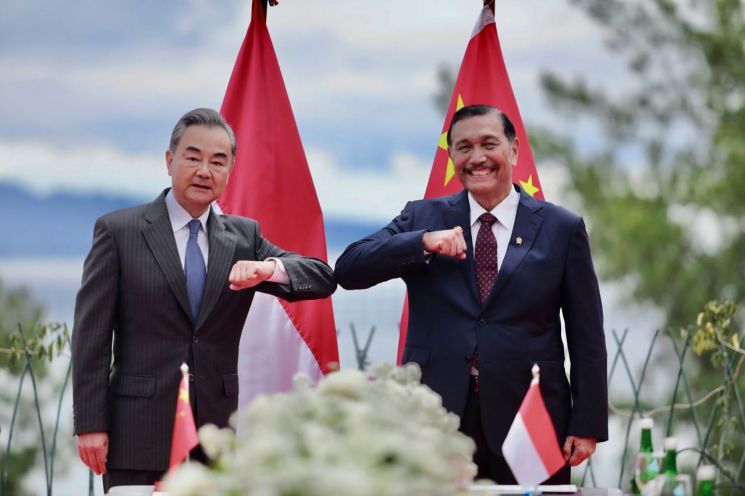
He also proposed linking China's '2035 Vision' with Brunei's '2035 Vision' to elevate bilateral cooperation to a new level.
In particular, Minister Wang emphasized cooperation in epidemic prevention, including support for Chinese-made COVID-19 vaccines. He also expressed high regard for Brunei's approach to maritime issues and conveyed hopes to make the South China Sea a sea of peace and friendship.
On the 13th, at a press conference with Indonesian media, Minister Wang emphasized multilateralism. He stated, "We expect the new U.S. administration to return to multilateralism," and expressed China's welcome of the U.S.'s return to multilateralism. This was interpreted as a message of hope for improved relations and expectations for changes from the U.S. side following the official inauguration of President-elect Joe Biden.
He stressed, "True multilateralism means adhering to the basic norms of international relations," emphasizing that the sovereignty of all countries must be respected, as well as the development rights and independent development of all countries. He added, "Only by practicing true multilateralism can we maintain world peace, stability, and development."
Prior to the press conference, Minister Wang visited Indonesian President Joko Widodo, shortly after President Widodo received a Chinese-made vaccine. Minister Wang conveyed his intention to support Indonesia in becoming a vaccine production hub in the Southeast Asian region.
During his visit to Myanmar on the 12th, Minister Wang promised to contribute to economic development through expanded exchanges between the two countries, including the urgent provision of 300,000 doses of Chinese-made vaccines.
In his final destination, the Philippines, Minister Wang is also expected to promise vaccine support. The Philippines is a country sensitive to the South China Sea territorial disputes, having even taken China to international litigation over the issue.
Zhao Lijian, spokesperson for the Chinese Ministry of Foreign Affairs, expressed satisfaction, stating that through Minister Wang's visit to four Southeast Asian countries, a consensus was reached on joint COVID-19 prevention efforts, safeguarding peace and stability in the South China Sea, and jointly supporting multilateralism.
© The Asia Business Daily(www.asiae.co.kr). All rights reserved.
![Clutching a Stolen Dior Bag, Saying "I Hate Being Poor but Real"... The Grotesque Con of a "Human Knockoff" [Slate]](https://cwcontent.asiae.co.kr/asiaresize/183/2026021902243444107_1771435474.jpg)















