Deputy Prime Minister Hong Chairs First Real Estate Market Inspection Meeting of the Year
"Firm Determination to Block Speculative Demand"
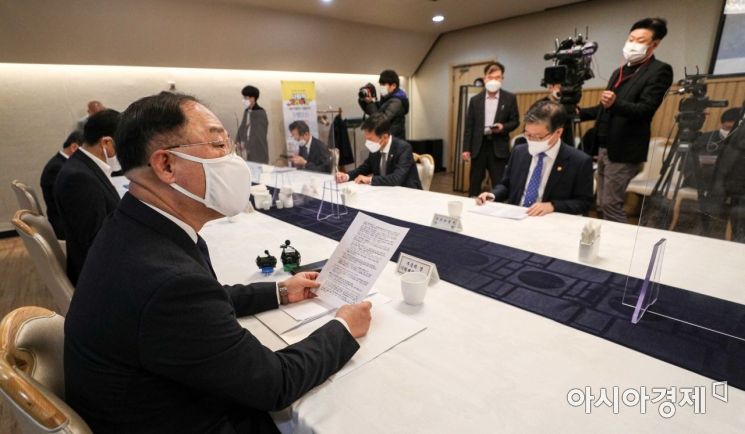 Hong Nam-ki, Deputy Prime Minister and Minister of Economy and Finance, is delivering opening remarks at the "13th Real Estate Market Inspection Meeting of Related Ministers" held on the 15th at the Government Seoul Office in Jongno-gu, Seoul. Photo by Kang Jin-hyung aymsdream@
[Sejong=Asia Economy Reporter Kim Hyunjung] Deputy Prime Minister and Minister of Strategy and Finance Hong Nam-ki announced that the government will proceed with the planned comprehensive real estate tax and capital gains tax surcharges as scheduled. This officially draws a line at the government's level against the market's 'easing theory,' which expected a delay or temporary reduction in the application timing of the capital gains tax surcharge as part of supply expansion. Deputy Prime Minister Hong emphasized the government's will and rather forecasted 'strict enforcement.'
On the morning of the 15th, Hong Nam-ki chaired a meeting of related ministers to review the real estate market at the Government Complex Seoul, stating, "The government's will to block speculative demand for housing is firm and unwavering," and added, "We will strictly and unwaveringly enforce the policy package, including the already prepared tax strengthening and liquidity regulations." He explained, "To encourage the release of housing listings, the implementation date for strengthening the comprehensive real estate tax and capital gains tax was set to June 1 of this year, guiding homeowners to sell their houses before that date to avoid the surcharge burden," and continued, "With just over four months left until the implementation date, we are closely monitoring the trend of listings, expecting multi-homeowners to release their properties."
Last year, through the 'July 10 Measures,' the government doubled the comprehensive real estate tax rates for owners of three or more houses or two houses in regulated areas, based on ownership as of June 1, from the current 0.6?3.2% to 1.2?6.0%. This measure was introduced with the expectation that multi-homeowners feeling the tax burden would put their properties on the market, increasing supply and stabilizing the market by easing supply-demand imbalances.
The problem is that at the same time, the capital gains tax rates and payment conditions were also significantly strengthened. The government raised the highest capital gains tax rate on housing transfers after June 1 from the existing 40% to up to 70%. Subsequently, not only opposition parties but also some ruling party members pointed out that the capital gains tax surcharge burden should be lowered for meaningful volumes to be released into the market.
Professor Kwon Dae-jung of Myongji University's Department of Real Estate commented, "The government's attempt to increase supply is welcome, but if they insist on strengthening the capital gains tax rate, the market listings will be limited as owners try to extend their holding periods to avoid the surcharge." He pointed out, "Rather than considering factors that would encourage listings, the government is sticking to existing policies because they must not contradict the policy direction."
© The Asia Business Daily(www.asiae.co.kr). All rights reserved.

















