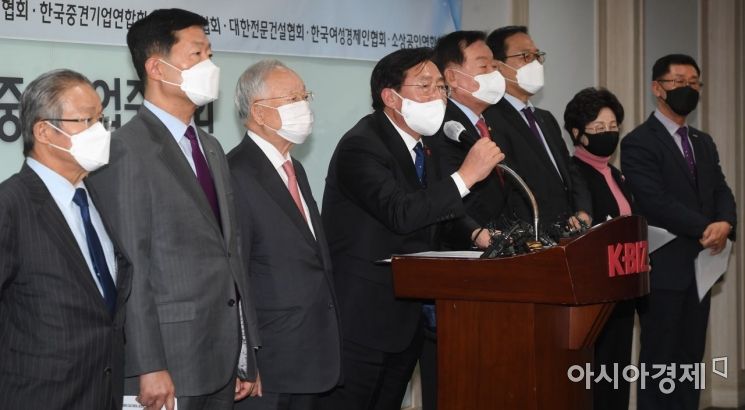
 On the 6th, Kim Ki-moon, Chairman of the Korea Federation of Small and Medium Business, is speaking at a press conference held at the Korea Federation of Small and Medium Business in Yeongdeungpo-gu, Seoul, regarding the enactment of the Serious Accidents Punishment Act. / Photo by Moon Ho-nam munonam@
[Asia Economy Reporters Kim Jong-hwa, Sung Ki-ho] "If we are criminally punished and fined, and then also have to pay civil damages, isn't that triple punishment? One lawsuit could ruin the company."
Jung Sang-cheol (pseudonym), CEO of Company A operating an auto parts factory in Anseong, Gyeonggi Province, expressed frustration, saying, "When consumer-related damage occurs, regardless of the cause, the responsibility is shifted to the partner company, and as the CEO, I have to bear all responsibility. If I have to serve prison time, pay fines by liquidating all my assets, and on top of that pay five times the amount of damages, both my employees and I will inevitably end up on the streets."
◆ Prison + Fine + Damages: The 'Triple Burden' = Four years ago, CEO Jung was involved in a recall incident with a primary contractor. Although the investigation concluded that the supplied parts were not directly related to the cause of the accident, the company was stigmatized as a "bad company," suffering consumer protests and lawsuit pressures, pushing the company to the brink of closure.
Despite having 150 employees, the CEO had to personally manage the accident response. He prepared for possible imprisonment or fines and even took out loans using his house as collateral in anticipation of fines. A year later, it was proven that the parts had no defects, but there was no way to recover the damages. The company had to accept the primary contractor's apology and continue supplying parts, waiting for consumer protests to subside.
According to a recent survey by the Korea Federation of SMEs, 68.6% of small and medium enterprises (SMEs) opposed the enactment of the Collective Litigation Act (class action system). Especially among SMEs with litigation experience, 85% opposed it, expressing significant concerns about planned lawsuits by black consumers and increased legal costs.
◆ 67% of SMEs Oppose Introduction of Class Action System = "The class action system and punitive damages are the laws that companies, both large and small, have most feared, along with the Serious Accident Corporate Punishment Act passed this month. The amendment to the Commercial Act, which includes provisions from these two laws, is currently under review by the Ministry of Government Legislation after a legislative notice from the Ministry of Justice. Once the review is completed this month, it will go through the State Council in February before being submitted to the National Assembly. For SMEs, this is a matter of survival beyond just costs."
Choo Moon-gap, head of the Economic Policy Headquarters at the Korea Federation of SMEs, said, "The class action system is an inefficient system that increases corporate costs while providing little relief to individual consumers. SMEs, which lack financial capacity and professional personnel, could face bankruptcy."
The class action system allows all victims to receive relief based on a lawsuit filed by some of the victims. The punitive damages system holds offenders liable for up to five times the actual damages for antisocial illegal acts. All damage claims involving more than 50 victims will be subject to the class action system.
◆ Experts Unite in Criticism of 'Overreaching Legislation' = Experts criticize the legislation as "overreaching." Professor Kwon Jae-yeol of Kyung Hee University Law School said, "This is an unreasonable law that does not fit Korea, where civil and criminal law are clearly distinguished. Implementing punitive damages on top of fines results in double or triple punishment. Lawsuits alone can be fatal to a company's image and reputation, and given the difficulties companies face due to COVID-19, the rationale for introducing this now is questionable."
Professor Han Seok-hoon of Sungkyunkwan University Law School pointed out, "This is a very wrong system that tries to import the U.S. system, which is criticized for lawsuit abuse. Punitive damages should be limited to special laws, and applying them to general commercial transactions violates fairness and may be unconstitutional."
The ruling Democratic Party of Korea is expected to focus on discussing regulatory bills such as the class action system, punitive damages, and the Distribution Industry Development Act during the February extraordinary session of the National Assembly. With the end of Democratic Party leader Lee Nak-yeon's term in early March, by-elections in April, and the party leadership and floor leader elections in May, the party plans to accelerate key legislative tasks in the first half of the year.
© The Asia Business Daily(www.asiae.co.kr). All rights reserved.
![Clutching a Stolen Dior Bag, Saying "I Hate Being Poor but Real"... The Grotesque Con of a "Human Knockoff" [Slate]](https://cwcontent.asiae.co.kr/asiaresize/183/2026021902243444107_1771435474.jpg)
















