Solution Report <20> CEO Hyunwoo Ahn of SoftPV
World's First Development of 1.1mm Ultra-Miniature Solar Cell 'SoftCell'
Capable of Absorbing Direct and Diffuse Light, Twice the Power Efficiency of Conventional Solar Panels
50% Transparency, Enabling "Self-Sufficient Power Supply" When Installed on Typical Buildings
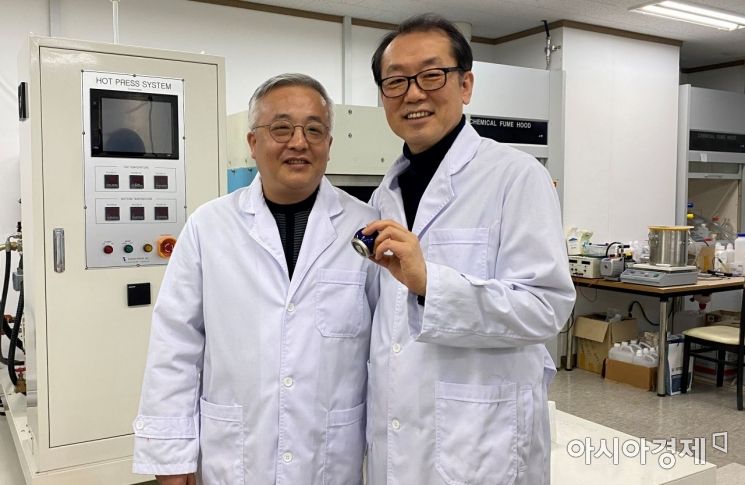 Ahn Hyun-woo (left), CEO of SoftPV, and Lee Sung-kyu, CTO of SoftPV. The model held by CEO Ahn is a 50 times enlarged version of a soft cell. Photo by Kim Hee-yoon
[Asia Economy Reporter Kim Heeyoon] An era where the amount of smoke emitted from factories must be offset by planting trees or purchasing carbon credits is fast approaching. Countries around the world have been declaring carbon neutrality in response to the climate crisis, and President Moon Jae-in emphasized accelerating the development of a low-carbon industrial ecosystem in his 2021 New Year's address. However, some have consistently pointed out that South Korea's sunlight exposure is not suitable for solar power generation. SoftPV has introduced a light-absorbing technology that turns these concerns into unfounded worries, recently winning an innovation award at ‘CES 2021,’ the world's largest consumer electronics and information technology exhibition. The protagonist is the three-dimensional spherical light-absorbing terminal called ‘SoftCell.’
SoftCell is an ultra-small spherical light-absorbing terminal with a diameter of 1.1mm, also known as a solar cell. Unlike conventional flat solar modules that only absorb direct sunlight, SoftCell’s spherical shape allows it to absorb light from all directions, including reflected rays. Two factors are important in calculating power generation: the amount generated in real-time and the duration of generation during the day. Multiplying these two gives the total daily power generation. SoftCell’s three-dimensional structure provides a larger surface area to receive light compared to conventional flat solar modules, resulting in higher real-time power generation. According to SoftPV, this enables more than twice the power efficiency per unit area compared to existing flat solar modules.
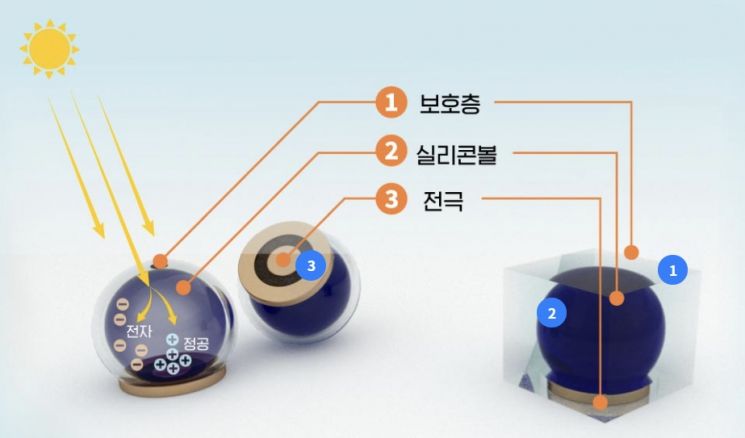
50% Transparency Enables Power Self-Sufficiency When Installing Solar Panels on Regular Buildings
SoftPV CEO Ahn Hyunwoo explained, “Solar power generation can take place not only in large areas like mountains or coastlines but also in urban building forests,” adding, “Installing semi-transparent solar modules on building surfaces transforms the building itself into a solar power plant.” SoftPV has also developed a transparent PET-based printed circuit board (PCB) solar module to enhance power generation efficiency. Conventional solar modules require large areas because they are installed on one side only, but SoftCell can be layered by stacking multiple transparent modules, maximizing power generation efficiency.
The spherical solar cell market has been a battleground for global technology companies. In the 1990s, Texas Instruments in the U.S. filed over 200 patents to develop particle-type semiconductors but failed to commercialize the technology. Later, the Japanese company Spella succeeded in commercializing spherical cells but faced difficulties due to panel issues and high production costs. CEO Ahn emphasized, “SoftCell, developed alongside transparent PCBs, overcomes the shortcomings of earlier spherical solar cells, enabling solar power generation in film form regardless of location. When this module film is installed on building exteriors, SoftCell particles are small enough to maintain about 50% transparency compared to glass while delivering higher power generation efficiency than conventional solar panels.”
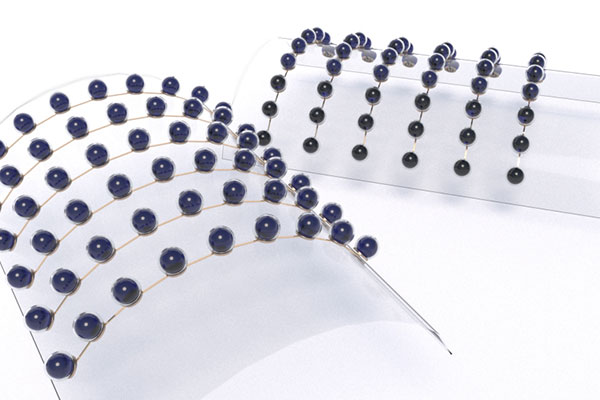 A soft cell mounted on a transparent printed circuit board (PCB). It achieves up to 60% transparency compared to regular glass, allowing it to be installed like a film on ordinary buildings. Photo by SoftPV
Carbon Neutrality Emerging as a Survival Issue, Playing a Role in the Renewable Energy Industry
The self-generating SoftCell’s functionality is being developed for various applications. CEO Ahn cited LED SoftCell as an example, stating, “We have completed development of LED SoftCell that emits light powered by electricity stored in batteries,” adding, “With the advent of the micro LED era, LED chips that operate on small amounts of power can be installed, enabling semi-permanent use not only in LED screens but also as replacements for dyes in road signs or road markings.”
CEO Ahn earned his bachelor's and master's degrees in chemical engineering from KAIST and POSTECH, respectively, and obtained a Ph.D. in polymer materials engineering from the University of Cincinnati in the U.S. After joining LG Chem, he led solar power projects following experience in semiconductors and displays, becoming an expert in new materials. Having worked as a renewable energy specialist at the global management consulting firm Arthur D. Little Korea, he decided to start his own company. He said, “I had planned to retire for health reasons, but SoftCell technology kept drawing my attention. I decided it would be faster to develop it myself rather than wait a long time for others to do so. After founding the company in 2017, developing the world’s first SoftCell within three years, I feel rewarded to contribute to the renewable energy industry.”
The global solar power market continues to grow steadily. According to a report released on the 4th by the Korea Eximbank Overseas Economic Research Institute, last year’s global solar installations exceeded the expected 120GW, surpassing 130GW. The report predicts that with demand stabilization in the largest markets?China, now ranked first globally, and the U.S. in second place?and the resumption of construction projects in developing countries post-COVID-19, the solar market will grow by 20% year-on-year to 150GW this year.
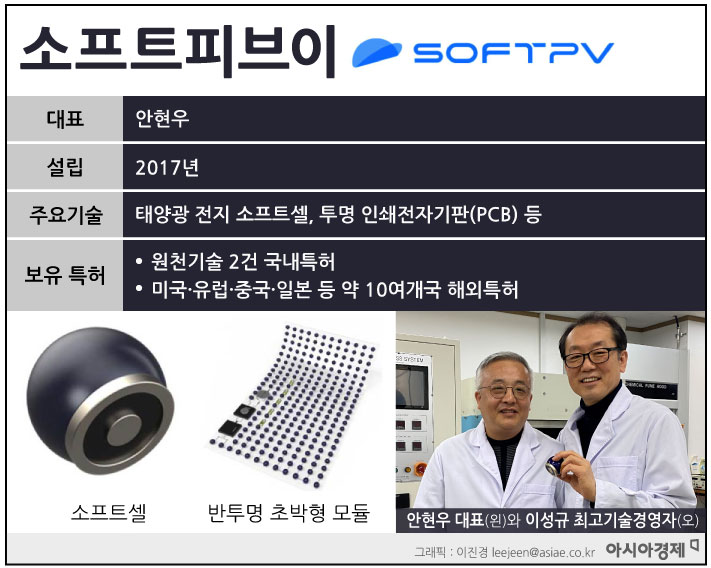
In a solar market dominated by aggressive investments from global leading companies, the development of SoftCell holds special significance. CEO Ahn stated, “Based on SoftCell and our excellent PCB technology, we are pushing forward with building a production plant and accelerating product manufacturing within two years. Having secured about 20 patents in the U.S., Europe, Japan, China, India, Saudi Arabia, and other countries, our goal is to further reduce SoftCell size to expand its applications and enter overseas markets with a broad business model.”
© The Asia Business Daily(www.asiae.co.kr). All rights reserved.
![Clutching a Stolen Dior Bag, Saying "I Hate Being Poor but Real"... The Grotesque Con of a "Human Knockoff" [Slate]](https://cwcontent.asiae.co.kr/asiaresize/183/2026021902243444107_1771435474.jpg)

















