Terrestrial Broadcasters' 'Long-Awaited' Mid-Roll Ads Fully Allowed
Significant Expansion of Programming Autonomy Planned
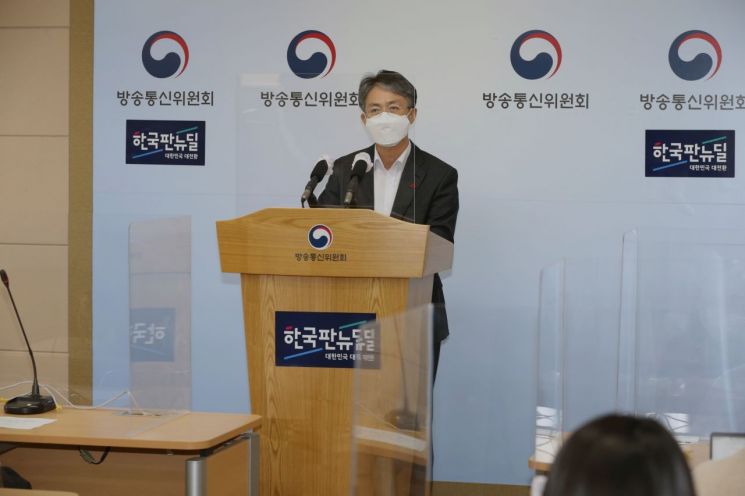 Bae Jung-seop, Director of the Broadcasting Infrastructure Bureau at the Korea Communications Commission (Photo by Korea Communications Commission)
[Asia Economy Reporter Koo Chae-eun] Starting as early as June, mid-roll advertisements will be allowed in terrestrial broadcaster programs. This marks the first time in 48 years since 1973 that mid-roll ads are permitted on terrestrial TV. The programming regulations that mandate a fixed amount of news, dramas, and entertainment per day will also be relaxed to grant broadcasters more autonomy.
The Korea Communications Commission (KCC) announced the "Broadcast Market Revitalization Policy Plan" containing these details on the 13th. Regarding mid-roll ads, programs lasting 45 to 60 minutes can have one mid-roll ad, 60 to 90-minute programs can have two, and one additional ad can be added every 30 minutes, allowing up to six mid-roll ads. Each ad must be within one minute.
If implemented, this will be the first time mid-roll ads are allowed on terrestrial broadcasts since the 1973 amendment to the Broadcasting Act banned them. The KCC supports allowing mid-roll ads on terrestrial TV to resolve unfair competition among media outlets. The rapidly changing terrestrial broadcasting environment, including sharp declines in advertising revenue, was also taken into account.
However, concerns remain that allowing mid-roll ads may lead terrestrial broadcasters to focus excessively on ratings, making commercialism more blatant and undermining their public service responsibilities. Stakeholders such as general programming channels and pay TV providers have sharply divided opinions, and debates over pros and cons are expected to intensify. Especially since this plan includes many demands consistently raised by terrestrial broadcasters, controversy over the KCC’s perceived favoritism toward terrestrial TV is likely to heat up.
Currently, under the Broadcasting Act, mid-roll ads are only permitted on general programming channels and cable TV, i.e., pay TV. Terrestrial broadcasters have used a loophole by splitting a single program into two or three parts and inserting pseudo mid-roll ads. Terrestrial broadcasters have continuously advocated for mid-roll ad permission citing sharp revenue declines and unfair competition among media.
The KCC explained the policy rationale: "Due to changes in the media environment centered on online platforms, the broadcast advertising market is stagnating, and pay TV advertising revenue has surpassed terrestrial broadcasters, necessitating a review of advertising regulations." The KCC plans to establish integrated standards for split-program ads (PCM) and mid-roll ads to protect viewer rights and prevent excessive program interruptions, introduce principles for allowing mid-roll ads, and strengthen notification obligations.
The draft revision of the Enforcement Decree also includes many deregulation measures. Regardless of media type, virtual and indirect advertising time will be set at 7%, and total advertising volume (maximum 20% of program length, 17% daily average) will be uniformly regulated. Previously, terrestrial broadcasters’ total ad volume was capped at 18% per program and 15% daily average.
Virtual and indirect product placement (PPL), previously banned for certain broadcast advertising time-restricted items such as alcoholic beverages, will now be allowed during permitted time slots for those items. For example, after 10 p.m., viewers will be able to see alcoholic beverages under 17 degrees such as soju and beer appearing in entertainment programs or dramas. Regarding programming, the mandatory entertainment program ratio for general programming broadcasters will be relaxed from 50% or less to 60% or less, improving the required programming ratios.
Chairman Han Sang-hyuk emphasized, "We will actively improve current broadcasting laws, unfair and discriminatory systems, and practices that fail to reflect rapid changes in the media environment, to ensure that the management crisis in the domestic broadcasting market does not lead to a weakening of broadcasting’s public value."
The KCC plans to announce the draft Enforcement Decree for public comment between January and March, consult with relevant ministries, undergo review by the Ministry of Government Legislation and approval by the State Council in April and May, and promulgate and implement the decree in June.
© The Asia Business Daily(www.asiae.co.kr). All rights reserved.
![Clutching a Stolen Dior Bag, Saying "I Hate Being Poor but Real"... The Grotesque Con of a "Human Knockoff" [Slate]](https://cwcontent.asiae.co.kr/asiaresize/183/2026021902243444107_1771435474.jpg)















