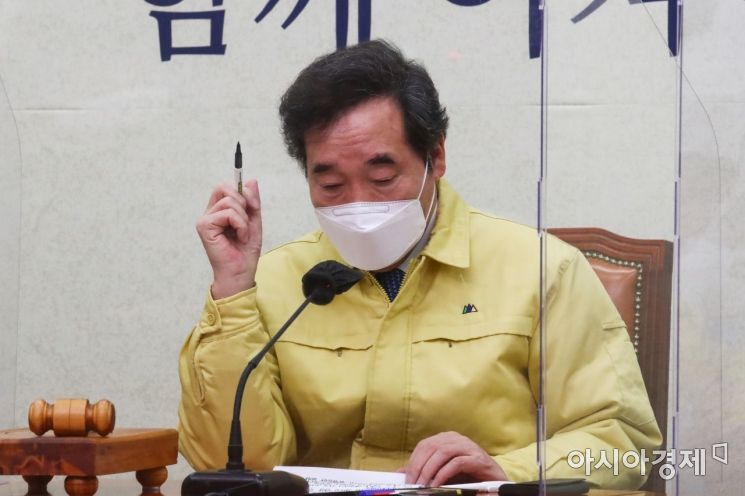
 Lee Nak-yeon, leader of the Democratic Party of Korea, is attending the Supreme Council meeting held at the National Assembly on the 13th, checking his speech materials before the meeting begins. Photo by Yoon Dong-joo doso7@
[Asia Economy Reporter Kang Nahum] The Democratic Party of Korea is embarking on full-scale efforts to institutionalize the 'profit-sharing system,' proposed as a measure to alleviate the economic inequality deepened by the COVID-19 pandemic.
On the 13th, at the Supreme Council meeting held at the National Assembly, Democratic Party leader Lee Nak-yeon said, "The profit-sharing system is a complementary measure aimed at creating a Korea where everyone prospers together by establishing a framework of solidarity and coexistence, rather than leaving the most unequal recession in history unattended." He added, "I hope Hong Ik-pyo, chairman of the Policy Committee and head of the Post-COVID Inequality Resolution Task Force (TF), along with lawmakers, will discuss feasible plans."
Leader Lee continued, "It should be based on voluntary participation by the private sector," and said, "It is desirable that goal setting and profit-sharing methods be decided through private autonomous choice rather than by coercion."
He also stated, "The party and government should focus on the role of supporters," and "Incentives such as tax benefits or policy fund support should be provided for the results of autonomously achieved win-win cooperation."
Leader Lee emphasized, "We need to develop a win-win model suitable for the platform era," and said, "If platform companies and self-employed workers jointly increase profits, they can share profits by raising the margin rate for self-employed workers or lowering commission rates."
However, concerns about the practicality and effectiveness of the profit-sharing system have been raised not only by the opposition but also within some circles of the ruling party. On the same day, Jeju Governor Won Hee-ryong criticized the profit-sharing system, calling it "another division that denies the market economy," and expressed concern that "Lee Nak-yeon's profit-sharing system is a policy with almost no effectiveness and is likely to become a bad policy that only pressures companies."
He pointed out, "There can be no disagreement on the urgent need for compensation and support for business owners who suffered damage due to the COVID-19 crisis. However, that support should not be in the form of sharing the profits of companies that are barely holding on," and added, "It is nothing more than an idea to shift the government's direct responsibilities onto private companies."
Jisangwook, head of the Yeouido Institute, a think tank of the People Power Party, also criticized the profit-sharing system, saying, "There is a significant criticism that it is very difficult to divide the groups that benefited and those that suffered losses due to COVID-19," and "Taking from those who benefited to give to the vulnerable who suffered losses ultimately leads to discussions about tax increases."
Ruling party lawmaker Lee Sang-min also questioned the effectiveness of the profit-sharing system. Lawmaker Lee said, "I agree with the purpose of the profit-sharing system. However, 'voluntary participation' does not guarantee effectiveness." He added, "There is a high possibility of controversy over fairness in calculating profits or losses," and said, "I think methods like a 'wealth tax' or 'social solidarity tax' are better."
© The Asia Business Daily(www.asiae.co.kr). All rights reserved.
![Clutching a Stolen Dior Bag, Saying "I Hate Being Poor but Real"... The Grotesque Con of a "Human Knockoff" [Slate]](https://cwcontent.asiae.co.kr/asiaresize/183/2026021902243444107_1771435474.jpg)















