Announcement of Housing Supply Plan Before Lunar New Year
Housing Supply Expected Through Zoning Upgrades in Downtown Seoul
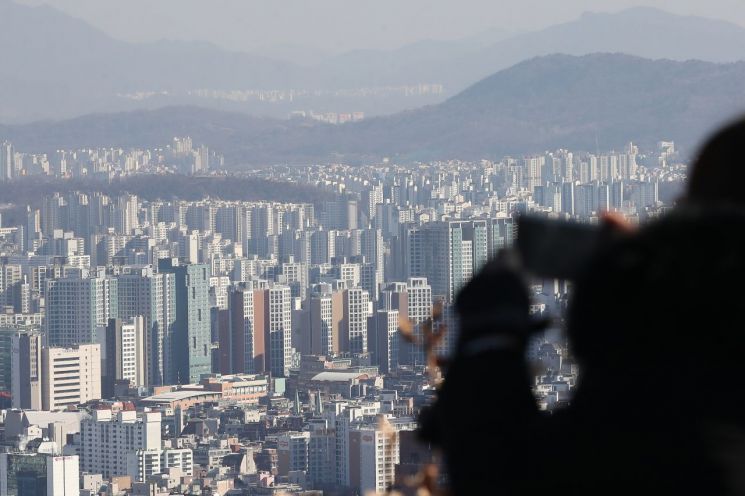
[Asia Economy Reporter Jang Sehee] The government and the ruling party are considering a plan to increase the floor area ratio for housing by actively changing land use zones through 'zoning upgrades' to expand housing supply in downtown Seoul and promote high-density development.
On the 12th, Hong Ik-pyo, the Policy Committee Chair of the Democratic Party of Korea, said on KBS Radio, "We are consulting with the Ministry of Land, Infrastructure and Transport on measures to dramatically increase supply in the Seoul metropolitan area, centered on Seoul, through densification and land use changes." This refers to raising the floor area ratio by upgrading the land use zones of housing development sites.
Under the "National Land Planning and Utilization Act," urban areas are divided into residential areas, commercial areas, industrial areas, and green areas.
The areas where housing is mainly supplied are residential areas, which are further classified into exclusive residential areas and general residential areas. General residential areas are subdivided into types 1 to 3 depending on whether the housing supplied is low-rise, mid-rise, or mid-to-high-rise.
Commercial areas are classified into central, general, neighborhood, and distribution commercial areas, while industrial areas are divided into exclusive, general, and semi-industrial areas.
The legal maximum floor area ratios vary: 300% for type 3 general residential areas, 500% for semi-residential areas, 900% for neighborhood commercial areas, and 1,500% for central commercial areas.
The government and ruling party plan to actively change land use zones to areas with higher allowable floor area ratios as needed during urban redevelopment projects to enable high-density development.
When the land use zone changes from residential to commercial, the floor area ratio increases significantly, but the types of housing that can be built in commercial areas are limited.
Under the National Land Planning Act, housing cannot be built in distribution commercial areas, and in other commercial areas, only mixed-use buildings with at least 10% commercial space can be constructed.
In semi-industrial areas, in principle, only dormitories can be built, but Seoul City allows housing construction if at least 60% of the industrial land is secured through district unit plans or redevelopment projects, according to local ordinances.
The Ministry of Land, Infrastructure and Transport, in consultation with Seoul City, has lowered the mandatory ratio to 50% for projects jointly implemented by public institutions that provide public rental housing.
The government and ruling party are also considering expanding public development methods involving public institutions such as the Korea Land and Housing Corporation (LH) to recover development profits from housing projects and facilitate smooth project implementation.
© The Asia Business Daily(www.asiae.co.kr). All rights reserved.
![Clutching a Stolen Dior Bag, Saying "I Hate Being Poor but Real"... The Grotesque Con of a "Human Knockoff" [Slate]](https://cwcontent.asiae.co.kr/asiaresize/183/2026021902243444107_1771435474.jpg)















