2011 Foreign Private Equity Macquarie 'Muktwi'
2019 STcorp and Hana Bank Also 'Leveraged Buyout'
Vicious Cycle of Covering 30% of Sales with Interest
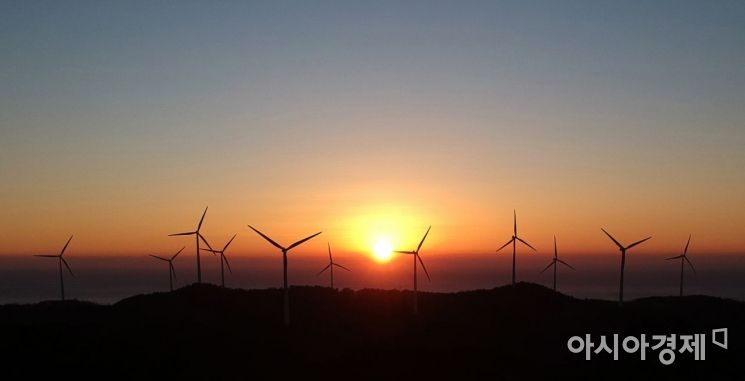 Beyond the Yeongdeok Wind Power Complex, the first large-scale wind power plant in Korea, a brilliant New Year is rising. The year 2021 is expected to be the starting point of South Korea's energy transition, which declared carbon neutrality by 2050.
 /Gyeongbuk Uljin=Photo by Dongju Yoon doso7@
[Asia Economy Yeongnam Reporting Headquarters, Reporter Park Dong-wook] Yeongdeok Wind Power Co., Ltd. in Yeongdeok-gun, Gyeongbuk Province, famous as Korea's first wind power generation project, is reportedly struggling with a net debt amounting to 40 billion KRW due to a complete capital erosion.
In particular, since its establishment in 2005, the ownership has changed every 6 to 8 years, but it has repeatedly fallen into a vicious cycle of capital erosion by borrowing high-interest private bonds under abnormal conditions without escaping the private equity fund system.
Ultimately, the company’s structure is such that no matter how much profit it makes, it is only able to repay the interest on private bonds borrowed from the owner, raising concerns that it has become a 'bottomless pit' where money is poured in vain.
According to the audit report of Yeongdeok Wind Power as of the end of March 2020 obtained by this outlet on the 11th, the company’s total capital was confirmed to be a capital deficit of approximately -15.3 billion KRW, with liabilities reaching about 39 billion KRW.
This abnormal insolvency occurred because after Samtan acquired Yeongdeok Wind Power in April 2019, it arbitrarily conducted a paid-in capital reduction of 90% of the total issued shares, resulting in a capital adjustment of -19.23 billion KRW and a project finance loan (PF loan) of 37.34 billion KRW.
By ST International Corporation (formerly Samtan), the owner, and Hana Bank withdrawing capital through a paid-in capital reduction and then lending it back to the company, Yeongdeok Wind Power suddenly fell into a complete capital deficit state, becoming an ultra-insolvent company burdened with a PF loan twice the amount of the previous year's convertible bonds of 17.6 billion KRW.
Yeongdeok Wind Power -15.3 Billion KRW Complete Capital Deficit: 'Pouring Water into a Bottomless Jar'
The ownership structure of Yeongdeok Wind Power is equally divided between ST International Corporation (formerly Samtan) and Hana Bank (trustee of the Shinhan National Pension Renewable Energy Specialized Private Investment Trust No. 1), each holding 50% of the shares.
The parent company of ST International Corporation is the Samchully Group, which controls Yeongyang Wind Power, Yeongdeok Wind Power, and Yeongdeok Haepalang Wind Power. The Samchully Group also established a separate company, Yeongdeok Haepalang Wind Power Co., Ltd., which holds major assets such as 486,744 m² of land in the Samgye-ri area, and then leases these assets back to Yeongdeok Wind Power, creating a dual corporate structure divided into debt and asset components.
ST International Corporation acquired Yeongdeok Wind Power in April 2019. At that time, it purchased Yeongyang Wind Power and Yeongdeok Wind Power as a package from the foreign private equity fund Macquarie PE (Yeongdeok Wind Power Investment Limited Company). The purchase price, including debt, was a total of 190 billion KRW.
Considering Yeongdeok Wind Power’s sales scale (approximately 8.1 billion KRW annually as of 2018), it appears to be a plausible big deal.
The problem is that, in addition to Macquarie PE’s 'mukjji' (hit-and-run) behavior of buying cheaply from the previous operator and taking only the profits, the current controlling shareholders are also forced to operate the company abnormally due to an excessive borrowing structure.
ST International Corporation and Hana Bank took on debts of 19.2 billion KRW and 85.4 billion KRW respectively when purchasing Yeongdeok Wind Power and Yeongyang Wind Power. The interest on these debts is 12% annually for the next 30 years. Therefore, the companies must pay 2.3 billion KRW and 10.2 billion KRW in interest annually, respectively.
In the case of Yeongdeok Wind Power, nearly 30% of its total annual sales must be paid as interest for 30 years.
2022 Wind Farm Land Lease Period Ends... Re-approval for Repowering Draws Intense Attention
Notably, both Macquarie PE, which sold Yeongdeok Wind Power, and the current acquirer are deeply involved with private equity funds. The National Pension Service’s Renewable Energy Blind Fund (trustee Hana Bank), established in 2018, reportedly raised 150 billion KRW and holds half of Yeongdeok Wind Power’s shares together with ST International Corporation.
Above all, the foreign private equity fund Macquarie PE is a typical 'mukjji' paper company. Macquarie PE acquired 100% of Yeongdeok Wind Power shares, including Unison’s 56.44%, for 21.5 billion KRW in 2011, six years after commercial operation began, unable to overcome cumulative losses caused by excessive leverage of 25% annually. It then collected 4.5 billion KRW in investment returns annually. After incurring tens of billions of KRW in unprocessed deficits each year, it demonstrated exceptional skill by selling the company at the point when capital erosion was imminent.
It is puzzling why Samchully Group’s ST International Corporation partnered with a domestic private equity fund to acquire such a company. What is clear is that immediately after acquisition, the company faced a complete capital deficit and ballooning debt due to capital reduction, putting the continuity of the business itself in jeopardy.
Moreover, given the nature of wind power farms like Yeongdeok Wind Power that lease land, if there are no fixed assets and the company runs at a deficit leading to financial insolvency, redevelopment becomes impossible. After 20 years, the wind farm will be completely depreciated and turn into a scrap heap, which only increases the concerns of local residents.
Under the government’s strong renewable energy policy, Yeongdeok County Office, which leases land where 12 out of 24 wind turbines are installed and must be satisfied with an annual land rent of 800,000 KRW and meager local taxes, is equally frustrated.
Regarding this, a local economic official in Yeongdeok County said, "Instead of just holding the commendation from the Ministry of Trade, Industry and Energy for fostering the renewable energy industry and watching cautiously, Yeongdeok County should prioritize financial soundness and corporate sustainability when re-approving repowering of the Yeongdeok Wind Power Complex."
Meanwhile, Yeongdeok County, selected as a 'Wind Industry Convergence Hub District' in last year’s Ministry of Trade, Industry and Energy renewable energy complex public offering project, faces the task of establishing detailed plans for local government or resident participation by the end of this year, as the land lease period within the Yeongdeok Wind Power Complex expires in 2022.
© The Asia Business Daily(www.asiae.co.kr). All rights reserved.
![Clutching a Stolen Dior Bag, Saying "I Hate Being Poor but Real"... The Grotesque Con of a "Human Knockoff" [Slate]](https://cwcontent.asiae.co.kr/asiaresize/183/2026021902243444107_1771435474.jpg)
















