From Unofficial Power Broker to 5th Rank Core Power Broker
Military Leadership Chief 'North Korea Golden Spoon' Oh Il-jung
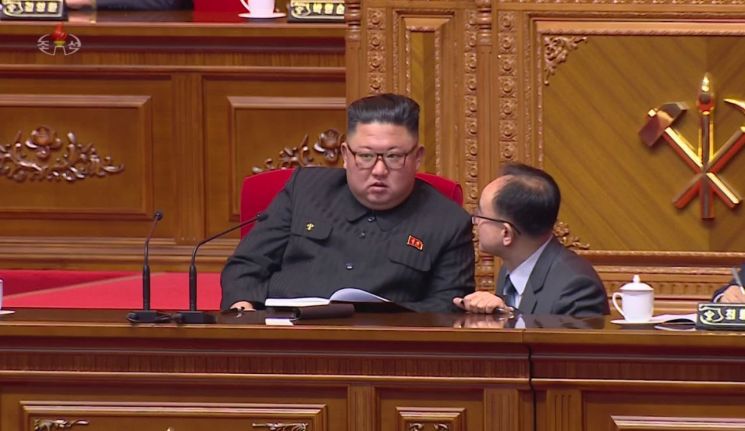 Chosun Central TV reported on the 9th that the fourth day meeting of North Korea's 8th Party Congress was held at the Pyongyang April 25th Cultural Hall on the 8th. North Korea has repeatedly emphasized through state media that this Party Congress is a "working congress." In fact, the business summary report lasted three days, one day longer than the 7th Party Congress, and the fourth day was devoted to discussions. On the presidium, party officials were seen approaching Kim Jong Un, the Party Chairman, to report or receive instructions. The photo shows Jo Yong Won, First Deputy Director of the Organization and Guidance Department, reporting to Party Chairman Kim Jong Un while kneeling. Deputy Director Jo is considered a close aide to Chairman Kim Jong Un.
 Jo Yong-won, who had been shadowing North Korean State Affairs Commission Chairman Kim Jong-un, has drawn attention by securing a key position and rising to fifth in the power hierarchy through the 8th Workers' Party Congress. Oh Il-jong, son of Oh Jin-woo, who was called the 'Eternal Minister of People's Armed Forces of North Korea,' also stood out.
According to North Korea's state media Korean Central News Agency on the 11th, Jo Yong-won was elected as a member of the Political Bureau Standing Committee. Jo was also appointed as a secretary of the Party Central Committee and a member of the Party Central Military Commission, indicating that he secured the position of organizational secretary.
Jo Yong-won has been a close confidant from the early days of Kim Jong-un's rule and has been regarded as a 'behind-the-scenes power' of the Kim family.
Considering that the Political Bureau Standing Committee was specified in the revised party rules at this congress to decide urgent and important political, economic, and military issues and to discuss appointments and dismissals of key state officials, Jo has effectively transformed from a 'behind-the-scenes power' to a 'core power insider.'
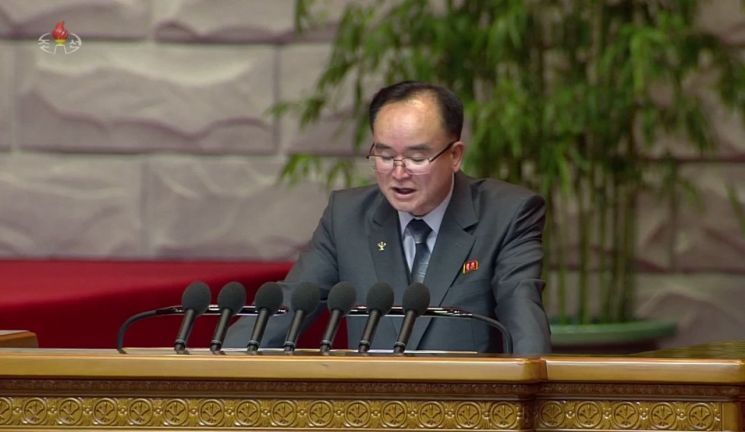 On the 8th, Chosun Central TV reported on the 9th that the 4th day meeting of North Korea's 8th Party Congress was held at the Pyongyang April 25th Cultural Hall. During the 4th day meeting, a discussion on the report summarizing the work of the Party Central Committee took place. The photo shows Jo Yong-won, First Deputy Director of the Organization and Guidance Department, speaking during the discussion. Photo by Jo Yong-won
Jung Sung-jang, a research fellow at the Wilson Center and senior researcher at the Sejong Institute, said, "Jo Yong-won was elected together with Kim Jong-un and Ri Pyong-chol to the three core organs of the Workers' Party?the Party Central Committee Political Bureau, Secretariat, and Central Military Commission?rapidly emerging as a key insider," adding, "Although his official rank is fifth, in reality, he can be evaluated as having influence next only to Kim Yo-jong alongside Kim Jong-un."
Jo Yong-won started as a junior cadre in the Organization Guidance Department, which controls the organizational life of cadres, party members, and residents, and first gained recognition in April 2012 when he received the 'Kim Il-sung Order.'
In 2014, he was promoted to deputy department head and was noted for appearing without fail during Kim Jong-un's field inspections, leading to a rapid rise in party ranks.
He was promoted to deputy department head of the Organization Guidance Department in 2014, then to first deputy department head and candidate member of the Political Bureau in 2019, without experiencing the usual setbacks or fluctuations common among cadres.
He spent an overwhelmingly large amount of time meeting and talking face-to-face with Kim Jong-un, earning him the nickname 'door-handle power.'
Since 2018, Jo Yong-won has accompanied Kim Jong-un as an aide during the North Korea?U.S. summits and inter-Korean summits, attending all of Kim's schedules and closely monitoring his every move.
Whenever Kim Jong-un goes on field inspections, Jo follows him like a shadow, holding a small notebook and pen, not only recording but also preparing and briefing the necessary reports for the inspections.
According to the 'Kim Jong-un Chairman Trend Analysis' data from the Ministry of Unification's North Korea Information Portal, Jo Yong-won is the person who has accompanied Kim Jong-un the most over the past five years.
He accompanied Kim 34 times in 2017, 51 times in 2018, 34 times in 2019, and 12 times in 2020, totaling 131 times. The second most frequent accompanier is Choe Ryong-hae, the Standing Chairman of the Supreme People's Assembly and second in the power hierarchy, who accompanied Kim 86 times during the same period.
Assemblyman Tae Yong-ho of the People Power Party once described Jo Yong-won as "the real power controlling North Korea" during a press conference held in Seoul in January 2017.
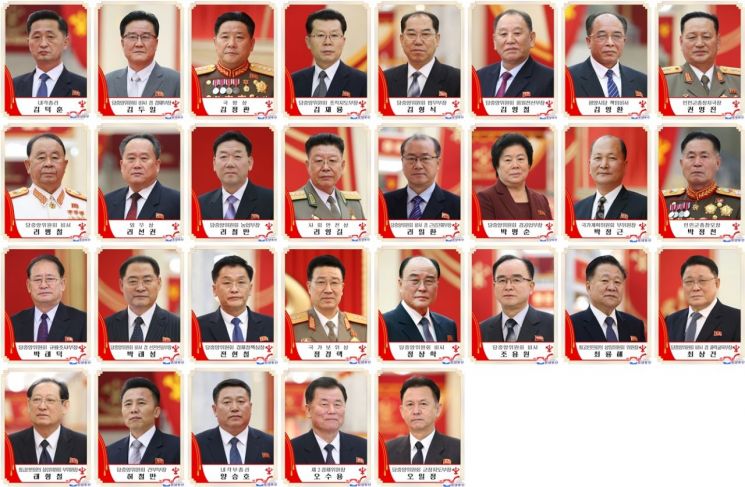 The members of the Standing Committee of the Political Bureau of the Central Committee of the Workers' Party of Korea, members of the Political Bureau of the Central Committee, and alternate members of the Political Bureau of the Central Committee were announced, according to a report by the Korean Central News Agency on the 11th.
(From the first row, left to right) Kim Deok-hoon, Premier of the Cabinet; Kim Du-il, Secretary of the Central Committee and Head of the Economic Department; Kim Jong-gwan, Minister of National Defense; Kim Jae-ryong, Head of the Organization and Guidance Department of the Central Committee; Kim Hyong-sik, Head of the Legal Affairs Department of the Central Committee; Kim Yong-chol, Head of the United Front Department of the Central Committee; Kim Yong-hwan, Secretary in charge of the Pyongyang City Party Committee; Kwon Young-jin, Director of the General Political Bureau of the Korean People's Army; (From the second row, left to right) Ri Pyong-chol, Secretary of the Central Committee; Ri Son-gwon, Minister of Foreign Affairs; Ri Chol-man, Head of the Agriculture Department of the Central Committee; Ri Yong-gil, Minister of Social Security; Ri Il-hwan, Secretary of the Central Committee and Head of the Workers' Organizations Department; Pak Myong-soon, Head of the Light Industry Department of the Central Committee; Pak Jong-geun, Vice Chairman of the State Planning Commission; Pak Jong-chon, Chief of the General Staff of the Korean People's Army; (From the third row, left to right) Pak Tae-dok, Head of the Discipline Inspection Department of the Central Committee; Pak Tae-sung, Secretary of the Central Committee and Head of the Propaganda and Agitation Department; Jon Hyun-chol, Director of the Economic Policy Office of the Central Committee; Jong Kyong-thaek, Minister of State Security; Jong Sang-hak, Secretary of the Central Committee; Jo Yong-won, Secretary of the Central Committee; Choe Ryong-hae, Chairman of the Standing Committee of the Supreme People's Assembly; Choe Sang-gun, Secretary of the Central Committee and Head of the Science and Education Department; (From the fourth row, left to right) Tae Hyong-chol, Vice Chairman of the Standing Committee of the Supreme People's Assembly; Huh Chol-man, Head of the Cadre Department of the Central Committee; Yang Seung-ho, Deputy Premier of the Cabinet; Oh Su-yong, Chairman of the Second Economic Committee; Oh Il-jong, Head of the Military Affairs Guidance Department of the Central Committee
◆ Oh Il-jong, 2nd Generation Anti-Japanese Guerrilla and North Korea's Representative Golden Spoon, Appointed Head of Military Political Guidance Department
Oh Il-jong, a 'second-generation anti-Japanese guerrilla,' skipped the candidate member stage of the Political Bureau and was elevated directly to full member. He also took on the position of head of the Military Political Guidance Department.
A representative golden spoon, he volunteered for military service after graduating early from university at age 22 in 1976, when the so-called 'axe incident' escalated war tensions.
Although he was at a disadvantage in his career because he was a schoolmate of Kim Jong-il's half-brother Kim Pyong-il at Namsan School in Pyongyang and Kim Il-sung University, he thrived under the Kim Jong-un regime due to his father's loyalty, his early distancing from Kim Pyong-il, and his unique diligence and capability.
North Korea revised its party rules this time to set a national policy to strengthen national defense. In Kim Jong-un's work summary report, he ordered improving the accuracy of intercontinental ballistic missiles (ICBMs) capable of striking the U.S. mainland, while also hinting at the development of hypersonic weapons and construction of nuclear submarines.
In this context, the appointment of Oh Il-jong as successor to Choe Bu-il, one of the few figures with deep childhood ties to Kim Jong-un, indicates the elevated status and weight of the head of the Party Military Political Guidance Department.
Oh Il-jong's father, Oh Jin-woo, was a 'first-generation revolutionary' trusted by President Kim Il-sung to serve as his bodyguard during the Korean War. During Kim Jong-il's era, he served as Minister of People's Armed Forces for nearly 20 years and was called the 'Eternal Minister of People's Armed Forces of North Korea.'
© The Asia Business Daily(www.asiae.co.kr). All rights reserved.
![Clutching a Stolen Dior Bag, Saying "I Hate Being Poor but Real"... The Grotesque Con of a "Human Knockoff" [Slate]](https://cwcontent.asiae.co.kr/asiaresize/183/2026021902243444107_1771435474.jpg)


















